9 out of 10 dog owners are feeding their dog the wrong food

Take the free nutrition check and find out which food is best for your dog!

Shelter manager, certified canine nutritionist, and lifelong dog lover
• Budget-friendly nutrition: At $0.06 per 100 grams, this kibble provides AAFCO-compliant complete nutrition for healthy adult dogs at grocery-store prices.
• Carbohydrate-heavy formula: Corn appears twice in top ingredients, creating a 50-60% carb content that’s adequate for average dogs but unsuitable for high-energy breeds.
• Vague protein sources: Uses “meat and bone meal” and plant proteins instead of named meats, compromising ingredient transparency and biological value.
• Clean safety record: No recalls for this specific product as of 2025, with generally positive customer feedback averaging 4.5-4.7 stars across retailers.
• Maintenance-level nutrition: Lacks omega-3s, joint support ingredients, and functional additives found in premium foods, making it unsuitable for dogs with special needs.
Take the free nutrition check and find out in under 1 minute which food is best tailored to your dog!
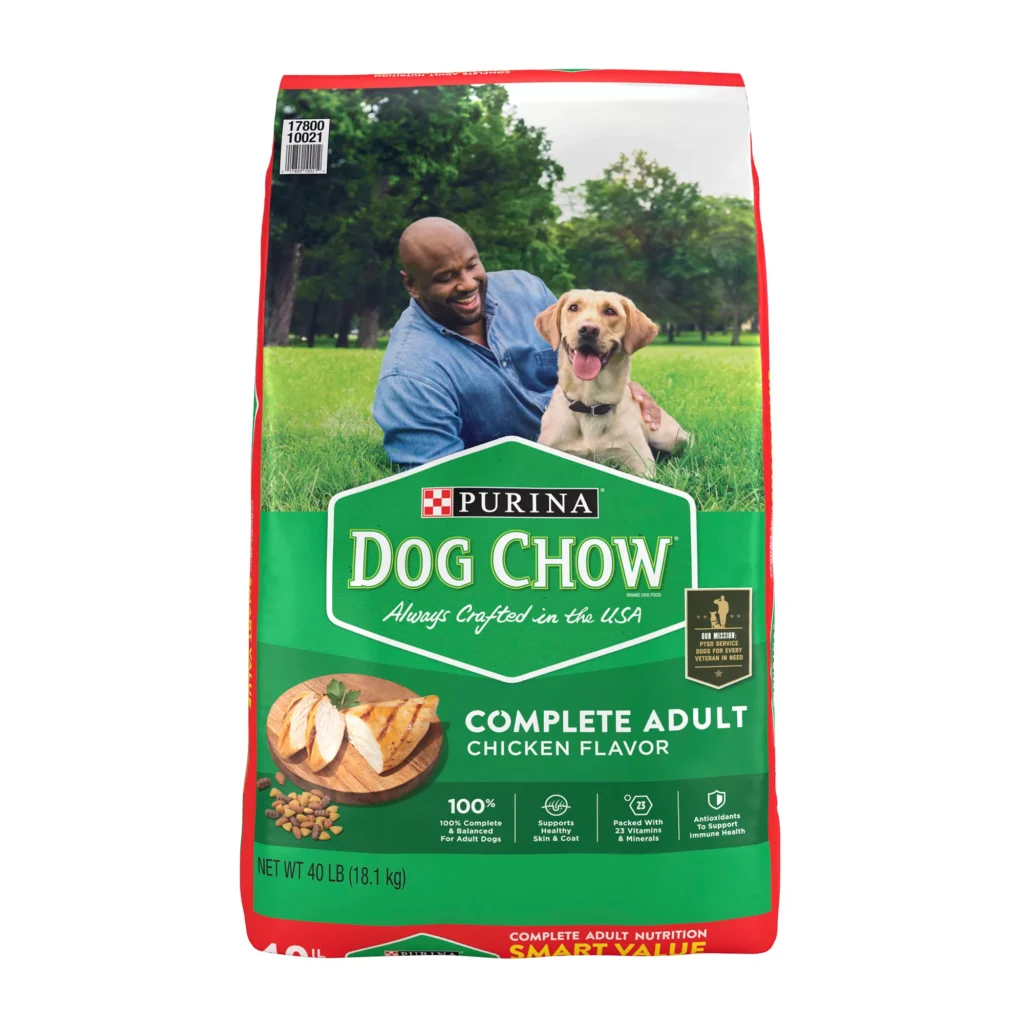
Purina Dog Chow Complete Adult is a dry kibble designed for adult dogs of all breeds and sizes. It’s positioned as an everyday maintenance food—nothing fancy, just straightforward nutrition that meets AAFCO standards for adult dogs. You won’t find exotic proteins or grain-free formulas here; this is a traditional recipe built around corn, meat and bone meal, and chicken by-product meal.
The brand markets itself as 100% complete and balanced, and it delivers on that promise from a regulatory standpoint. It’s available in a wide range of bag sizes, from 4.4 pounds all the way up to 48 pounds, making it convenient whether you have a small apartment dog or multiple large breeds. At around 415 kcal per 100 grams, it sits in the middle range for caloric density, suitable for dogs with normal activity levels.
What stands out immediately is the affordability. At roughly $0.06 per 100 grams and $1.45 per 1,000 kcal, Dog Chow is one of the most budget-friendly options in the grocery tier. For families feeding multiple dogs or those on a tight budget, that’s a significant factor. But as with any food in this price range, you’re making trade-offs—primarily in ingredient quality and protein sourcing.
| Price per pound | $0.27 (approximately) |
| Primary protein | Meat and bone meal, chicken by-product meal |
| By-products | Yes (chicken by-product meal) |
| AAFCO compliance | Yes (adult maintenance) |
| Formula options | Limited (Complete Adult is main formula) |
| Availability | Grocery stores nationwide + online |
Take the free nutrition check and find out in under 1 minute which food is best tailored to your dog!
In just 60 seconds, find out which food fits your dog best — for free.
The first ingredient is whole grain corn, not a named meat. That’s your first red flag if you’re looking for a protein-rich, meat-based diet. Corn is a cheap filler that provides calories and some plant-based protein, but it’s lower in biological value compared to animal proteins. Dogs can digest corn, but it’s not their optimal fuel source.
Next up is meat and bone meal. This is a rendered product made from animal tissues, and while it does provide protein, the term “meat and bone meal” is vague—there’s no indication of which animal it comes from or the quality of the parts used. It’s a cost-effective way to boost protein, but it’s far less transparent and digestible than named whole meats like chicken meal or beef meal.
The third ingredient is corn gluten meal, another plant protein concentrate. Combined with soybean meal later in the list, you’re looking at a formula that leans heavily on plant proteins to hit its 21% crude protein guarantee. While these ingredients aren’t harmful, they’re less bioavailable than animal proteins and are often used to pad the protein percentage inexpensively.
Corn appears twice in the top five ingredients, and whole grain wheat shows up further down. On a dry matter basis, carbohydrates make up roughly 50–60% of this food. That’s high, even for a budget kibble. If your dog is moderately active and maintaining a healthy weight, this might be fine. But for highly active dogs, working breeds, or dogs prone to weight gain, that carb load is a concern.
The high carbohydrate content also means less room for quality animal protein and fat. While the food meets AAFCO minimums, it’s doing so with the least expensive ingredients possible. That’s the trade-off when you’re paying grocery-store prices.
The fat source is listed as animal fat preserved with mixed-tocopherols. Mixed-tocopherols are a natural preservative (a form of vitamin E), which is a plus. However, “animal fat” without specifying the source—chicken fat, beef fat, etc.—is less transparent. It suggests the manufacturer is using whatever fat source is available and cost-effective at the time.
You’ll also see egg and chicken flavor and natural flavor in the ingredient list. These are added to make the kibble more palatable, which is common in lower-cost foods where the base ingredients might not be as appealing to dogs. Garlic oil is included as well, likely for flavor, though garlic in large amounts can be toxic to dogs—the quantity here is almost certainly safe, but it’s worth noting.
One of the more eyebrow-raising aspects of this formula is the inclusion of artificial colors: Yellow 5, Yellow 6, Red 40, and Blue 2. These dyes serve no nutritional purpose—they’re purely cosmetic, meant to make the kibble look more appealing to humans. Some studies have linked artificial colors to hyperactivity and allergic reactions in sensitive dogs, and many pet owners prefer to avoid them entirely. If you’re feeding this food, just know you’re giving your dog dyed kibble for no real benefit.
The reliance on chicken by-product meal is another sticking point. By-products can include organs, feet, beaks, and other parts not typically consumed by humans. While some by-products—like liver and heart—are nutritious, the lack of specificity makes it impossible to know what you’re actually feeding. It’s a quality control issue more than a safety one, but it’s still a compromise.
On an as-fed basis, Purina Dog Chow Complete Adult guarantees a minimum of 21% crude protein and 10% crude fat, with a maximum of 4.5% fiber and 12% moisture. When you convert these to a dry matter basis (which removes moisture for a more accurate comparison), you get approximately 23.9% protein and 11.4% fat.
These numbers exceed AAFCO’s minimum requirements for adult dog maintenance (18% protein and 5.5% fat on a dry matter basis), so the food is technically complete and balanced. However, compared to premium brands that offer 30–40% protein and 15–20% fat, Dog Chow is on the lower end. It’s adequate, but not impressive.
The macronutrient profile breaks down to roughly 24% protein, 11% fat, and 51–60% carbohydrates on a dry matter basis. This is a carbohydrate-rich, moderate-protein, moderate-fat kibble. For a healthy adult dog with average activity levels, this works. For a high-energy breed, a senior dog needing joint support, or a dog with specific dietary sensitivities, it’s not optimal.
The caloric density is 415 kcal per 100 grams, which is middle-of-the-road. You’ll need to feed moderate portions to maintain your dog’s weight, and the feeding guidelines on the bag are a good starting point—but every dog is different, so monitor body condition and adjust as needed.
Take the free nutrition check and find out in under 1 minute which food is best tailored to your dog!
In just 60 seconds, find out which food fits your dog best — for free.
The formula includes 23 vitamins and minerals, which is standard for a complete and balanced food. You’ll see added zinc sulfate, ferrous sulfate, manganese sulfate, and copper sulfate for minerals, plus a full spectrum of B vitamins, vitamin A, vitamin E, and vitamin D-3. There’s also added L-lysine and L-tryptophan, amino acids that support protein synthesis and mood regulation.
What’s missing? There’s no mention of omega-3 fatty acids (EPA or DHA), glucosamine, chondroitin, or L-carnitine. These are common in senior or joint-support formulas, but they’re not included here. If your dog needs joint support or has skin and coat issues, you’ll likely need to supplement separately.
Purina Dog Chow Complete Adult has a clean recall record as of November 2025. There have been no FDA-mandated recalls for this specific product. That’s a significant point in its favor, especially compared to some budget brands that have had repeated issues with contamination or mislabeling.
Purina as a whole has had recalls in the past—most recently in early 2023 for certain Pro Plan Veterinary Diets due to elevated vitamin D levels, and a 2022 recall for mislabeled wet food. However, none of these involved Dog Chow Complete Adult. There were widespread online rumors in January 2024 claiming Purina products were causing illness or death in pets, but Purina denied the allegations, and the FDA took no action. Without confirmed evidence, these remain unsubstantiated claims.
Purina states it conducts regular internal testing for safety, pathogens, and nutritional adequacy. The company operates its own manufacturing facilities in the U.S., which gives it more control over production compared to brands that outsource to co-packers. However, there are no published third-party lab results for heavy metals, mycotoxins, or bacterial contamination specific to Dog Chow Complete Adult.
For a large manufacturer like Purina, this level of transparency is standard but not exceptional. Smaller premium brands often publish third-party test results as a selling point, but Purina relies on its scale and reputation instead. If independent verification is important to you, that’s a gap worth noting.
Purina Dog Chow is made by Nestlé Purina PetCare, one of the largest pet food manufacturers in the world. Sister brands include Pro Plan, Beneful, Alpo, and Friskies. The company has been around for over 90 years and has the resources to conduct research, maintain quality control, and respond to recalls quickly when needed.
That said, transparency around ingredient sourcing is limited. You won’t find detailed information about where the chicken by-product meal or animal fat comes from, or whether suppliers meet specific welfare or sustainability standards. For a budget brand, this is typical—most of the cost savings come from using commodity ingredients with less traceability.
Batch and lot codes are printed on every bag, which is useful for tracking in the event of a recall. Customer service is accessible through Purina’s website, and the company has a track record of responding to consumer complaints. If you have an issue, you’ll likely get a response, though whether it results in meaningful action is another question.
Across major retailers like Walmart, Target, and Sam’s Club, Purina Dog Chow Complete Adult averages 4.5 to 4.7 out of 5 stars. That’s solid, especially for a budget food. About 70–75% of reviews are five stars, with only 5–7% giving it one star. The most common praise? Dogs like the taste, it’s affordable, and it doesn’t cause digestive upset.
One recurring theme is long-term loyalty. Many reviewers mention feeding Dog Chow for years or even decades without issues. Comments like “fed this for over twenty years” and “both my dogs love it” are common. For dogs with no special dietary needs, this food seems to work just fine day in and day out.
On the flip side, some dogs simply won’t eat it. A few reviewers noted their picky eaters refused the kibble or showed less enthusiasm compared to other brands. Digestive issues—mostly soft stools—were mentioned occasionally, though not frequently enough to suggest a widespread problem.
The ingredient list is a sticking point for some owners. Comments like “too many fillers” and “meat isn’t the first ingredient” reflect concerns about quality, even if the dog is doing fine on the food. If you’re someone who reads labels closely and prioritizes named meats and low carbs, the ingredient panel here will likely disappoint you.
A handful of reviews mentioned freshness issues—bags arriving stale or with crumbled kibble. This seems to be more of a storage or shipping problem than a manufacturing defect, but it’s worth checking the bag when you buy it, especially if you’re ordering online.
Most dogs seem to find the food palatable, which is likely due to the added flavors and animal fat. If your dog is a vacuum cleaner at mealtime, they’ll probably eat this without complaint. Digestion appears to be generally good, with firm stools reported by the majority of reviewers. The moderate fiber content (4.5%) helps with that.
However, if your dog has a sensitive stomach or food allergies, the corn, soy, and wheat in this formula could be triggers. Several reviewers whose dogs had grain sensitivities reported switching away from Dog Chow for that reason. It’s not a hypoallergenic food by any stretch.
At approximately $0.06 per 100 grams and $1.45 per 1,000 kcal, Purina Dog Chow Complete Adult is one of the cheapest complete dog foods you can buy. For comparison, Pedigree Adult Complete Nutrition costs about the same per 100 grams but slightly more per 1,000 kcal due to lower caloric density. Purina Beneful, another grocery-store brand, runs closer to $0.10 per 100 grams and $2.60 per 1,000 kcal.
If you’re feeding a 30 kg (66 lb) dog, you’ll need roughly 2.75 to 3.33 cups per day, which works out to about 319–386 grams. At $0.06 per 100 grams, that’s roughly $0.19 to $0.23 per day, or $5.70 to $6.90 per month. Compare that to a premium brand at $0.20+ per 100 grams, and you’re looking at $18 to $24 per month or more. Over a year, that difference adds up significantly.
With Dog Chow, you’re paying for basic nutrition at the lowest possible price. The ingredient quality is what you’d expect for this price point: heavy on corn and plant proteins, light on named meats, and supplemented to meet AAFCO standards. You’re not getting probiotics, omega-3s, or joint support ingredients. You’re getting calories, protein, fat, and vitamins in a shelf-stable kibble.
Is it good value? That depends on your priorities. If your dog is healthy, has no special dietary needs, and you’re on a tight budget, then yes—it’s excellent value. You’re getting a complete food that won’t harm your dog, and many dogs thrive on it for years. If you’re looking for higher-quality protein, lower carbs, or added functional ingredients, you’ll need to spend more. Not sure if a budget formula is right for your dog? Check out our Purina Dog Chow review for a full brand overview.
This food is ideal for healthy adult dogs with no special dietary requirements. If your dog has a normal activity level, no known allergies, and you need an affordable, widely available kibble, Dog Chow fits the bill. It’s also a good choice if you’re feeding multiple dogs and need to keep costs down without resorting to the absolute bottom-tier brands.
Dogs that do well on grain-inclusive diets will have no issues here. The moderate protein and fat levels are appropriate for couch potatoes and average-activity pets. If your dog has been eating Dog Chow for years without problems, there’s no compelling reason to switch unless their health status changes.
Avoid this food if your dog has food allergies or sensitivities, especially to corn, wheat, or soy. The ingredient list is full of common allergens, and there’s no limited-ingredient or hypoallergenic version of this formula. If your dog has a history of digestive upset or skin issues related to grains, this isn’t the right choice.
It’s also not ideal for highly active dogs or working breeds. The moderate protein and fat levels won’t provide the fuel needed for sustained high-energy activity. You’d need to feed larger portions, which negates some of the cost savings, and even then, the protein quality might not support optimal muscle maintenance.
Senior dogs with joint issues or specific health needs should look elsewhere. There’s no added glucosamine, chondroitin, or omega-3s to support aging joints, and the carb-heavy formula might not be ideal for older dogs with slower metabolisms. Similarly, puppies and pregnant or nursing dogs need higher protein and fat, so this adult maintenance formula isn’t appropriate for them.
Purina Dog Chow Complete Adult makes no specific claims about sustainability, animal welfare, or ethical sourcing. There are no certifications like organic, non-GMO, or humane-raised on the packaging. The corn and wheat are likely commodity crops grown with conventional agriculture methods, and the meat and bone meal could come from any number of suppliers.
The packaging is a standard plastic bag, not marketed as recyclable or compostable. For environmentally conscious consumers, this is a drawback. Some premium brands are moving toward more sustainable packaging and transparent supply chains, but that’s not a focus for budget grocery brands like Dog Chow.
If sustainability and animal welfare are priorities for you, this food won’t meet your expectations. It’s designed to be affordable and widely available, and that comes at the cost of traceability and ethical sourcing transparency. Curious how Dog Chow compares to other Purina budget lines? Take a look at our Purina Alpo dog food review for another affordable option.
Purina Dog Chow Complete Adult is a no-frills, budget-friendly kibble that does exactly what it says on the bag: it provides complete and balanced nutrition for adult dogs. The ingredient quality is mediocre—heavy on corn and plant proteins, light on named meats—but it meets AAFCO standards and has a clean safety record. Most dogs tolerate it well, and many thrive on it for years.
The biggest selling point is the price. At around $0.06 per 100 grams, it’s one of the most affordable complete dog foods available. For families on a budget, or those feeding multiple dogs, that’s a significant advantage. You’re not getting premium ingredients or functional additives, but you are getting a food that won’t harm your dog and keeps them fed without breaking the bank.
On the downside, the high carbohydrate content, reliance on by-products and plant proteins, and inclusion of artificial colors are all compromises that come with the low price. If your dog has allergies, high energy needs, or specific health concerns, this food won’t meet those needs. It’s a maintenance formula in the truest sense—adequate for healthy, average dogs, but not optimized for anything beyond that.
Would I recommend it? If you’re looking for a cheap, widely available food for a healthy adult dog with no special requirements, yes. It’s a reliable option that’s been on the market for decades, and many dogs do just fine on it. But if you have the budget to spend more, or if your dog has any dietary sensitivities or health issues, you’ll likely see better results with a higher-quality formula. This is a practical choice, not an aspirational one, and that’s perfectly okay if it fits your situation.
Take the free nutrition check and find out in under 1 minute which food is best tailored to your dog!
In just 60 seconds, find out which food fits your dog best — for free.
Yes, Purina Dog Chow Complete Adult is safe for dogs. It has a clean recall record with no FDA-mandated recalls for this specific product. The formula meets AAFCO standards for complete and balanced nutrition, and Purina conducts regular internal testing for safety and pathogens. While the ingredient quality is budget-tier, there are no safety concerns with this food when fed as directed.
Corn is the first ingredient because it’s a cost-effective way to provide calories and plant-based protein. This is common in budget dog foods where the goal is to meet nutritional requirements at the lowest possible price. While dogs can digest corn, it’s not as bioavailable as animal protein. The meat and bone meal listed second does provide animal protein, but using corn first keeps manufacturing costs down.
No, Purina Dog Chow Complete Adult is formulated specifically for adult dogs in maintenance. Puppies need higher protein and fat levels for growth, while senior dogs often benefit from joint support ingredients and adjusted nutrient profiles. Both life stages would be better served with formulas designed for their specific needs rather than this adult maintenance food.
No, this is not recommended for dogs with food allergies. The formula contains common allergens including corn, wheat, soy, and chicken by-products. If your dog has known sensitivities to grains or specific proteins, you’ll need a limited-ingredient or hypoallergenic formula. The ingredient list here is full of potential triggers for sensitive dogs.
Follow the feeding guidelines on the bag as a starting point, but adjust based on your dog’s body condition. At 415 kcal per 100 grams, a 30 kg (66 lb) dog typically needs about 2.75 to 3.33 cups per day, divided into two meals. Monitor your dog’s weight and adjust portions up or down as needed. Every dog’s metabolism is different, so the guidelines are just a baseline.
The artificial colors (Yellow 5, Yellow 6, Red 40, Blue 2) are added for cosmetic purposes to make the kibble more appealing to humans. They serve no nutritional benefit for your dog whatsoever. Some studies suggest artificial colors may contribute to hyperactivity in sensitive dogs, and many pet owners prefer to avoid them. Unfortunately, they’re included in this formula despite being unnecessary.
Dog Chow is significantly cheaper but uses lower-quality ingredients compared to premium brands. While premium foods often offer 30-40% protein from named meats, Dog Chow provides about 24% protein mostly from plant sources. You won’t find omega-3 fatty acids, probiotics, or joint support ingredients here. It’s adequate nutrition, but premium foods offer better ingredient quality and functional benefits.
Yes, you can mix Dog Chow with other foods, though it’s best to transition gradually over 7-10 days to avoid digestive upset. Some owners mix a budget food like this with a higher-quality kibble to balance cost and nutrition. Just make sure the total daily calories remain appropriate for your dog’s size and activity level, and maintain consistent proportions once you find a mix that works.
That depends on your dog’s size and the bag size you choose. For a 30 kg (66 lb) dog eating about 320-385 grams per day, a 15.5 lb (7 kg) bag will last approximately 18-22 days. Smaller dogs will stretch it further, while multiple large dogs will go through it faster. The larger 48-pound bags offer better value per pound if you have storage space.
Meat and bone meal isn’t harmful, but it’s a less transparent protein source than named meat meals. It’s a rendered product that could come from various animals and includes parts like bones and connective tissue. While it provides protein, you don’t know exactly what animal or which parts were used. It’s a cost-cutting measure that’s safe but not ideal from a quality standpoint.
9 out of 10 dog owners are feeding their dog the wrong food.
Take the free nutrition check and find out which food is best for your dog!
2,847+ dog owners already did