9 out of 10 dog owners are feeding their dog the wrong food

Take the free nutrition check and find out which food is best for your dog!

Shelter manager, certified canine nutritionist, and lifelong dog lover
• Moderate nutrition at budget-friendly price: Delivers 22% protein, 12% fat with joint support ingredients, positioning itself as accessible vet-recommended nutrition for large breeds without premium costs.
• High customer satisfaction with palatability concerns: Earns 4.4-4.5 star ratings across retailers, with 74% five-star reviews praising taste, though some dogs experience digestive issues or weight gain.
• Calorie-dense formula requiring careful portion control: Contains 355 kcal per 100 grams with 49% carbohydrates, making it easy to overfeed sedentary or weight-prone large breed dogs.
• Solid safety record with transparent ownership: Mars Petcare manufacturing with only one recall since 2013, offering consistent quality control but limited sourcing transparency compared to premium competitors.
• Middle-ground positioning between budget and premium: Uses chicken and by-product meal with whole grains, competing directly with Purina ONE while costing significantly less than Blue Buffalo or premium brands.
Take the free nutrition check and find out in under 1 minute which food is best tailored to your dog!
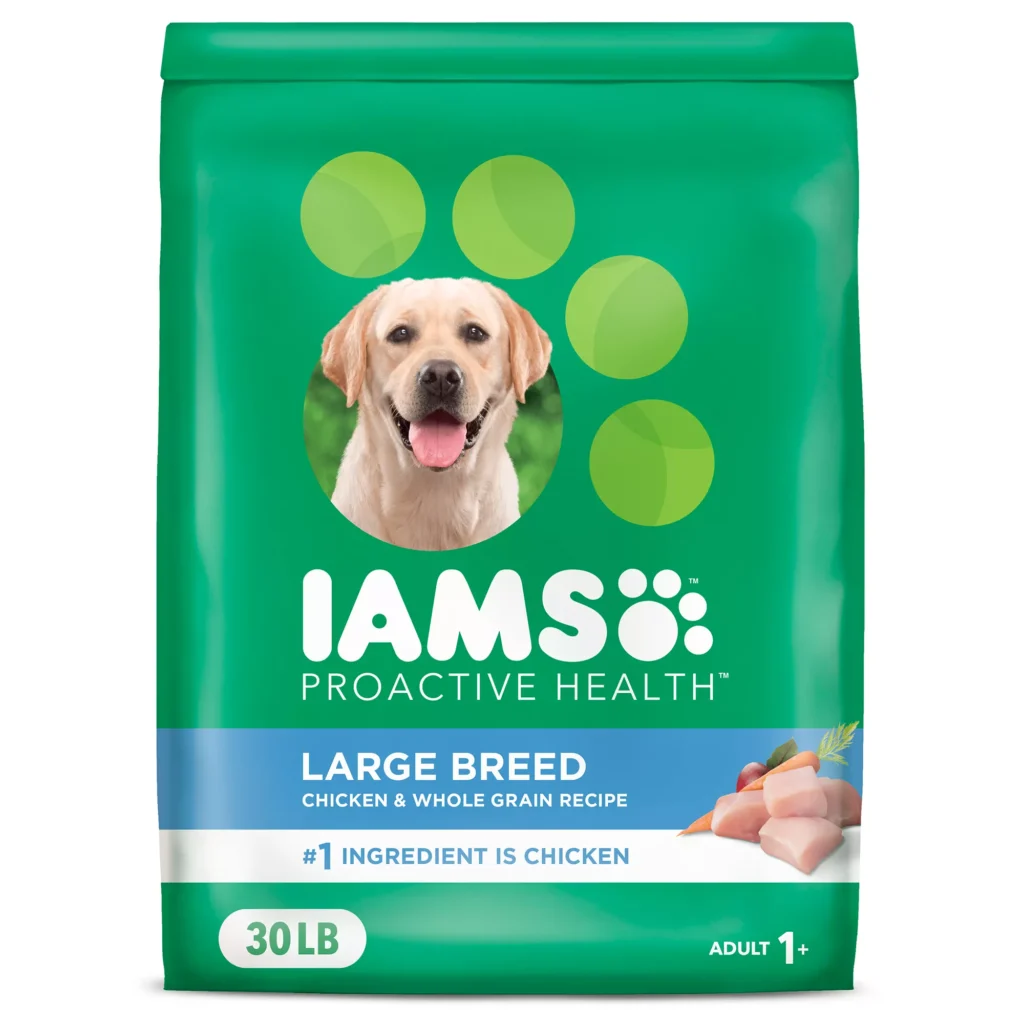
Iams ProActive Health Large Breed Adult is designed specifically for dogs weighing over 50 pounds, with a formula that emphasizes joint health, digestible energy, and immune support. The brand positions this food as a vet-recommended option that balances quality and value, making it accessible for owners who want reliable nutrition without premium pricing. Real chicken is the first ingredient, and the recipe includes added glucosamine and chondroitin to support the hips and joints of larger dogs.
What stands out right away is the calorie density—around 355 kcal per 100 grams—which is fairly high for a maintenance formula. That’s something to keep in mind if your dog is more couch potato than athlete. The kibble size is also larger than standard formulas, which helps slow down fast eaters and supports dental health through mechanical chewing action.
Available in 30-pound and 44-pound bags, this food is widely stocked at major retailers like Chewy, Walmart, and Tractor Supply, making it easy to find and restock. It meets AAFCO standards for adult maintenance, which means it’s formulated to provide complete and balanced nutrition for grown dogs. However, it’s worth noting that “adult maintenance” is a broad category—this formula isn’t specifically tailored for seniors or dogs with special health needs.
| Price per pound | Budget-friendly (exact pricing not specified) |
| Primary protein | Chicken |
| By-products | Yes (chicken by-product meal) |
| AAFCO compliance | Yes (adult maintenance) |
| Formula options | Large breed adult specific |
| Availability | Major retailers (Chewy, Walmart, Tractor Supply) |
Take the free nutrition check and find out in under 1 minute which food is best tailored to your dog!
In just 60 seconds, find out which food fits your dog best — for free.
The first ingredient is chicken, which is a positive sign. Chicken is a high-quality, complete protein that provides essential amino acids for muscle maintenance and overall health. It’s also highly digestible for most dogs, which is especially important for large breeds that can be prone to sensitive stomachs.
However, the second major protein source is chicken by-product meal. Now, before you write this off entirely, let’s be clear about what by-product meal actually is. According to AAFCO definitions, chicken by-product meal includes rendered parts like organs, feet, and necks—basically, everything except feathers, heads, and intestinal contents. While it’s not as appealing as “deboned chicken breast,” it’s still a concentrated source of protein and nutrients. Many dogs do just fine on it, and it’s a common ingredient in mid-tier kibbles.
That said, if you’re the type of owner who prefers whole-meat meals or named meat meals (like “chicken meal”), you might find this ingredient less desirable. It’s a trade-off that helps keep the price down while still delivering adequate protein levels.
Iams uses a blend of ground whole grain corn, ground barley, and ground whole grain sorghum as its carbohydrate base. These grains provide energy and are generally well-tolerated by dogs without grain sensitivities. They also contribute to the kibble’s structure and texture, making it crunchy and shelf-stable.
Here’s where opinions split. Corn often gets criticized in the dog food world as a “cheap filler,” but nutritionally, whole grain corn does offer carbohydrates, fiber, and some essential fatty acids. It’s not an empty ingredient, though it’s also not as nutrient-dense as sweet potatoes or legumes. For large breed dogs that need sustained energy, grains can actually be a practical choice—especially given the recent concerns around grain-free diets and potential links to heart disease (DCM).
The formula also includes dried plain beet pulp, a source of soluble and insoluble fiber that supports healthy digestion and firm stools. Some owners appreciate this because it can make cleanup easier, while others prefer more “natural” fiber sources like pumpkin or chickpeas.
Chicken fat, preserved with mixed tocopherols (a natural form of vitamin E), is the primary fat source. This is a good choice—it’s palatable, digestible, and provides essential fatty acids for skin and coat health. The inclusion of flaxseed adds plant-based omega-3s, though it’s worth noting that flaxseed omega-3s (ALA) are not as bioavailable for dogs as the EPA and DHA found in fish oil.
Iams also lists dried egg product, which is an excellent source of highly digestible protein and nutrients. Natural flavor is included to improve palatability, and while it’s a vague term, it’s generally derived from animal sources and helps make the kibble more appealing to picky eaters.
One ingredient that raises eyebrows is caramel color. This is purely cosmetic—it makes the kibble look more uniform and appealing to humans. It has no nutritional value and, while generally recognized as safe, it’s the kind of ingredient you won’t find in premium brands. If you’re focused on minimal processing and transparency, this is a small red flag.
Iams includes natural sources of glucosamine and chondroitin from chicken, which is a smart addition for large breed dogs. These compounds support cartilage health and joint function, which is especially important for breeds prone to hip dysplasia or arthritis. While the exact amounts aren’t quantified on the label, the inclusion is still a plus compared to generic large breed formulas that skip joint support altogether.
The formula is also fortified with a standard suite of vitamins and minerals, including vitamin E, calcium, and phosphorus, to meet AAFCO requirements. There’s mention of “seven essential nutrients” in marketing materials, though the specifics aren’t detailed on the ingredient panel—this is fairly typical for mass-market brands.
On an as-fed basis, Iams Large Breed Adult contains around 22% protein and 12% fat. When you convert that to a dry matter basis (removing moisture), you’re looking at approximately 25% protein and 14% fat. These levels meet AAFCO minimums for adult maintenance and are appropriate for most healthy large breed dogs.
However, if you’re comparing this to premium or performance formulas, you’ll notice the protein is on the moderate side. Active dogs—think working breeds, agility competitors, or dogs that hike regularly—might benefit from a higher-protein food. On the flip side, if your dog is a laid-back senior or tends to gain weight easily, this moderate protein level is actually a reasonable fit.
The fat content is also moderate, which supports steady energy without being overly rich. That’s generally a good thing for large breeds, as too much fat can contribute to weight gain and pancreatitis risk in susceptible dogs.
Carbohydrates make up roughly 49% of the formula on a dry matter basis. That’s on the higher end for dog food, especially compared to grain-free or high-protein formulas. For large breed dogs, carbs provide the energy needed for daily activity, but if your dog is sedentary or overweight, this carb load could be a concern.
Imagine you’ve got a Labrador who loves food and has a tendency to pack on pounds. A high-carb kibble like this might make weight management trickier, especially if portion control isn’t strict. In that case, you’d want to monitor your dog’s body condition closely and adjust feeding amounts as needed.
At around 355 kcal per 100 grams, this food is fairly calorie-dense. That means you don’t need to feed as much volume compared to a lower-calorie kibble, which can be helpful for large dogs with big appetites. However, it also means it’s easier to overfeed if you’re not measuring portions carefully.
Unfortunately, Iams doesn’t publish a detailed feeding guide on their website for this specific formula, so you’ll need to rely on the back-of-bag chart or consult your vet for personalized recommendations. As a rough guideline, a 70-pound adult dog with moderate activity might need around 3 to 4 cups per day, but this can vary widely based on metabolism and lifestyle.
Take the free nutrition check and find out in under 1 minute which food is best tailored to your dog!
In just 60 seconds, find out which food fits your dog best — for free.
Iams had a salmonella-related recall in August 2013, which affected specific lots of their dry dog foods, including some large breed formulas. The recall was handled transparently, with lot codes and best-by dates published by the FDA, and there were no widespread reports of illness. Since then, Iams has had a clean record—no recalls have been issued from 2014 through 2025.
That’s a solid track record, especially compared to some competitors that have faced multiple recalls in recent years. While no brand is immune to contamination risk, Iams’ decade-plus of recall-free production is reassuring.
Iams is owned by Mars Petcare, one of the largest pet food manufacturers in the world. Mars operates its own production facilities and conducts post-manufacture batch testing for safety and nutrient content. However, there’s no public disclosure of third-party testing, heavy metal analysis, or food safety certifications like GFSI or ISO for Iams-specific plants.
For budget-conscious owners, this level of quality control is generally adequate—Mars has the resources and infrastructure to maintain consistent production standards. That said, if you’re looking for the kind of radical transparency you get from brands like Orijen or The Honest Kitchen, Iams doesn’t offer that level of detail.
Iams is a legacy brand that’s been around since 1946, and it’s now part of the Mars Petcare portfolio, which also includes Royal Canin, Pedigree, Nutro, and Eukanuba. Mars is a privately held, Fortune 500 company with a massive global footprint in pet nutrition. That scale brings advantages—consistent supply chains, extensive research capabilities, and widespread availability—but it also means Iams operates more like a mass-market brand than a boutique, craft producer.
When it comes to transparency, Iams provides the basics: a full ingredient list, guaranteed analysis, and AAFCO compliance statements. However, they don’t publish detailed sourcing information, supplier names, or country-of-origin data for their chicken or grains. There’s also no batch-level traceability available to consumers, which is something you’ll find with more premium brands.
Mars employs veterinarians and animal nutritionists in their R&D teams, and Iams formulas are developed with input from these experts. However, the specific credentials or involvement of nutritionists in the Large Breed Adult formula aren’t publicly disclosed, so you’re taking the brand’s word on this.
If you’re the kind of owner who wants to know exactly where your dog’s protein comes from and how the food is tested, you might find Iams lacking. But if you’re comfortable with a well-established, vet-endorsed brand that meets regulatory standards, the transparency here is typical for the category.
For more insights into Iams’ overall approach and other formulas, check out our Iams dog food review.
Across major retailers like Chewy, Walmart, and Influenster, Iams Large Breed Adult consistently earns an average rating of 4.4 to 4.5 out of 5 stars. About 74% of reviews are five-star ratings, which suggests the majority of owners are happy with the food. Only around 8% of reviews are one-star, and those tend to focus on specific issues like digestive upset or picky eating.
This kind of rating distribution is solid for a mid-tier kibble. It’s not perfect, but it shows that most dogs tolerate and enjoy the food without major problems.
The most common praise centers on palatability. Owners frequently mention that their dogs “devour” the food and show genuine enthusiasm at mealtime. One Chewy reviewer wrote, “Both of my dogs love this dog food,” while another on Influenster said, “My dog devours this in no time flat.” For picky eaters or dogs transitioning from another brand, this can be a huge relief.
Another recurring positive is digestive tolerance. Many reviews highlight smooth transitions with no vomiting, diarrhea, or stomach upset. One owner noted, “Happy to see it didn’t cause tummy upset,” and another said, “She had no issues with transitioning.” For large breed dogs with sensitive stomachs, this is a meaningful advantage.
Owners also appreciate the value for money. Comments like “Great value. Would purchase again” and “provides healthy ingredients” reflect satisfaction with the price-to-quality ratio. The larger kibble size is another plus—owners report it helps slow down gulpers and doesn’t have an overpowering smell, which makes feeding time more pleasant.
On the flip side, a small but vocal group of owners report digestive issues. One Chewy reviewer wrote, “Made my dogs sick! Messiest/smelliest ‘trips outside’ issues,” and another mentioned increased gassiness after switching to Iams. While these cases are in the minority, they’re worth noting—especially if your dog has a history of food sensitivities.
Weight gain is another concern. One owner said, “This food added weight to her… switched her food back… immediately she was fine.” Given the calorie density and carb load, it’s not surprising that some dogs gain weight if portions aren’t carefully controlled. If your dog is prone to obesity, you’ll need to be diligent about measuring meals and adjusting based on body condition.
A few owners also mention that their dogs lost interest over time. One review stated, “She has started to tolerate this kibble less and less the past few months. She will literally have her stomach growl before eating it now.” This could be due to flavor fatigue or individual preference, but it’s something to watch for if you’re feeding the same food long-term.
Finally, some buyers note that the price has increased significantly in recent years. One Sam’s Club reviewer said, “Price has almost doubled since I started using it.” While Iams is still more affordable than premium brands, rising costs can be frustrating for budget-conscious households.
When you compare Iams ProActive Health Large Breed Adult to other popular large breed formulas, it’s clear that it occupies a middle ground. It’s not the cheapest option, but it’s also not trying to compete with ultra-premium brands.
Blue Buffalo Life Protection Large Breed Adult, for example, offers slightly higher protein (26% DMB) and markets itself as a natural, holistic option with no by-products. It also costs about 20 to 30% more per pound. If you’re willing to spend extra for deboned chicken and a grain-inclusive recipe with peas instead of corn, Blue Buffalo is a solid step up. However, Blue Buffalo has also had recalls in the past, so the safety advantage isn’t as clear-cut as the marketing might suggest.
Purina ONE Large Breed Adult is Iams’ closest competitor in terms of price and formulation. It also features chicken as the first ingredient, uses by-product meal, and relies on grains for carbohydrates. Protein and fat levels are nearly identical, and the price per 1,000 kcal is comparable. The main difference is brand preference—some owners swear by Purina, while others prefer Iams. Both are vet-endorsed, widely available, and meet AAFCO standards.
If you’re looking at premium options like Orijen or Acana, you’re talking about a completely different tier. These brands use fresh, regional ingredients, offer much higher protein levels (often 35% or more DMB), and provide detailed sourcing transparency. They also cost two to three times as much as Iams. For most large breed dogs, that extra expense isn’t necessary unless you have specific health or ethical priorities.
In short, Iams delivers reliable, vet-backed nutrition at a price that’s accessible for most households. It’s not the fanciest option, but it’s a practical choice for owners who want quality without premium pricing.
This food is ideal if you have a healthy adult large breed dog between the ages of one and seven years. Dogs like Labrador Retrievers, Golden Retrievers, German Shepherds, and mixed breeds over 50 pounds will generally do well on this formula. It’s especially suitable if your dog has a moderate activity level and no major food sensitivities or allergies.
If you’re looking for a budget-friendly option that’s easy to find and backed by a reputable manufacturer, Iams is a smart pick. The inclusion of joint support ingredients is a bonus for large breeds, and the palatability means most dogs will eat it without fuss.
It’s also a good choice if you’re concerned about grain-free diets and potential DCM risk. Since Iams uses whole grains instead of legumes or potatoes, it aligns with current veterinary recommendations for most dogs.
This formula isn’t the best fit for senior dogs with advanced joint issues or kidney concerns. While it does include glucosamine and chondroitin, the protein and phosphorus levels aren’t specifically tailored for aging dogs. If your dog is over seven years old or has been diagnosed with arthritis or renal disease, talk to your vet about a senior-specific or therapeutic formula.
Dogs with chicken or corn allergies should avoid this food entirely. If your dog has a history of itching, ear infections, or gastrointestinal upset related to these ingredients, you’ll need to look for a novel protein or limited-ingredient diet.
Overweight or sedentary dogs might also struggle with this formula due to its calorie density and carb load. If your dog is already battling obesity or has a slow metabolism, a weight management formula with lower calories and higher fiber would be a better choice.
Finally, if you’re deeply committed to organic, sustainably sourced, or humanely raised ingredients, Iams won’t meet your standards. The brand doesn’t carry certifications like MSC, organic, or animal welfare labels, and sourcing transparency is limited.
Iams doesn’t offer much in the way of sustainability or ethical certifications. There’s no indication that the chicken is humanely raised, the grains are organic, or the fish oil (if any) is MSC-certified. The packaging is standard recyclable plastic, but there’s no mention of post-consumer recycled materials or eco-friendly alternatives.
Mars Petcare, as a parent company, has made some corporate sustainability commitments, including reducing greenhouse gas emissions and improving supply chain transparency. However, these initiatives aren’t always reflected in individual product lines like Iams. If you’re passionate about environmental impact or animal welfare, you’ll find more robust programs with brands like Open Farm, The Honest Kitchen, or Stella & Chewy’s.
That said, sustainability often comes with a higher price tag. For many owners, the priority is simply feeding their dog a safe, nutritious food they can afford. Iams delivers on that front, even if it doesn’t check all the eco-conscious boxes.
If you decide to try Iams Large Breed Adult, make sure to transition gradually over seven to ten days. Start by mixing 25% Iams with 75% of your dog’s current food, then slowly increase the proportion of Iams every few days. This helps prevent digestive upset and gives your dog’s gut microbiome time to adjust.
Because this food is calorie-dense, measure portions carefully. Use a standard measuring cup or kitchen scale, and adjust based on your dog’s body condition. If you notice weight gain, cut back slightly; if your dog seems hungry or is losing weight, you can increase the amount.
For dogs that gulp their food, consider using a slow feeder bowl or puzzle feeder. The larger kibble size already helps, but adding an extra challenge can improve digestion and reduce bloat risk, which is especially important for deep-chested large breeds.
Finally, keep an eye on your dog’s coat, energy level, and stool quality during the first few weeks. These are good indicators of how well your dog is tolerating the food. If you see improvements, that’s a sign the formula is working. If issues arise, don’t hesitate to consult your vet or consider an alternative.
If you’re curious about how Iams’ other formulas compare, you might want to explore our iams lamb and rice review for another perspective on the brand’s offerings.
Iams ProActive Health Large Breed Adult is a solid, dependable choice for most healthy large breed dogs. It delivers balanced nutrition, includes joint support, and comes at a price that’s accessible for the average household. The ingredient list isn’t perfect—by-product meal and corn won’t appeal to everyone—but it’s honest, meets AAFCO standards, and is backed by a company with extensive resources and a clean recent safety record.
Customer feedback is overwhelmingly positive, with high marks for palatability and digestive tolerance. The few complaints about weight gain and occasional stomach upset are manageable with proper portion control and gradual transitions. Compared to competitors in the same price range, Iams holds its own and offers good value for the quality delivered.
That said, this food isn’t ideal for seniors, dogs with specific health conditions, or owners who prioritize premium sourcing and sustainability. If your dog falls into one of those categories, you’ll want to explore more specialized or transparent options.
For everyone else—owners raising healthy, active large breed dogs on a reasonable budget—Iams is a practical, vet-endorsed option that’s worth serious consideration. It won’t win awards for innovation or luxury, but it gets the job done, and sometimes that’s exactly what you need.
Take the free nutrition check and find out in under 1 minute which food is best tailored to your dog!
In just 60 seconds, find out which food fits your dog best — for free.
No, this specific formula is designed for adult dogs over one year old. Large breed puppies have different nutritional needs, including controlled calcium and phosphorus levels to support proper bone development. Look for Iams’ puppy-specific large breed formula instead, which is formulated to meet AAFCO standards for growth and development.
For an 80-pound adult dog with moderate activity, you’d typically feed around 3.5 to 4.5 cups per day, split into two meals. However, this can vary based on your dog’s metabolism, age, and activity level. Start with the feeding guide on the bag and adjust based on your dog’s body condition—you should be able to feel their ribs without pressing hard, but not see them clearly.
Yes, but with realistic expectations. Iams includes natural sources of glucosamine and chondroitin from chicken, which can support cartilage health and joint function. However, the exact amounts aren’t specified, and this isn’t a therapeutic joint supplement. If your dog already has significant arthritis or mobility issues, your vet might recommend additional joint supplements alongside the food.
Some dogs experience increased gas during the transition period, especially if you switched foods too quickly. The higher carbohydrate content from grains can also contribute to gas in sensitive dogs. Try a slower transition over 10-14 days instead of the usual 7 days. If gas persists beyond the transition period, your dog might be sensitive to one of the ingredients, particularly corn or chicken.
You can feed this to dogs over 50 pounds, but don’t give it to smaller breeds. The kibble size is designed for large mouths, and the nutrient profile is formulated specifically for the metabolic needs of bigger dogs. Small and medium dogs should stick to formulas designed for their size category to ensure proper nutrition and kibble size.
Both are very similar in terms of protein levels, ingredient quality, and price point. Iams and Purina ONE both use chicken as the first ingredient, include by-product meal, and meet AAFCO standards. The choice often comes down to which one your dog prefers taste-wise and tolerates better digestively. Both brands have solid safety records and vet endorsement.
For a 70-pound dog eating about 3.5 cups per day, a 30-pound bag will last approximately 3 to 4 weeks. This can vary depending on your dog’s exact size and activity level. The 44-pound bag would last roughly 5 to 6 weeks for the same dog, which often works out to better value per pound.
Chicken by-product meal isn’t inherently bad—it’s a concentrated protein source that includes organs, feet, and necks, but excludes feathers, heads, and intestinal contents. Many dogs do fine on it, and it helps keep costs reasonable. However, if you prefer whole meats or named meat meals like “chicken meal,” you might want to consider a premium formula, though you’ll pay more for that preference.
Yes, if portions aren’t controlled properly. This formula is fairly calorie-dense at 355 kcal per 100 grams, and the higher carbohydrate content can contribute to weight gain in less active dogs. Measure portions carefully, feed twice daily instead of free-feeding, and monitor your dog’s body condition. If you notice weight gain, reduce portions slightly or consider a weight management formula.
No, this formula contains corn, barley, and sorghum. Given the recent concerns about grain-free diets potentially being linked to heart disease (DCM) in some dogs, many veterinarians actually recommend grain-inclusive formulas like this one for most healthy dogs, unless your dog has a diagnosed grain allergy.
9 out of 10 dog owners are feeding their dog the wrong food.
Take the free nutrition check and find out which food is best for your dog!
2,847+ dog owners already did