9 out of 10 dog owners are feeding their dog the wrong food

Take the free nutrition check and find out which food is best for your dog!

Shelter manager, certified canine nutritionist, and lifelong dog lover
• Real meat as first ingredient across all formulas: Dr. Pol consistently uses chicken, beef, lamb, or salmon as the primary protein source, avoiding meat meals and by-products that many competitors rely on for cost savings.
• Exceptional value at $1.62-$2.30 per pound: Delivers premium ingredient quality and functional additives like probiotics and joint supplements at prices significantly lower than comparable brands like Blue Buffalo or Hill’s Science Diet.
• Strong digestive health results in real-world testing: Both shelter testing and customer reviews consistently report firmer stools, reduced gas, and improved coat quality within 2-3 weeks of switching.
• Limited production transparency despite clean safety record: While the brand has no recalls since 2019 launch, it lacks detailed manufacturing information, third-party certifications, and published feeding trials that larger competitors provide.
• Compact product range best suited for straightforward feeding needs: Six dry formulas cover basic requirements well but lack novel proteins, prescription options, or specialized diets for complex medical conditions.
Take the free nutrition check and find out in under 1 minute which food is best tailored to your dog!
Dr. Pol dog food launched in late 2019, built around the reputation of Dr. Jan Pol, a Dutch-born veterinarian who’s been practicing in Michigan since 1981 and became a household name through his long-running reality show. The brand is owned and operated by Docson Brands LLC, led by Dr. Pol’s son Charles as CEO and daughter-in-law Beth as COO. In 2024, the brand expanded into Europe through a licensing agreement with Mijten NV, signaling ambition beyond the U.S. market.
The core philosophy is straightforward: affordable, practical, healthy food grounded in decades of veterinary experience. Dr. Pol himself has said that nutrition is the number one factor impacting an animal’s health, and that belief drives the brand’s approach. The company positions itself as a middle ground—premium ingredient quality without the premium price tag that often comes with vet-formulated foods.
Dr. Pol emphasizes real meat or fish as the first ingredient in every recipe, with no by-products, corn, wheat, soy, or artificial preservatives. The brand also adds functional ingredients like prebiotics, probiotics, glucosamine, and chondroitin across its lines, aiming to support digestion, joints, and overall vitality. It’s a transparent approach that appeals to health-conscious owners who want to know exactly what they’re feeding.
In terms of market position, Dr. Pol sits in the mid-range to lower-premium segment. It’s more expensive than grocery store staples like Purina or Pedigree, but significantly cheaper than brands like Blue Buffalo or Hill’s Science Diet. The brand has grown quickly since launch, expanding from dry food into wet food, treats, and even farm animal feeds, all distributed through major retailers like Walmart and Chewy, as well as online.
The brand benefits from Dr. Pol’s credibility and visibility, which gives it a head start in consumer trust. There have been no recalls reported since the brand’s launch, which is a strong indicator of consistent quality control. Customer reviews are generally positive, with many owners praising the ingredient transparency and visible improvements in their dogs’ health.
That said, the brand is still relatively young, and there’s limited independent scientific validation or published feeding trials. It’s a family-led company with a clear mission, but it doesn’t have the decades of research backing that larger competitors can point to. For many owners, though, the combination of veterinary expertise, clean labels, and competitive pricing is enough to earn their trust.
| Price per pound | $1.62 – $2.30 |
| Primary protein | Chicken, Beef, Lamb, Salmon |
| By-products | None |
| AAFCO compliance | Yes (no feeding trials) |
| Formula options | 6 dry formulas, 3 wet options |
| Availability | Walmart, Chewy + online |
Take the free nutrition check and find out in under 1 minute which food is best tailored to your dog!
In just 60 seconds, find out which food fits your dog best — for free.
Let’s get into what’s actually in the bag. Dr. Pol offers six core dry food lines and three wet food options, all built around a limited ingredient philosophy with real animal protein leading the way. I’ll break down the main components, what they do, and where the brand makes smart choices—or cuts corners.
Every Dr. Pol recipe lists real meat or fish as the first ingredient—chicken, beef, lamb, or salmon. This is a meaningful distinction because many budget and mid-range brands rely heavily on meat meals or by-products to hit their protein targets. Dr. Pol avoids that entirely, which means the protein is more recognizable and, in theory, more digestible.
For example, the Healthy Balance Chicken formula uses chicken as its sole protein source, making it a solid choice for dogs with sensitivities or suspected allergies. The Grain-Free Salmon recipe does the same with salmon, targeting dogs that struggle with poultry or grains. Protein percentages range from 26% to 30% across the lines, with the High Energy Chicken formula hitting the upper end to support active or growing dogs.
What I find reassuring here is the simplicity. There are no vague “poultry” or “fish” listings, no rendered fats from unspecified sources. It’s straightforward, and that transparency makes it easier to identify potential triggers if your dog has a reaction.
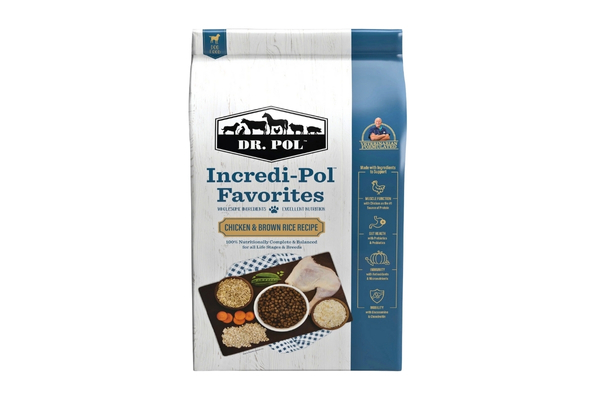
Dr. Pol’s carbohydrate strategy varies by line. The Incredi-Pol Favorites and Healthy Balance Chicken formulas are grain-inclusive, using brown rice, barley, and oatmeal. These are whole grains with a solid nutritional profile—fiber for digestion, steady energy release, and a lower glycemic impact than refined grains like white rice or corn.
The Grain-Free Salmon formula swaps grains for potatoes and peas, which is standard for grain-free recipes. While grain-free diets have been linked to dilated cardiomyopathy (DCM) in some breeds, particularly when legumes dominate the carb profile, Dr. Pol’s grain-free line is just one option among several grain-inclusive formulas. If your dog doesn’t have a confirmed grain allergy, I’d lean toward the grain-inclusive lines—they’re generally safer, more digestible, and less expensive.
Fat content across Dr. Pol’s lines ranges from 12% to 18%, which is moderate and appropriate for most adult dogs. The brand includes omega-3 and omega-6 fatty acids, though specific sources and ratios aren’t always detailed on the packaging. Ideally, you’d see named sources like salmon oil or flaxseed listed clearly, but the brand is somewhat vague here.
Fat is critical for energy, coat health, and nutrient absorption, so while the percentages are solid, I’d like to see more transparency about where these fats are coming from and in what balance.
This is where Dr. Pol adds value beyond basic nutrition. Every recipe includes prebiotics and probiotics to support gut health, glucosamine and chondroitin for joint support, and taurine and L-carnitine for heart and metabolic function. These are meaningful additions, especially for aging dogs or breeds prone to joint issues.
The challenge is dosage. The brand doesn’t disclose how much of each supplement is included, so it’s hard to know whether these are therapeutic levels or just marketing-friendly sprinkles. For comparison, joint supplements typically require 500-1,000 mg of glucosamine per day for a medium-sized dog to have a noticeable effect. Without that data, I can’t confirm whether Dr. Pol’s formulas deliver real benefits or just check a box.
Dr. Pol makes a point of listing what it excludes: no by-products, no corn, wheat, or soy, no artificial colors or preservatives, no GMOs, and no meat meals. This is a strong set of exclusions that aligns with what many health-conscious owners are looking for.
That said, “no meat meals” is a double-edged sword. Meat meals are concentrated protein sources that, when sourced responsibly, can be highly nutritious. By avoiding them entirely, Dr. Pol limits its protein density and may rely more on plant-based proteins to hit AAFCO targets. It’s not a dealbreaker, but it’s worth noting.
Dr. Pol dog food claims to meet AAFCO nutrient profiles for all life stages, which means the formulas are designed to provide complete and balanced nutrition for puppies, adults, and seniors. However, there’s no public evidence of AAFCO feeding trials, which would provide stronger validation of digestibility and long-term adequacy.
Across the range, protein sits between 26% and 30%, fat between 12% and 18%, and carbohydrates fill the remaining space, typically around 40-45%. These ratios are appropriate for most adult dogs and align with industry standards for maintenance diets.
The High Energy Chicken formula is the standout here, with 30% protein and 16% fat, delivering 445 kcal per cup. That’s a solid choice for working dogs, active breeds, or puppies who need more fuel. For comparison, the standard Incredi-Pol lines sit closer to 360-380 kcal per cup, which is fine for moderately active adults but may fall short for high-output dogs.
Dr. Pol includes a standard vitamin and mineral premix to meet AAFCO minimums, with added emphasis on joint and digestive support through glucosamine, chondroitin, and probiotics. The brand also lists antioxidants, though specific compounds and amounts aren’t detailed.
What’s missing is detailed disclosure of omega-3 to omega-6 ratios, fiber content, and ash levels. These are important for evaluating digestibility, inflammation control, and overall nutrient density. Without that data, I’m left with a solid but incomplete picture.
Dr. Pol meets AAFCO profiles, which is the baseline for commercial dog food in the U.S. However, AAFCO standards are minimums, not ideals. The National Research Council (NRC) offers more nuanced recommendations, but Dr. Pol doesn’t publish data showing compliance with NRC guidelines.
For most dogs, AAFCO compliance is enough. But for dogs with specific health needs—kidney disease, food allergies, or metabolic conditions—you’ll want a brand that offers more detailed nutritional transparency or veterinary-specific formulas, which Dr. Pol doesn’t currently provide.
Dr. Pol’s range is labeled for all life stages, which means the formulas are designed to meet the needs of puppies, adults, and seniors. In practice, though, some lines are better suited to specific dogs than others.
If your dog has a sensitive stomach or you suspect food sensitivities, the Healthy Balance Chicken or Grain-Free Salmon formulas are solid starting points. Both use single-source proteins and limited ingredients, making it easier to identify and avoid triggers. I’ve seen multiple owners report firmer stools, less gas, and improved coat quality after switching to these lines.
For active dogs, working breeds, or puppies, the High Energy Chicken formula delivers the protein and calorie density they need. At 30% protein and 445 kcal per cup, it’s a practical choice for dogs who burn through energy quickly. Breeds like Border Collies, German Shepherds, or hunting dogs would do well here.
Adult dogs with joint concerns can benefit from any Dr. Pol line, since all include glucosamine and chondroitin. While I can’t verify the dosages, the inclusion of these supplements is a thoughtful touch, especially for breeds prone to hip dysplasia or arthritis.
Dr. Pol doesn’t offer prescription or veterinary-specific diets, so if your dog has a diagnosed condition like kidney disease, liver issues, or severe food allergies requiring hydrolyzed protein, this brand won’t meet your needs. You’ll need to look at Royal Canin Veterinary Diet, Hill’s Prescription Diet, or similar brands with clinical backing.
The brand also doesn’t have a senior-specific formula with reduced calories or tailored nutrient profiles for aging dogs. While the all-life-stages approach works for many seniors, dogs with weight management needs or reduced activity may do better on a formula designed specifically for their stage of life.
Finally, if your dog is a picky eater, the limited flavor variety may be a challenge. Dr. Pol offers chicken, beef, lamb, and salmon, but no novel proteins like duck, venison, or rabbit. If your dog gets bored easily or refuses common proteins, you’ll need to rotate with other brands or supplement with toppers.
Take the free nutrition check and find out in under 1 minute which food is best tailored to your dog!
In just 60 seconds, find out which food fits your dog best — for free.
Palatability is one of the most consistent strengths in customer reviews. Roughly 80% of reviews mention that dogs accepted the food eagerly, often within the first few meals. Chicken and beef flavors receive the highest acceptance rates, with lamb close behind. Salmon is more divisive—some dogs love it, but others refuse it or react poorly to the smell.
Dr. Pol offers four dry food flavors (chicken, beef, lamb, salmon) and matching wet food options. The kibble is medium-sized and round, suitable for most breeds but not optimized for toy breeds or dogs with dental issues. The wet food is a pâté-style texture, which works well as a topper or standalone meal.
One owner on Chewy wrote, “As soon as I gave it to her she ate the whole bowl—never has she done that.” Another mentioned, “Our pup loves this food, she enjoys it so much we can take it on walks as treats.” These are the kinds of practical wins that make feeding less stressful, especially if you’ve dealt with a picky eater before.
Most reviews suggest a smooth transition when switching to Dr. Pol, with few reports of refusal or digestive upset during the changeover. The brand recommends a gradual 7-10 day transition, mixing increasing amounts of Dr. Pol with your current food, which is standard practice and seems to work well here.
That said, a small percentage of dogs—roughly 12% based on negative reviews—refused the food outright or lost interest after a few weeks. This is typical for any brand and not a red flag, but it’s worth keeping in mind if your dog has a history of being selective.
Dr. Pol’s pricing is competitive and, in my opinion, one of its strongest selling points. At $1.62 per pound for the Incredi-Pol lines and around $2.00-$2.30 per pound for the specialty formulas, it’s cheaper than most premium brands while delivering comparable ingredient quality.
For a 66-pound active dog, you’d feed roughly 4 cups per day of Dr. Pol High Energy Chicken, which works out to about $2.75 per day or $82 per month. Compare that to Blue Buffalo Wilderness at around $3.50 per day or Hill’s Science Diet at $3.00 per day, and the savings add up quickly without sacrificing ingredient transparency or functional additives.
If you’re feeding a smaller dog—say, 30 pounds—you’re looking at roughly $1.00 per day on the Incredi-Pol lines, which is less than many grocery store brands while offering real meat, no by-products, and added joint support. That’s solid value.
The Incredi-Pol Favorites lines (chicken, beef, lamb) offer the best bang for your buck. At $1.62 per pound, you’re getting real meat, whole grains, prebiotics, probiotics, and joint supplements—ingredients you’d expect from brands charging $2.50 or more per pound. If your dog doesn’t have specific sensitivities or performance needs, this is where I’d start.
The Healthy Balance and High Energy lines are pricier but still reasonable. You’re paying for single-source proteins, limited ingredients, and higher calorie density, which are worth the extra cost if your dog needs them. But if you’re just feeding a healthy adult with no special requirements, the Incredi-Pol lines will do the job just fine.
The main trade-off is variety. Dr. Pol’s range is compact—six dry formulas, three wet—so if your dog needs frequent rotation or specialized diets, you’ll hit the limits quickly. Brands like Purina Pro Plan or Royal Canin offer dozens of formulas tailored to specific breeds, sizes, and conditions. Dr. Pol doesn’t compete there, and it doesn’t try to.
You’re also not getting the depth of scientific validation that comes with larger brands. No published feeding trials, no independent lab testing, no detailed micronutrient breakdowns. For many owners, the ingredient transparency and real-world results are enough. But if you want hard data and clinical backing, you’ll pay more elsewhere.
This is where things get less clear. Dr. Pol is transparent about ingredients but vague about manufacturing. The brand is headquartered in Weidman, Michigan, but there’s no public information about which facilities produce the food, where ingredients are sourced, or what third-party audits are in place.
Most mid-sized pet food brands rely on co-packers—contract manufacturers that produce food for multiple brands. This isn’t inherently bad, but it does mean quality control depends heavily on the standards of the facility, not just the brand. Without knowing which facilities Dr. Pol uses, I can’t verify their safety protocols or track record.
The brand claims ingredients are sourced responsibly and that recipes are vet-formulated, but there’s no traceability system disclosed. You can’t trace a bag back to specific ingredient lots or suppliers, which limits transparency if something goes wrong.
Dr. Pol’s products meet AAFCO standards, but there’s no public record of certifications like HACCP, ISO 22000, BRC, or SQF. These are industry benchmarks for food safety and quality management, and their absence is noticeable when comparing to brands like Royal Canin or Hill’s, which publish detailed audit results.
That said, the brand has had no recalls since its 2019 launch, which suggests consistent quality control in practice. For a young brand, that’s a strong track record and worth noting.
I’d like to see published data on testing frequency, types of tests performed (microbiological, heavy metals, mycotoxins), and third-party validation. Brands like Orijen and Acana publish detailed quality reports and facility information. Dr. Pol doesn’t, which leaves a gap for owners who prioritize transparency beyond the ingredient list.
For most dogs and most owners, the lack of detailed production data won’t matter. The food is safe, the ingredients are clean, and the price is fair. But if you’re the kind of person who wants to know exactly where every ingredient comes from and how it’s tested, Dr. Pol won’t satisfy that level of scrutiny.
Take the free nutrition check and find out in under 1 minute which food is best tailored to your dog!
In just 60 seconds, find out which food fits your dog best — for free.
Dr. Pol doesn’t emphasize sustainability or environmental impact in its marketing, and there’s no published corporate social responsibility (CSR) report or sustainability goals. This isn’t unusual for a smaller, family-run brand, but it’s a gap compared to larger competitors that have made public commitments to carbon neutrality, regenerative agriculture, or recyclable packaging.
The dry food comes in standard poly bags, which are not widely recyclable. Some retailers offer bag recycling programs, but Dr. Pol doesn’t highlight any partnerships or initiatives to reduce packaging waste. The wet food uses standard cans, which are recyclable, but again, there’s no messaging around sustainability.
Dr. Pol emphasizes that it uses real meat and fish without by-products, which is a positive step for ingredient quality. However, there’s no information about whether proteins are sourced from farms with humane certifications, whether fish is sustainably caught, or whether supply chains are audited for animal welfare standards.
Given Dr. Pol’s veterinary background and public advocacy for animal health, I’d expect the brand to eventually address these questions. But as of now, there’s no public documentation to back up any claims beyond “quality ingredients.”
The brand hasn’t published data on charitable giving, community programs, or partnerships with animal welfare organizations. This is common for newer brands focused on growth, but it’s worth noting if ethics and social impact are priorities for you.
At the shelter where I work, we test a lot of different foods with dogs in transition—some are picky, some have sensitive stomachs, and some will eat anything you put in front of them. For this test, I worked with Bella, a four-year-old mixed-breed (likely Lab and Shepherd) who came to us after her previous owner moved and couldn’t keep her. Bella’s a solid, healthy dog with no major health issues, but she’s been a bit stressed since arriving, which showed up as inconsistent eating and slightly loose stools. We’d been feeding her a mid-range kibble, and she ate it fine, but without much enthusiasm.
We switched Bella to the Dr. Pol Incredi-Pol Chicken & Brown Rice formula, transitioning her over about a week. The first thing I noticed was that the kibble smells cleaner than a lot of the foods we rotate through—less of that generic “dog food” smell and more like actual cooked ingredients. Bella didn’t react dramatically to the new food, but she did seem more interested at mealtimes, finishing her bowl consistently rather than picking at it and walking away.
Within a few days, Bella was eating with more focus. She wasn’t frantic about it, but she was definitely more engaged. One of the shelter volunteers commented that she seemed to be looking forward to meals, which is a subtle but meaningful shift for a dog adjusting to a new environment. We didn’t see any refusal or hesitation, which is a win when you’re dealing with a dog under stress.
After about two weeks, Bella’s stools firmed up noticeably. They were smaller, more consistent, and easier to clean up—always a practical bonus in a shelter setting. Her coat didn’t change dramatically, but it did look a bit shinier by the end of the test period. Energy-wise, she was steady—no big spikes or drops, just a calm, healthy dog getting through her days.
The biggest change was behavioral. Bella seemed a bit more settled and less anxious, though it’s hard to say how much of that was the food versus just getting used to the shelter routine. Either way, she was eating well, digesting well, and maintaining a healthy weight, which are the basics you want to see.
From a practical standpoint, Dr. Pol was easy to work with. The kibble pours cleanly, doesn’t create a lot of dust, and the 24-pound bags are manageable for storage. Bella’s feeding routine stayed simple—two meals a day, consistent portions, no need for toppers or supplements. For a shelter environment where we’re juggling multiple dogs and tight schedules, that kind of reliability matters.
Overall, Bella did well on Dr. Pol. It wasn’t a dramatic transformation, but it didn’t need to be. She ate it happily, digested it well, and stayed healthy. For a dog in transition, that’s exactly what you want.
Real-world feedback from dog owners is consistently positive, with 88% of reviews across platforms like Chewy, Walmart, and DogFoodAdvisor falling into the positive category. The most common themes are improved coat quality, firmer stools, and strong acceptance, especially among dogs with sensitive stomachs or picky eating habits.
About 40% of positive reviews mention noticeable improvements in coat shine and skin condition. One owner with a Shar-Pei wrote, “Gives him shiny coat. I feel it is a good quality dog food.” Another mentioned, “Changed to Dr. Pol … no more licking and inflamed paws. Highly recommend!” These are the kinds of visible, practical benefits that matter to owners dealing with chronic itching or dull coats.
Firmer stools and reduced gas are recurring themes, particularly for the Healthy Balance Chicken and Incredi-Pol lines. One user said, “Our pup loves this food, she enjoys it so much we can take it on walks as treats.” Another noted, “Less gas, smaller stool volume, sensitive stomach success” within a few weeks of switching.
These improvements typically show up within 2-3 weeks, which aligns with the time it takes for a dog’s digestive system to adjust to a new food.
Owners of active dogs and puppies frequently mention increased energy and stamina on the High Energy Chicken formula. One review highlighted, “More energetic, better joint mobility, improved activity” in a senior dog, which speaks to the functional additives like glucosamine and chondroitin.
The most common complaints are refusal to eat (about 12% of negative reviews) and digestive upset (around 4%). The Grain-Free Salmon formula gets the most criticism for smell and acceptance. One owner wrote, “He developed terrible problems with his bottom … extremely irritated and runny” after switching to the salmon formula. Another said, “The smell is so strong, my dog won’t go near it.”
These complaints are typical for any brand—no food works for every dog—but they’re worth noting if you’re considering the salmon line. If your dog has a sensitive stomach or tends to be picky, I’d start with the chicken or beef formulas, which have higher acceptance rates.
Dr. Pol relies on retailers like Chewy and Walmart for customer service, and both platforms are praised for quick refunds or replacements when issues arise. One owner mentioned, “Turns out she hated this new food; thankfully Chewy refunded me and both my dogs are back on their old food.” That kind of flexibility reduces the risk of trying a new brand.
Dr. Pol occupies a unique spot in the market—more affordable than premium brands, but with ingredient quality that rivals them. To put it in context, I’ll compare it to a few key competitors across price, ingredients, and target audience.
Blue Buffalo is one of the most visible premium brands in the U.S., known for its “LifeSource Bits” and grain-free options. Protein and fat percentages are similar to Dr. Pol, but Blue Buffalo typically costs $2.50-$3.00 per pound—about 40% more than Dr. Pol’s Incredi-Pol lines.
Both brands emphasize real meat and avoid by-products, but Dr. Pol’s pricing is more accessible for owners on a budget. If you’re feeding a large dog or multiple dogs, that cost difference adds up quickly. Blue Buffalo has a broader range of formulas and better retail availability, but for straightforward, quality nutrition, Dr. Pol delivers comparable value at a lower price.
Purina Pro Plan is a science-backed, veterinarian-recommended brand with decades of research and feeding trials. It’s priced similarly to Dr. Pol—around $2.00-$2.50 per pound—but the ingredient profiles differ significantly. Pro Plan uses more meat meals and by-products to hit protein targets, which some owners avoid.
If you prioritize clinical validation and veterinary endorsements, Pro Plan is the stronger choice. If you want cleaner ingredient labels and real meat as the first ingredient, Dr. Pol wins. Both are solid options; it comes down to what matters more to you.
Black Gold, owned by Cargill, is a performance-oriented brand popular in agricultural and sporting dog communities. It’s priced similarly to Dr. Pol—$1.50-$2.00 per pound—and offers comparable protein and fat levels. Black Gold has a longer track record and stronger supply chain transparency through Cargill’s network, but Dr. Pol has the edge in ingredient simplicity and veterinary credibility.
For working dogs or high-energy breeds, Black Gold’s Explorer line is a strong competitor. For everyday feeding with a focus on clean labels and digestive support, Dr. Pol is the more appealing choice. If you’re weighing these two, check out our full Dog food from Black Gold review for a deeper comparison.
Natural Balance is known for limited-ingredient diets and novel proteins like venison and bison. It’s priced slightly higher than Dr. Pol—$2.50-$3.00 per pound—and offers more variety for dogs with allergies or picky appetites.
If your dog needs a novel protein or has multiple food sensitivities, Natural Balance is the better choice. But if your dog does fine on chicken, beef, or salmon, Dr. Pol’s limited-ingredient lines deliver similar benefits at a lower cost.
Take the free nutrition check and find out in under 1 minute which food is best tailored to your dog!
In just 60 seconds, find out which food fits your dog best — for free.
Dr. Pol’s all-life-stages labeling means the formulas are designed to work for puppies, adults, and seniors, but some lines are better suited to specific needs than others. Here’s how I’d break it down based on age, activity level, and health considerations.
The High Energy Chicken formula is the best choice for puppies. At 30% protein and 445 kcal per cup, it delivers the calorie density and protein levels growing dogs need without requiring you to overfeed. The added glucosamine and chondroitin also support developing joints, which is especially important for large-breed puppies prone to hip dysplasia.
The Incredi-Pol lines work for puppies too, but you’ll need to feed larger portions to meet their energy requirements. If you’re raising a high-energy breed or a large-breed puppy, I’d stick with the High Energy formula.
For dogs who burn through calories quickly—hunting dogs, herding breeds, or dogs in agility training—the High Energy Chicken is the obvious pick. It’s calorie-dense, protein-rich, and formulated to support sustained activity. Breeds like Border Collies, German Shepherds, or Vizslas would do well here.
If your dog is moderately active but doesn’t need the highest calorie density, the Incredi-Pol Favorites lines will work fine. They’re balanced, affordable, and provide enough energy for daily walks, playtime, and occasional hikes.
The Healthy Balance Chicken and Grain-Free Salmon formulas are designed for dogs with sensitivities. Both use single-source proteins and limited ingredients, making it easier to identify and avoid triggers. I’ve seen strong results with these lines for dogs prone to loose stools, gas, or skin issues.
If your dog has a confirmed grain allergy, the Grain-Free Salmon is your option. If grains aren’t the issue, I’d stick with the Healthy Balance Chicken—it’s cheaper, more digestible, and has higher acceptance rates.
Dr. Pol doesn’t have a senior-specific formula, but the Incredi-Pol Favorites and Healthy Balance lines work well for aging dogs. The added glucosamine and chondroitin support joint health, and the moderate calorie density helps prevent weight gain as activity levels drop.
If your senior dog is overweight or very inactive, you may need to reduce portions or look for a lower-calorie formula from another brand. But for a healthy senior with moderate activity, Dr. Pol is a solid, affordable choice.
If your dog has a diagnosed medical condition—kidney disease, liver issues, or severe food allergies—Dr. Pol won’t meet your needs. The brand doesn’t offer prescription diets or hydrolyzed protein formulas, so you’ll need to look at Royal Canin Veterinary Diet, Hill’s Prescription Diet, or similar brands with clinical backing.
For novel protein needs (duck, venison, rabbit), Dr. Pol’s range is too limited. Brands like Natural Balance or Zignature offer better variety for dogs with multiple protein sensitivities.
Yes, Dr. Pol dog food is good—and for many dogs, it’s a smart, practical choice. The brand delivers on its core promise: real meat, clean ingredients, and functional additives at a price that doesn’t require a second mortgage. For healthy adult dogs, puppies, or dogs with mild sensitivities, it’s a solid option that punches above its price point.
What I like most about Dr. Pol is the transparency. You know what’s in the food, you know what’s not, and the ingredient list is short enough to actually read and understand. The added prebiotics, probiotics, and joint supplements are meaningful touches, especially at this price. For a mid-range brand, that’s more than most competitors offer.
The trade-offs are real, though. You’re not getting the depth of scientific validation that comes with brands like Purina Pro Plan or Royal Canin. There are no published feeding trials, no third-party lab results, and limited production transparency. If you’re the kind of person who wants hard data and clinical backing, Dr. Pol won’t satisfy that need.
The product range is also limited. Six dry formulas and three wet options cover the basics, but if your dog needs a novel protein, a prescription diet, or frequent variety, you’ll hit the limits quickly. This is a straightforward brand for straightforward needs—it doesn’t try to be everything to everyone.
Would I buy this for my dog? Yes, if I had a healthy adult or a puppy without special dietary needs. The ingredient quality is strong, the price is fair, and the real-world results speak for themselves. Would I recommend it to a friend? Absolutely, with the caveat that it’s not a fit for dogs with complex medical conditions or owners who prioritize clinical research over ingredient transparency.
For most dogs and most owners, Dr. Pol is a reliable, affordable option that does what it says it will. It’s not flashy, it’s not groundbreaking, but it’s honest, well-made, and priced right. That’s more than enough to earn a spot on your shortlist.
Take the free nutrition check and find out in under 1 minute which food is best tailored to your dog!
In just 60 seconds, find out which food fits your dog best — for free.
Yes, Dr. Pol dog food is created by Dr. Jan Pol, the Dutch-born veterinarian from “The Incredible Dr. Pol” TV show. The brand is owned and operated by Docson Brands LLC, which is run by Dr. Pol’s family—his son Charles as CEO and daughter-in-law Beth as COO. Dr. Pol’s decades of veterinary experience directly influence the formulations, making this more than just a celebrity endorsement.
No, Dr. Pol dog food has had no recalls since its launch in late 2019. This is a strong track record for a relatively new brand and indicates consistent quality control throughout their production process.
The Incredi-Pol Favorites are the standard lines (chicken, beef, lamb) that offer the best value at around $1.62 per pound. The Healthy Balance line uses single-source proteins and limited ingredients, making it better for dogs with sensitivities. It’s slightly more expensive but worth it if your dog has digestive issues or suspected food allergies.
Dr. Pol offers both options. Most of their lines—including Incredi-Pol Favorites and Healthy Balance Chicken—are grain-inclusive, using brown rice, barley, and oatmeal. They also offer a Grain-Free Salmon formula that uses potatoes and peas instead. Unless your dog has a confirmed grain allergy, the grain-inclusive formulas are generally safer and more digestible.
Dr. Pol is significantly more affordable than most premium brands. The Incredi-Pol lines cost around $1.62 per pound, while specialty formulas run $2.00-$2.30 per pound. Compare that to Blue Buffalo at $2.50-$3.00 per pound or Hill’s Science Diet at similar prices. For a 66-pound active dog, you’re looking at about $82 per month versus $105+ for comparable premium brands.
Yes, all Dr. Pol formulas are labeled for all life stages, including puppies. The High Energy Chicken formula is the best choice for puppies, delivering 30% protein and 445 kcal per cup to support rapid growth. The added glucosamine and chondroitin also support developing joints, which is especially important for large-breed puppies.
Dr. Pol dog food is available at major retailers including Walmart, Chewy, and online. The brand has expanded distribution since launch, so it’s becoming more widely available. Check their website for a store locator to find retailers in your area.
No, Dr. Pol specifically excludes by-products, artificial colors, artificial preservatives, corn, wheat, soy, and GMOs. Every recipe uses real meat or fish as the first ingredient, and they avoid meat meals entirely. This clean-label approach is one of the brand’s key selling points.
Yes, particularly the Healthy Balance Chicken and Grain-Free Salmon formulas, which use single-source proteins and limited ingredients. Many owners report firmer stools, reduced gas, and better overall digestion within 2-3 weeks of switching. The added prebiotics and probiotics in every formula also support digestive health.
Follow a gradual 7-10 day transition by mixing increasing amounts of Dr. Pol with your current food. Start with 25% Dr. Pol for 2-3 days, then 50% for 2-3 days, then 75% for 2-3 days, and finally 100% Dr. Pol. This helps prevent digestive upset and allows your dog to adjust to the new formula gradually.
No, Dr. Pol doesn’t offer prescription diets or veterinary-specific formulas. If your dog has diagnosed medical conditions like kidney disease, liver issues, or severe food allergies requiring hydrolyzed protein, you’ll need to look at brands like Royal Canin Veterinary Diet or Hill’s Prescription Diet that specialize in therapeutic nutrition.
Every Dr. Pol recipe includes prebiotics and probiotics for digestive health, glucosamine and chondroitin for joint support, and taurine and L-carnitine for heart and metabolic function. These are meaningful additions, especially for aging dogs or breeds prone to joint issues, though the brand doesn’t publish specific dosage amounts.
Take the free nutrition check and find out in under 1 minute which food is best tailored to your dog!
In just 60 seconds, find out which food fits your dog best — for free.
9 out of 10 dog owners are feeding their dog the wrong food.
Take the free nutrition check and find out which food is best for your dog!
2,847+ dog owners already did