9 out of 10 dog owners are feeding their dog the wrong food

Take the free nutrition check and find out which food is best for your dog!

Shelter manager, certified canine nutritionist, and lifelong dog lover
Safety concerns overshadow quality: Multiple FDA advisories for Salmonella, Listeria, and E. coli contamination, including a child hospitalized with E. coli genetically linked to Darwin’s beef recipe.
High-quality ingredients with poor execution: Pasture-raised meats and organic vegetables provide excellent nutrition, but systemic quality control failures undermine the premium positioning and pricing.
Significant cost barrier: Daily feeding costs range from $2.30 for small dogs to nearly $14 for large breeds on Natural Selections, making it 2-4x more expensive than premium kibble.
Strong palatability and digestive benefits: Most dogs eat Darwin’s enthusiastically and show improved coat quality, firmer stools, and better energy levels, particularly those with food sensitivities.
Safer alternatives available at similar prices: Competitors like The Farmer’s Dog and Stella & Chewy’s offer comparable nutrition with better safety records and more transparent operations.
Take the free nutrition check and find out in under 1 minute which food is best tailored to your dog!
Raw feeding has grown from a niche philosophy to a mainstream choice for health-conscious dog owners. Darwin’s entered this space early, positioning itself as a pioneer willing to ship frozen raw meals nationwide when most brands stuck to kibble. The appeal is clear: whole meat, organ blends, minimal processing, and the promise of a diet closer to what dogs evolved eating. For many owners, switching to raw means watching their dog’s energy climb, coat shine, and digestion stabilize. But raw food also comes with unique risks—bacterial contamination being the most serious—and Darwin’s recent track record on this front is troubling.
In this review, I’ll walk through what Darwin’s actually delivers: the quality of their ingredients, how their recipes stack up nutritionally, what real customers report after months of feeding, and how the brand handles transparency and safety. I’ll also share observations from testing Darwin’s with a shelter dog, compare it to competitors in the same premium tier, and give you my honest take on whether this food is worth the investment—or whether you’re better off looking elsewhere.
Darwin’s Natural Pet Products was founded in 2004 by Gary Tashjian, who started feeding his dog Max a raw diet after a holistic veterinarian suggested it might help with arthritis. Tashjian saw improvements and began formulating meals at home before launching the company to make quality raw diets accessible to other dog owners. The brand’s mission centers on helping pet parents see a healthier and happier pet in 30 days, combining what they describe as dogs’ natural, instinctive diet with modern nutritional science and all-natural ingredients.
From the beginning, Darwin’s positioned itself as a direct-to-consumer subscription service, bypassing retail shelves entirely. This model allows them to ship frozen meals nationwide, maintaining cold chain integrity and offering personalized feeding plans. The company emphasizes transparency about sourcing—claiming free-range or hormone-free meats depending on the product tier—and avoids fillers, preservatives, and artificial additives across all recipes.
Over two decades, Darwin’s has served more than 300,000 families and built a loyal following among raw feeding advocates. The brand operates from a single facility in Tukwila, Washington, and maintains a relatively small team of around 50 employees. This boutique scale contributes to their identity as a founder-led, mission-driven company rather than a mass-market player.
Darwin’s built its reputation on several pillars: minimal processing, high-quality protein sources, and a commitment to holistic pet health. They market themselves as the first U.S. raw pet food company to embrace e-commerce subscriptions, framing their approach as “farm-to-table” for pets. The brand appeals to owners who distrust kibble, worry about synthetic additives, and want more control over what goes into their dog’s bowl.
However, Darwin’s recent history complicates this narrative. Multiple FDA advisories between 2023 and 2025 for bacterial contamination—including a case where a child was hospitalized with E. coli linked genetically to Darwin’s beef food—have damaged trust. The company’s response has been defensive, challenging the FDA’s risk assessments and resisting full recalls, which raises questions about their commitment to transparency and consumer safety.
From a market positioning standpoint, Darwin’s occupies the premium raw food niche, competing with brands like Stella & Chewy’s, Primal Pet Foods, and The Farmer’s Dog. They’re more expensive than most kibble but positioned as delivering superior nutrition and health outcomes. The subscription model creates recurring revenue and customer relationships, but it also means Darwin’s lacks the retail visibility and impulse-buy potential of shelf brands.
| Price per pound | $6.60 – $12.99 |
| Primary protein | Beef, Chicken, Turkey, Lamb |
| By-products | None (includes organ meats) |
| AAFCO compliance | Yes (formulation only, no feeding trials) |
| Formula options | 3 product lines (Natural Selections, BioLogics, Intelligent Design) |
| Availability | Direct-to-consumer subscription only |
Take the free nutrition check and find out in under 1 minute which food is best tailored to your dog!
In just 60 seconds, find out which food fits your dog best — for free.
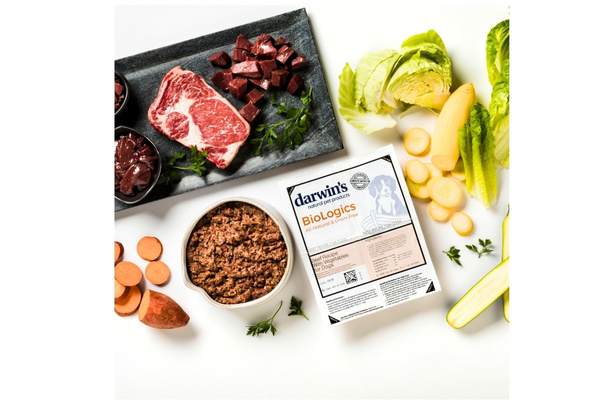
Darwin’s offers three main product lines: Natural Selections (premium, pasture-raised meats), BioLogics (budget-friendly, supermarket-grade meats), and Intelligent Design (veterinary prescription diets). All are grain-free, raw frozen formulas built around a 75% meat / 25% vegetable split. Let’s break down what’s actually in these recipes.
The Natural Selections line uses grass-fed beef, cage-free chicken, free-range turkey, and grass-fed lamb. Each recipe includes muscle meat, organ meat (heart, liver), and sometimes gizzards, which boosts nutritional density and mimics whole prey feeding. Protein content ranges from 13-14% as fed (wet basis), translating to roughly 40-50% on a dry matter basis—competitive with other raw brands.
BioLogics uses the same formula structure but sources USDA-inspected meats without the pasture-raised or organic premiums. This lowers cost but maintains the core raw feeding philosophy. Protein levels are slightly lower (12-13% as fed) but still solid.
Intelligent Design formulas vary by condition—kidney support recipes use modified protein levels and reduced phosphorus, while joint support versions may add omega-3-rich fish or specific amino acid blends. These are tailored by veterinary nutritionists for therapeutic use.
Darwin’s uses organic vegetables in Natural Selections (carrots, zucchini, leafy greens like lettuce, squash) and conventional vegetables in BioLogics. Carbohydrate content is low—around 5-6% estimated—making these recipes suitable for dogs with grain sensitivities or those thriving on low-carb diets. The vegetables provide fiber, vitamins, and minerals without adding empty calories or triggering common allergens.
There are no grains, legumes, or starchy fillers like corn, wheat, or soy. This aligns with the ancestral diet philosophy but also means the food is calorie-dense and requires careful portioning to avoid weight gain.
Fat content ranges from 6-8% as fed (around 20-35% dry matter), sourced primarily from the meat itself plus added cod liver oil and sunflower oil in some recipes. These oils boost omega-3 and omega-6 fatty acids, supporting coat health, joint function, and anti-inflammatory pathways. The fat profile is generally well-balanced, though the exact omega-3 to omega-6 ratio isn’t published for all recipes.
Darwin’s keeps additive lists short. You’ll see added vitamins and minerals (vitamin E, zinc, iron) to ensure AAFCO completeness, but no artificial preservatives, colors, or flavors. Some Intelligent Design formulas include targeted supplements like glucosamine or chondroitin for joint support, or specific vitamin blends for liver or kidney conditions.
There’s no evidence of probiotics or prebiotics in the standard lines, though these could theoretically be included in therapeutic formulas. The lack of synthetic preservatives is a selling point but also underscores the need for proper frozen storage and handling.
Darwin’s provides full ingredient lists on packaging and their website, which is a plus. They claim free-range, hormone-free, and antibiotic-free sourcing, but detailed supplier information, farm locations, or batch-level traceability aren’t publicly available. This is a significant transparency gap compared to brands like The Honest Kitchen, which is B Corp certified and publishes more about its supply chain.
The company emphasizes USDA-audited sourcing and antimicrobial pre-treatment of raw materials, but recent FDA findings suggest these controls haven’t been sufficient to prevent pathogen contamination. This raises questions about whether the sourcing standards are as rigorous as marketed, or whether the issue lies in handling and processing after ingredients arrive.
Darwin’s recipes are formulated to meet AAFCO nutrient profiles for all life stages, meaning they’re technically complete and balanced for puppies, adults, and seniors. However, the brand doesn’t appear to conduct AAFCO feeding trials—the gold standard for validating digestibility and long-term safety—which means their nutritional adequacy is based on formulation alone.
Here’s how the macros shake out on an as-fed (wet) basis for Natural Selections Beef:
Converting to dry matter (removing moisture) gives you roughly 48% protein, 28% fat, and 17% carbs—numbers that align well with high-protein, low-carb feeding philosophies. Caloric density is around 36 kcal/oz, which is typical for raw food but much higher per gram than kibble due to moisture content.
BioLogics recipes are slightly lower in protein and fat (12% protein, 6-7% fat as fed) but still respectable. Intelligent Design formulas vary based on therapeutic goals—kidney diets drop protein and phosphorus, while joint formulas may bump omega-3s.
Darwin’s includes organ meats like liver and heart, which are nutrient powerhouses—rich in vitamin A, B vitamins, iron, and essential amino acids. This is a major advantage over kibble that relies on synthetic vitamin premixes. The added vegetables contribute antioxidants, fiber, and phytonutrients, though the exact micronutrient profile isn’t published in detail.
Omega-3 and omega-6 fatty acids are present thanks to cod liver oil and meat fats, but without published ratios or dosing, it’s hard to compare directly to brands that disclose these metrics. The lack of added probiotics is a minor downside, as gut health support is a common feature in premium foods.
Darwin’s meets AAFCO nutrient profiles on paper, which is the baseline for any complete dog food. However, the absence of feeding trials means we don’t have independent verification of digestibility, stool quality, or long-term health outcomes. Brands that invest in feeding trials can make stronger claims about how well dogs actually absorb and utilize the nutrients, which is a meaningful difference.
The recipes are also designed to be fed exclusively—Darwin’s doesn’t recommend mixing with kibble or other foods, which simplifies things but limits flexibility if you want to stretch the budget or transition gradually.
Darwin’s raw frozen meals work best for specific types of dogs and owners. Let’s break down who benefits most—and who should probably look elsewhere.
Dogs with food sensitivities or allergies: The single-protein recipes, grain-free formulas, and minimal ingredient lists make Darwin’s a solid choice for dogs that react to common kibble additives or fillers. Turkey and lamb are particularly gentle for sensitive stomachs.
Active, high-energy dogs: The high protein and fat content supports muscle maintenance and endurance. If your dog runs, hikes, or works regularly, the calorie density and nutrient profile align well with their needs.
Dogs with chronic digestive issues: Many owners report that switching to raw stabilizes loose stools, reduces gas, and improves nutrient absorption. The lack of fillers and high moisture content can ease digestion for dogs struggling with kibble.
Owners committed to raw feeding: If you’ve researched raw diets, understand the handling requirements, and want a convenient subscription service, Darwin’s delivers on the core promise—provided you’re comfortable with the recent safety concerns.
Puppies under 4 months: Darwin’s recommends lightly cooking the food for very young puppies to reduce bacterial exposure. This adds a step and somewhat defeats the purpose of raw feeding.
Households with immunocompromised members: The FDA has documented cases of human illness linked to Darwin’s products, including a child hospitalized with E. coli. If anyone in your home has a weakened immune system, the pathogen risk is too high.
Budget-conscious owners: Even the BioLogics line runs $6-7 per pound, which translates to $3-14 per day depending on dog size. That’s significantly more expensive than premium kibble and even some fresh-cooked options.
Dogs with specific medical needs requiring prescription diets: While Intelligent Design offers therapeutic formulas, they require a vet prescription and aren’t a substitute for established veterinary diets from Hill’s or Royal Canin if your vet recommends those specifically.
Darwin’s markets all recipes as suitable for all life stages, but the high calorie density means small dogs can thrive on very small portions (often more cost-effective), while large and giant breeds will burn through packs quickly and face steep monthly bills. A 60-pound dog eats roughly $9-10 per day on Natural Selections—manageable for some, prohibitive for others.
For senior dogs, the digestibility and moisture content are advantages, especially if they have dental issues or weakened digestion. However, seniors with kidney or liver disease should use the Intelligent Design therapeutic formulas, not the standard lines.
Take the free nutrition check and find out in under 1 minute which food is best tailored to your dog!
In just 60 seconds, find out which food fits your dog best — for free.
Palatability is one area where Darwin’s generally performs well. The food looks, smells, and behaves like real meat—because it is. Most dogs take to it quickly, especially if they’ve been eating bland kibble.
Darwin’s offers beef, chicken, turkey, and lamb in the Natural Selections line, with beef, chicken, and turkey available in BioLogics. Duck was previously offered but appears discontinued as of 2025. Each recipe is single-protein, which simplifies things for dogs with allergies but limits variety for picky eaters who crave novelty.
Anecdotally, chicken and beef tend to be the most universally accepted flavors. Lamb is often recommended for sensitive dogs but can be richer and sometimes less appealing to picky eaters. Turkey sits in the middle—mild enough for most dogs, but not as intensely flavored as beef.
Feeding Darwin’s requires some planning. The food arrives frozen in pre-portioned patties (usually 8-ounce packs), and you’ll need dedicated freezer space—a chest freezer is ideal if you have a large dog or multiple pets. Thawing takes 12-24 hours in the fridge, so you need to stay ahead of your dog’s meal schedule.
The texture is soft and pliable once thawed, easy to break apart or portion. There’s no kibble dust, no greasy residue on your hands, but you do need to handle raw meat, so proper hygiene matters—wash hands, clean bowls thoroughly, and don’t leave food out for extended periods.
Some owners appreciate the ritual and control of raw feeding; others find it inconvenient compared to scooping kibble. If you travel frequently or have unpredictable schedules, Darwin’s can be tricky unless you have a reliable thawing routine or someone to manage feeding.
Darwin’s recommends a gradual transition over 7-10 days, mixing increasing amounts of their food with your current diet. Most dogs adapt quickly, but some experience loose stools or mild digestive upset during the switch—common with any diet change, especially moving from kibble to raw.
If your dog refuses the food, it’s usually due to texture unfamiliarity rather than taste. Warming it slightly (not cooking) or mixing in a spoonful of bone broth can help. Picky eaters who’ve been on kibble for years may need more time to adjust.
Darwin’s is expensive—there’s no way around it. Natural Selections runs $8.99 to $12.99 per pound, while BioLogics comes in at $6.60 to $7.50 per pound. For context, premium kibble like Blue Buffalo or Wellness Core costs $2-4 per pound, and even high-end fresh options like The Farmer’s Dog range from $6-10 per pound.
Here’s what you’re looking at for different dog sizes on Natural Selections:
BioLogics drops those costs by roughly 30-40%, making it more accessible but still pricier than kibble. For a medium-sized dog, you’re looking at $150-180 per month on BioLogics, or $240-300+ on Natural Selections.
The premium reflects several factors: high-quality protein sources (pasture-raised, grass-fed), minimal processing, cold chain logistics, and the convenience of a subscription model with personalized feeding plans. The ingredient quality is genuinely higher than most kibble, and the nutritional density means you’re feeding smaller volumes.
However, the recent safety issues complicate the value equation. If you’re paying top dollar for raw food, you should expect rigorous quality control and transparent handling of recalls. Darwin’s track record here is concerning, and it’s hard to justify premium pricing when bacterial contamination has been a recurring problem.
Against other raw brands, Darwin’s is competitively priced. Stella & Chewy’s freeze-dried runs $6-8 per pound, Primal Pet Foods is similar, and Steve’s Real Food is slightly cheaper. Fresh-cooked options like The Farmer’s Dog or Nom Nom are in the same ballpark but offer more transparent safety records and feeding trial data.
If you compare Darwin’s to premium kibble, you’re paying 2-4x more for the raw format. Whether that’s worth it depends on your dog’s response—if you see meaningful improvements in coat, energy, and digestion, the cost may feel justified. If your dog does fine on kibble, it’s harder to make the case.
Darwin’s often offers trial packs at up to 50% off for first-time customers, which lowers the barrier to entry. Subscription pricing includes some bulk discounts, and you can adjust delivery frequency to manage costs. However, there’s no loyalty program or significant long-term savings compared to other DTC brands.
Darwin’s operates from a single facility in Tukwila, Washington. The company claims to use USDA-audited suppliers and antimicrobial pre-treatment of raw materials, but the specifics of their quality control processes aren’t publicly detailed.
Darwin’s states they follow FDA guidelines for pet food production, but there’s no evidence of third-party certifications like ISO, HACCP, or independent lab verification. This is a significant transparency gap—many premium brands publish audit results, batch testing data, or third-party safety reports. Darwin’s doesn’t.
The raw food format inherently carries higher bacterial risk than kibble or cooked foods. Effective quality control requires rigorous testing at multiple stages: incoming ingredients, during processing, and on finished products. The FDA findings suggest Darwin’s protocols have failed repeatedly, either through inadequate testing, contamination during handling, or insufficient sanitation.
Darwin’s has faced multiple FDA advisories since 2023 for Salmonella, Listeria, and E. coli contamination. The most serious incident involved a child hospitalized with hemolytic uremic syndrome (HUS) after exposure to E. coli genetically linked to Darwin’s beef recipe. Other recalls affected chicken, duck, and beef products across both BioLogics and Natural Selections lines.
The company’s response has been problematic. In some cases, Darwin’s notified customers about Listeria but omitted mention of Salmonella found in the same lots. They’ve also challenged the FDA’s risk assessments publicly, arguing their products pose minimal danger—despite documented human illness. This defensive stance, combined with resistance to full recalls, raises serious questions about their commitment to consumer safety.
For comparison, most reputable brands issue immediate, transparent recalls and work cooperatively with regulators. Darwin’s pattern of minimizing risk and disputing FDA findings is a red flag.
Darwin’s doesn’t publish batch-level traceability, supplier lists, or detailed sourcing information. You can find lot numbers on packaging, but there’s no public database to verify where ingredients came from or what testing was performed. This lack of transparency is below industry best practices, especially for a premium brand.
Take the free nutrition check and find out in under 1 minute which food is best tailored to your dog!
In just 60 seconds, find out which food fits your dog best — for free.
Darwin’s emphasizes “conscious sourcing” and claims to prioritize animal welfare, but concrete sustainability initiatives are largely absent from public documentation.
The Natural Selections line uses pasture-raised, grass-fed meats, which generally align with more sustainable and humane farming practices compared to industrial feedlots. Organic vegetables further reduce pesticide use and environmental impact. However, Darwin’s doesn’t publish supplier audits, animal welfare certifications, or carbon footprint data, so it’s difficult to verify these claims independently.
BioLogics uses conventional USDA meats, which likely come from standard commercial operations. There’s no indication of third-party animal welfare certification (like Global Animal Partnership or Certified Humane) for any Darwin’s products.
Darwin’s ships meals in recyclable cardboard boxes with BPA-free plastic packs and dry ice. The packaging is functional for maintaining cold chain integrity, but it’s not particularly innovative from a sustainability standpoint. There’s no mention of carbon-neutral shipping, compostable materials, or take-back programs.
The frozen format does reduce food waste—pre-portioned packs mean you’re less likely to overfeed or throw away spoiled food—but the energy required for freezer storage and shipping adds to the environmental footprint.
Darwin’s doesn’t publish corporate social responsibility reports, emissions goals, or community engagement initiatives. For comparison, brands like The Honest Kitchen are B Corp certified, which requires meeting rigorous standards for social and environmental performance, accountability, and transparency. Darwin’s hasn’t pursued similar third-party validation.
I tested Darwin’s Natural Selections Chicken with a dog at the shelter where I work—a four-year-old mixed breed named Rosie. She’s a medium-sized dog, around 45 pounds, with a history of mild digestive sensitivity. Rosie came to us after being surrendered by her previous owner, and while she’s generally healthy, she’s had occasional bouts of soft stools and doesn’t always eat enthusiastically. We’ve rotated her through a few different foods to see what works best.
When the Darwin’s shipment arrived, I thawed the first patty overnight in the shelter fridge. The next morning, I broke it into chunks and mixed about a quarter of it with her usual kibble. Rosie sniffed it immediately—more interest than she usually shows—and ate the entire bowl within a few minutes. That was a good sign, because she’s typically a slow, picky eater.
Over the next week, I gradually increased the Darwin’s portion while reducing kibble. Rosie had no refusal or hesitation—she consistently finished her meals faster than she had on kibble alone. Her energy level seemed about the same, but her stools firmed up noticeably by day five. Instead of the occasional soft or mushy stool, she was producing smaller, more compact ones that were easier to clean up during yard time.
There was a brief day of mild digestive upset around day three—slightly looser stool, but nothing alarming. This is common during transitions, and it resolved on its own without needing to slow down the switch.
By the second week, Rosie was eating Darwin’s exclusively. Her coat, which had always been decent, started looking shinier—more noticeable when she was in direct sunlight. She didn’t seem more or less energetic than usual, but she was definitely more engaged at mealtimes. Where she used to take 10-15 minutes to finish a bowl, she was now done in under five.
The smaller, firmer stools continued, which made daily cleanup easier. There was no noticeable change in gas or odor—Rosie’s never been a particularly gassy dog, so this wasn’t a big concern either way. Her weight stayed stable, which was good since she’s at a healthy size and doesn’t need to gain or lose.
From a handling standpoint, feeding Darwin’s at the shelter required some coordination. We had to make sure someone thawed the next day’s portion every evening, and we needed dedicated freezer space. It wasn’t difficult, but it added a step compared to scooping kibble. Rosie didn’t seem to mind the texture or temperature of the food once thawed—she ate it cold from the fridge without hesitation.
Overall, Rosie responded positively to Darwin’s. She ate it willingly, her digestion improved, and her coat looked better. There wasn’t a dramatic transformation, but the changes were noticeable enough to suggest the food agreed with her. Whether those improvements justify the cost and handling requirements is a different question, but from Rosie’s perspective, she seemed happy with it.
Customer feedback on Darwin’s is mixed, with strong enthusiasm from long-term raw feeding advocates balanced by frustration over recent safety issues and cost concerns.
Many owners report improved coat quality, firmer stools, and increased energy after switching to Darwin’s. Dogs with chronic digestive issues or food sensitivities often show noticeable improvement, and picky eaters frequently eat Darwin’s more enthusiastically than kibble. The convenience of home delivery and pre-portioned packs is a recurring praise point—especially for busy owners who want the benefits of raw feeding without sourcing ingredients themselves.
Several reviews mention weight stabilization—dogs who were overweight on kibble slimmed down, while underweight dogs gained healthy muscle. The high protein and moisture content seem to support better satiety and nutrient absorption.
Cost is the most common complaint. Even on BioLogics, feeding a large dog runs $200+ per month, which is prohibitive for many households. Some owners also report digestive upset during the transition, particularly with the lamb recipe, which tends to be richer.
The recent safety concerns dominate negative reviews. Multiple customers express frustration with Darwin’s handling of recalls—feeling the company downplayed risks or failed to notify them promptly. The documented case of a child hospitalized with E. coli has particularly shaken confidence, even among owners whose dogs tolerated the food well.
A smaller subset of reviews mention inconsistent batches—occasional strange odors or texture variations—though it’s unclear whether these are isolated incidents or signs of broader quality control issues.
Owners who’ve fed Darwin’s for years tend to remain loyal, but many express concern about the brand’s direction. There’s a sense that Darwin’s was once a trusted pioneer but has lost ground to competitors with better safety records and more transparent operations. Some long-term customers have switched to brands like The Farmer’s Dog or Stella & Chewy’s, citing peace of mind over ingredient quality.
Darwin’s faces stiff competition in the premium raw and fresh food space. Let’s see how it stacks up against key rivals.
The Honest Kitchen offers dehydrated, human-grade dog food that doesn’t require freezing—a major convenience advantage. Their recipes are also human-grade certified by the FDA and B Corp verified, giving them a transparency edge Darwin’s can’t match. The Honest Kitchen has a wider product range (wet, dry clusters, toppers, treats) and stronger retail distribution, making it more accessible.
However, The Honest Kitchen is more expensive per pound ($7-12 vs. Darwin’s $6-10), and some owners prefer the unprocessed nature of Darwin’s frozen raw format. If convenience and ingredient transparency are top priorities, The Honest Kitchen wins. If you’re committed to raw feeding and want higher protein density, Darwin’s may appeal more—assuming you’re comfortable with the safety concerns.
The Farmer’s Dog delivers gently cooked, fresh meals customized to your dog’s profile. Cooking eliminates bacterial risk, which is a huge advantage over Darwin’s raw format. The Farmer’s Dog also has a cleaner safety record, transparent sourcing, and published feeding trial data. Pricing is comparable, and the convenience factor is similar (both require freezer space).
The trade-off is that cooking destroys some enzymes and nutrients that raw feeding advocates value. If you want the benefits of fresh, whole ingredients without the pathogen risk, The Farmer’s Dog is the safer bet. If you’re philosophically committed to raw, Darwin’s offers that—but with meaningful safety trade-offs.
Stella & Chewy’s offers freeze-dried and frozen raw options with wider retail availability and a better safety track record. Their freeze-dried format is more convenient for travel and doesn’t require freezer space, though it’s pricier per serving. Stella & Chewy’s also publishes more detailed sourcing and testing information.
Darwin’s subscription model and personalized feeding plans are more tailored, but Stella & Chewy’s broader product range (including meal mixers and treats) offers more flexibility. If you want raw food with retail convenience and stronger quality control, Stella & Chewy’s is a solid alternative.
Compared to high-end kibble like Blue Buffalo Wilderness or Wellness Core, Darwin’s offers higher moisture content, less processing, and no synthetic preservatives. The ingredient quality is generally superior, and many dogs show better digestion and coat health on raw versus kibble.
However, premium kibble is 2-4x cheaper, requires no freezer space, and carries no bacterial risk. For dogs that thrive on kibble, Darwin’s added cost and handling requirements may not be justified. For dogs with chronic issues that kibble doesn’t resolve, Darwin’s (or a similar fresh option) is worth considering—though I’d personally lean toward a cooked fresh brand given the safety concerns.
Take the free nutrition check and find out in under 1 minute which food is best tailored to your dog!
In just 60 seconds, find out which food fits your dog best — for free.
Darwin’s works best for adult dogs with food sensitivities, chronic digestive issues, or high activity levels. The single-protein, grain-free recipes and minimal ingredient lists make it a strong choice for dogs that react poorly to kibble fillers or common allergens. Active dogs benefit from the high protein and fat content, which supports muscle maintenance and endurance.
For puppies, Darwin’s recommends lightly cooking the food until four months of age, which adds inconvenience and somewhat defeats the raw feeding philosophy. If you’re committed to raw for a puppy, it’s workable, but fresh-cooked options like The Farmer’s Dog or Nom Nom are simpler and safer.
Senior dogs can benefit from Darwin’s digestibility and moisture content, especially if they have dental issues or weakened digestion. However, seniors with kidney or liver disease should use the Intelligent Design therapeutic formulas, not the standard lines, and only under veterinary guidance.
For picky eaters, Darwin’s palatability is generally strong—most dogs eat it enthusiastically. The real meat texture and aroma appeal to dogs that turn their noses up at kibble.
Darwin’s is not suitable for households with immunocompromised members (human or canine), budget-conscious owners, or anyone uncomfortable with the recent safety issues. If you’re risk-averse or want maximum transparency, there are better options at similar price points.
Here’s my honest take: Darwin’s offers genuinely high-quality ingredients and a nutritional profile that aligns well with raw feeding principles. For dogs that thrive on raw diets—particularly those with food sensitivities or chronic digestive issues—the food can deliver meaningful improvements in coat health, stool quality, and energy levels. The convenience of a subscription model with pre-portioned packs is a real advantage over sourcing raw ingredients yourself.
But the recent safety record is a serious problem. Multiple FDA advisories for Salmonella, Listeria, and E. coli—including a documented case of a child hospitalized with E. coli linked to Darwin’s food—are not minor hiccups. These are major quality control failures that suggest systemic issues with testing, handling, or sanitation. Darwin’s defensive response, including challenging the FDA and resisting full recalls, makes it worse. When you’re paying premium prices for raw food, you should expect rigorous safety standards and transparent communication. Darwin’s hasn’t delivered that.
If I were feeding my own dog, I wouldn’t choose Darwin’s right now. The ingredient quality is solid, but the safety concerns outweigh the benefits when there are safer alternatives at comparable prices. Brands like The Farmer’s Dog, Nom Nom, or even Stella & Chewy’s offer similar nutritional benefits with better safety records and more transparent operations. If you’re philosophically committed to raw and trust Darwin’s handling protocols, it’s an option—but I’d recommend waiting until the brand demonstrates consistent, verifiable improvements in quality control.
For owners already feeding Darwin’s successfully, monitor your dog closely and stay current on FDA advisories. If your dog is thriving and you’re comfortable with the risk, you can continue—but keep an eye on alternatives. For new customers, I’d suggest starting with a fresh-cooked option instead. You’ll get most of the benefits of whole-food feeding without the bacterial risk, and you’ll support brands that prioritize transparency and safety over defending their reputation.
Bottom line: Darwin’s has the foundation of a good product, but the execution and accountability need major improvement before I’d confidently recommend it over competitors.
Take the free nutrition check and find out in under 1 minute which food is best tailored to your dog!
In just 60 seconds, find out which food fits your dog best — for free.
Darwin’s has faced multiple FDA advisories since 2023 for Salmonella, Listeria, and E. coli contamination, including a case where a child was hospitalized with E. coli linked to their beef recipe. While the company continues to operate and claims their products are safe, the pattern of bacterial contamination and their defensive response to FDA findings raises serious safety concerns. If you have immunocompromised family members or are risk-averse, consider alternatives with cleaner safety records.
Daily feeding costs vary by dog size and product line. For Natural Selections, expect around $2.30/day for a 10-pound dog, $5.90/day for a 30-pound dog, and $9.60/day for a 60-pound dog. The BioLogics line costs roughly 30-40% less but is still significantly more expensive than premium kibble. Monthly costs range from $70-400+ depending on your dog’s size and which formula you choose.
For larger dogs or multi-pet households, a dedicated chest freezer is highly recommended. Darwin’s ships frozen meals in bulk, and you’ll need substantial freezer space to store monthly deliveries. Small dogs may fit within regular freezer space, but you’ll need to plan carefully. Remember that thawing takes 12-24 hours, so staying ahead of your dog’s meal schedule is essential.
Darwin’s markets their recipes as suitable for all life stages, but they recommend lightly cooking the food for puppies under 4 months to reduce bacterial exposure. This adds inconvenience and somewhat defeats the purpose of raw feeding. If you want fresh, whole food for a puppy, cooked options like The Farmer’s Dog or Nom Nom are simpler and safer alternatives.
Both offer fresh, whole-ingredient meals at comparable prices, but The Farmer’s Dog gently cooks their recipes, eliminating bacterial risk while preserving most nutritional benefits. The Farmer’s Dog also has a cleaner safety record, more transparent sourcing, and published feeding trial data. Darwin’s raw format appeals to owners philosophically committed to uncooked diets, but The Farmer’s Dog is the safer choice for most families.
Natural Selections uses premium, pasture-raised meats and organic vegetables, while BioLogics uses conventional USDA-inspected meats without the organic premiums. Both follow the same 75% meat / 25% vegetable formula and are grain-free. Natural Selections costs $8.99-12.99 per pound versus $6.60-7.50 for BioLogics. The nutritional profiles are similar, with Natural Selections offering slightly higher protein and fat content.
Darwin’s doesn’t recommend mixing their raw food with kibble, as the different digestion rates can potentially cause stomach upset. Their recipes are designed to be fed exclusively. If you want to stretch your budget or transition gradually, you can mix during the initial transition period (7-10 days), but long-term mixing isn’t advised by the company.
Yes, the Intelligent Design line requires a veterinary prescription. These therapeutic formulas are tailored for specific conditions like kidney disease, joint issues, or liver problems. The standard Natural Selections and BioLogics lines don’t require prescriptions and can be ordered directly through their subscription service.
Once thawed, Darwin’s food should be used within 2-3 days and kept refrigerated. Don’t leave it out at room temperature for more than 2 hours, as bacterial growth accelerates rapidly in raw food. Each pack is portioned for daily feeding, so plan to thaw only what you’ll use within that window. Never refreeze thawed raw food.
Darwin’s costs 2-4x more than premium kibble but offers higher moisture content, less processing, and no synthetic preservatives. Many dogs show improved digestion, coat health, and energy on raw versus kibble. However, the recent safety issues complicate the value equation. If your dog thrives on premium kibble, the added cost and handling requirements may not be justified. For dogs with chronic issues that kibble doesn’t resolve, fresh food is worth considering—but safer alternatives exist at similar price points.
Take the free nutrition check and find out in under 1 minute which food is best tailored to your dog!
In just 60 seconds, find out which food fits your dog best — for free.
9 out of 10 dog owners are feeding their dog the wrong food.
Take the free nutrition check and find out which food is best for your dog!
2,847+ dog owners already did