9 out of 10 dog owners are feeding their dog the wrong food

Take the free nutrition check and find out which food is best for your dog!

Shelter manager, certified canine nutritionist, and lifelong dog lover
• Exceptional palatability for picky eaters: The air-dried texture and 87% meat content consistently win over dogs who refuse other foods, making it highly effective for finicky appetites.
• Premium pricing creates value challenges for large breeds: At $20 per pound, costs reach $400-500 monthly for 100-pound dogs, making fresh food delivery services more competitive at that scale.
• Strong digestibility with visible health improvements: Users report firmer stools, shinier coats, and better overall condition within 3-5 weeks, indicating efficient nutrient absorption and utilization.
• Limited product range restricts medical applications: Unlike science-driven brands like Royal Canin, Badlands Ranch offers no veterinary or breed-specific formulas for dogs with diagnosed health conditions.
• Multi-protein formulas complicate severe allergy management: Most recipes include several protein sources (beef, salmon, chicken), making it unsuitable for dogs requiring strict elimination diets or single-protein nutrition.
Take the free nutrition check and find out in under 1 minute which food is best tailored to your dog!
Walking through the pet food aisle or scrolling online, you’ve probably noticed a surge in brands promising “human-grade” this and “superfood” that. Badlands Ranch entered that crowded field with a distinct edge: a celebrity founder genuinely involved in animal welfare, a focused product line that doesn’t try to be everything to everyone, and marketing that emphasizes what’s in the bag rather than what’s left out. For dog owners tired of decoding ingredient panels or wondering where their money actually goes, that clarity matters.
But premium branding and good intentions don’t automatically translate to good nutrition or good value. Does Badlands Ranch deliver food that supports your dog’s health in a measurable way? Is the air-dried process more than a marketing gimmick? And—let’s be honest—can you justify spending this much per pound when there are dozens of other high-quality options available? Over the next few sections, I’ll walk you through exactly what Badlands Ranch offers, how it stacks up nutritionally and practically, and whether it’s the right fit for your dog.
Katherine Heigl founded Badlands Ranch in 2022, drawing the name and inspiration from her Utah animal rescue ranch. The brand operates under KHGH Group LLC and remains independent—no parent conglomerate, no major acquisition. Heigl’s public profile and long-standing animal advocacy work through the Jason Debus Heigl Foundation give the company credibility and a clear mission: transparent, high-quality nutrition for dogs, paired with meaningful charitable contributions. Each year, Badlands Ranch donates $250,000 to the foundation, supporting rescue, adoption, and spay-neuter programs.
The company positions itself squarely in the ultra-premium segment. You won’t find Badlands Ranch in every grocery store or big-box pet chain. Distribution started direct-to-consumer and has expanded gradually through independent pet retailers and specialty distributors like Pet Food Experts. This selective approach reinforces the brand’s image as a boutique, high-value product rather than a mass-market option.
Core values center on ingredient integrity, ethical sourcing, and minimal processing. Badlands Ranch emphasizes what it calls “low and slow” air-drying, a method designed to preserve nutrients and flavor without the high heat of traditional kibble extrusion. The brand commits to no corn, soy, wheat, or artificial preservatives, and highlights the use of humanely raised meats and nutrient-dense “superfoods” like chia seeds, blueberries, and pumpkin.
Transparency is a recurring theme in the company’s messaging. Ingredient lists are short and readable. Nutritional information is clearly published. However, some gaps remain: the company doesn’t publicly disclose factory locations, detailed supply chain data, or third-party certification numbers. For a brand that markets itself on openness, that’s a mild inconsistency worth noting.
Reputation-wise, Badlands Ranch has built a clean track record since launch. No recalls, no FDA warnings, no major controversies. Customer reviews tend to be enthusiastic, especially among owners who’ve struggled with picky eaters or digestive issues. The brand won the 2023 Pet Innovation Award for “Dog Food Functional Diet Product of the Year,” and sales figures—over 8 million units of Superfood Complete sold by early 2024—suggest strong market acceptance.
That said, the brand is still young. Three years in the dog food industry is a short runway, and long-term consistency matters more than early success. Badlands Ranch has the foundation of a trustworthy brand, but it hasn’t yet weathered the supply chain disruptions, ingredient shortages, or market pressures that test a company’s commitment to quality over time.
| Price per pound | $20 – $50 |
| Primary protein | Beef, Chicken, Bison, Lamb, Venison, Salmon, Whitefish, Turkey |
| By-products | None (includes organ meats) |
| AAFCO compliance | Yes (formulated, not feeding trials) |
| Formula options | 2 product lines (Superfood Complete + Nuggets) |
| Availability | Direct-to-consumer + specialty stores |
Take the free nutrition check and find out in under 1 minute which food is best tailored to your dog!
In just 60 seconds, find out which food fits your dog best — for free.
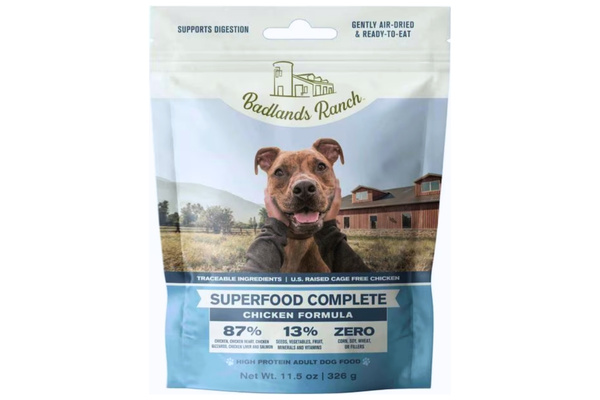
Badlands Ranch makes a bold claim: 87% meat, seafood, and organ content in its Superfood Complete line. That’s significantly higher than most kibbles, which often rely heavily on grains, legumes, or other fillers to bulk up the bag. The protein sources vary by recipe—beef, chicken, bison, lamb, venison, salmon, whitefish, turkey—and each formula includes organ meats like beef heart, liver, and tripe.
Organ meats are nutrient-dense and provide vitamins, minerals, and amino acids that muscle meat alone doesn’t deliver. Including them is a smart move nutritionally, and it’s something you see more often in premium brands. The meat is listed as fresh or freeze-dried, not rendered into meal, which generally means higher moisture content and less processing before it reaches the bag.
The freeze-dried Superfood Nuggets, positioned as meal toppers or treats, push meat content even higher—around 90% or more, depending on the flavor. These are essentially pure protein with minimal carbohydrate or filler, making them a good option for boosting palatability or protein intake without adding bulk.
All Badlands Ranch formulas are grain-free, relying instead on sweet potatoes and pumpkin as primary carbohydrate sources. Both are nutrient-dense, provide soluble and insoluble fiber, and are generally well-tolerated by dogs with grain sensitivities. Fiber content sits around 5%, which is moderate and appropriate for most adult dogs.
Pumpkin, in particular, is a functional ingredient. It supports digestive health, helps regulate stool consistency, and provides beta-carotene and other antioxidants. Sweet potatoes offer slow-releasing energy and additional vitamins. Neither ingredient is a cheap filler, and both contribute meaningfully to the nutritional profile.
That said, grain-free doesn’t automatically mean better. The link between grain-free diets and dilated cardiomyopathy (DCM) in dogs has been studied extensively, with mixed conclusions. Badlands Ranch includes taurine-rich organ meats and omega-3 sources, which may mitigate some risk, but the brand doesn’t make specific claims about DCM prevention. If your dog has a known heart condition or breed predisposition, it’s worth discussing grain-free diets with your vet before switching.
The “superfood” angle is central to Badlands Ranch’s marketing, and the ingredient list backs it up—at least on paper. Chia seeds, blueberries, flaxseed, salmon oil, spinach, and carrots all appear across formulas. These ingredients bring omega-3 fatty acids, antioxidants, fiber, and micronutrients that support skin, coat, immune function, and overall vitality.
Chia seeds, for example, are rich in omega-3s and provide a plant-based source of alpha-linolenic acid (ALA). Flaxseed offers similar benefits. Blueberries are packed with antioxidants that combat oxidative stress. Salmon oil delivers EPA and DHA, the omega-3 fatty acids most directly beneficial for dogs.
The practical question is whether these ingredients are present in meaningful amounts or just sprinkled in for marketing appeal. Badlands Ranch doesn’t publish exact quantities or percentages for individual superfoods, so it’s hard to know if your dog is getting a therapeutic dose or a token amount. Based on the overall ingredient list and guaranteed analysis, I’d estimate the inclusion levels are moderate—enough to contribute to the nutritional profile, but not enough to replace targeted supplementation if your dog has specific health needs.
Badlands Ranch uses natural preservatives—tocopherols (vitamin E) and rosemary extract—to maintain freshness. No artificial preservatives, colors, or flavors appear on the ingredient list. Air-drying also acts as a preservation method, reducing moisture content to a level that inhibits bacterial growth without requiring chemical stabilizers.
The ingredient list is short and readable. You won’t find vague terms like “animal fat” or “meat by-product meal.” Everything is clearly identified, which is a refreshing change from brands that bury questionable ingredients under generic labels.
One minor note: the air-drying process, while gentler than high-heat extrusion, still involves some heat. It’s not raw feeding, and it’s not freeze-drying (which Badlands Ranch reserves for its Nuggets line). Air-drying strikes a middle ground—less processed than kibble, more convenient than raw, and still nutrient-preserving. It’s a solid approach, though not without trade-offs in texture and shelf life compared to fully dehydrated or freeze-dried options.
There are no glaring red flags in the ingredient list—no corn, soy, wheat, artificial colors, or unnamed by-products. The grain-free formulation will concern some owners given the DCM conversation, but as mentioned, Badlands Ranch includes taurine-rich organ meats and omega-3 sources that may help mitigate risk.
One potential concern for dogs with multiple protein sensitivities is that most formulas include several protein sources. The Bison & Beef recipe, for example, also includes salmon. If your dog has a confirmed allergy to fish, you’d need to avoid that formula even if bison and beef are fine. For true elimination diets or dogs with severe allergies, a single-protein, limited-ingredient formula from another brand might be a better fit.
Badlands Ranch Superfood Complete delivers 30-38% protein (dry matter basis), depending on the recipe. The Bison & Beef formula sits at the higher end, while Chicken and Wild Fish & Turkey are slightly lower. Fat content ranges from 14-18%, which is moderate to moderately high. Fiber holds steady around 5%, and estimated carbohydrate content falls between 25-35%.
For comparison, AAFCO minimum standards for adult maintenance are 18% protein and 5.5% fat (dry matter). Badlands Ranch exceeds those minimums comfortably, which is what you’d expect from a premium brand. The protein-to-fat ratio is well-balanced for most adult dogs, providing energy without tipping into excessively high-fat territory that can trigger pancreatitis in sensitive dogs.
Caloric density sits around 4,200-4,500 kcal/kg, which is higher than many kibbles but typical for air-dried foods. The higher calorie concentration means you’ll feed less by volume, which can offset some of the sticker shock when you see the per-pound price. A 60-pound dog might eat around 8 ounces per day, translating to roughly $10-12 in daily feeding costs at the 3.5-pound bag price.
Omega-3 and omega-6 fatty acids come from salmon oil, flaxseed, and chia seeds. The brand doesn’t publish exact omega-3:omega-6 ratios, but the inclusion of multiple sources suggests a reasonable balance. Omega-3s support skin and coat health, reduce inflammation, and contribute to cognitive function, especially in senior dogs.
Antioxidants come primarily from blueberries, spinach, and other plant-based ingredients. These compounds help combat oxidative stress and support immune function. Again, exact quantities aren’t disclosed, so it’s hard to say whether the antioxidant load is therapeutic or just adequate.
Vitamin and mineral supplementation is included to meet AAFCO standards. The label lists a proprietary blend, but detailed breakdowns aren’t published. This is standard practice for most dog food brands, though it does limit transparency for owners who want to know exact levels of, say, calcium or phosphorus for a dog with specific health needs.
Badlands Ranch formulas are formulated to meet AAFCO nutrient profiles for all life stages. This means the recipes, on paper, provide complete and balanced nutrition for puppies, adults, and seniors. However, the brand hasn’t published results from AAFCO feeding trials—the gold standard for demonstrating nutritional adequacy in real-world conditions.
Formulation-based compliance is less rigorous than feeding trials. It confirms the recipe meets minimum nutrient levels but doesn’t verify digestibility, bioavailability, or long-term health outcomes. Most premium brands rely on formulation rather than trials, so Badlands Ranch isn’t an outlier here, but it’s worth noting if you’re comparing brands that have invested in feeding trial data.
No published digestibility studies exist for Badlands Ranch, so we’re working with educated inference rather than hard data. Air-drying preserves more nutrients than high-heat extrusion, and the high meat content suggests strong biological value—a measure of how efficiently a dog’s body can use the protein provided.
Customer reviews frequently mention smaller, firmer stools, which is a practical indicator of good digestibility. When a dog absorbs more nutrients from the food, less waste passes through. The inclusion of organ meats, which are highly bioavailable, further supports the idea that Badlands Ranch is efficiently utilized by the body.
That said, without published digestibility coefficients or amino acid profiles, I can’t give you precise numbers. What I can say is that the formulation and processing method are consistent with above-average digestibility compared to standard kibble.
Badlands Ranch works particularly well for picky eaters. The air-dried texture and high meat content make it more palatable than many kibbles, and customer reviews consistently mention dogs who refused other foods suddenly eating enthusiastically. If you’ve cycled through multiple brands without success, this is a strong candidate to try.
Dogs with mild grain sensitivities or owners who prefer grain-free diets for philosophical reasons will find Badlands Ranch a good fit. The sweet potato and pumpkin base is gentle on digestion, and the lack of common allergens like corn, wheat, and soy reduces the risk of adverse reactions.
For small to medium-sized dogs, the cost per day is more manageable than for large breeds. A 10-pound dog might eat 2 ounces per day, translating to around $2.50-3 in feeding costs. That’s expensive, but not prohibitively so for owners who prioritize ingredient quality.
Senior dogs with dental issues or reduced appetite can benefit from the softer texture of air-dried food. You can also add water to soften it further, making it easier to chew and swallow. The nutrient density means older dogs with smaller appetites still get adequate nutrition in smaller volumes.
Active adult dogs with high energy needs will do well on the higher protein and fat content, especially with the Bison & Beef formula. The calorie density supports sustained energy without requiring large meal volumes.
Large and giant breed owners face a tough value proposition. A 100-pound dog might eat 12 ounces per day, costing $14-16 daily or $400-500 per month. At that price point, you’re competing with fresh food delivery services that offer similar or better nutritional profiles with more customization. Unless budget is no concern, this is hard to justify for large breeds.
Dogs with confirmed heart conditions or breed predispositions to DCM should approach grain-free diets cautiously. While Badlands Ranch includes taurine-rich organ meats, the grain-free formulation still warrants a conversation with your vet. If your dog is a golden retriever, Doberman, or another breed at higher DCM risk, consider whether grain-inclusive options might be safer.
For dogs with severe food allergies or multiple protein sensitivities, the multi-protein formulas pose a challenge. If your dog reacts to chicken, beef, and salmon, finding a Badlands Ranch recipe that works becomes difficult. Limited-ingredient, single-protein diets from brands like Natural Balance or ACANA Singles would be a better fit.
Owners seeking prescription or veterinary diets won’t find what they need here. Badlands Ranch doesn’t offer formulas for kidney disease, liver disease, urinary health, or other medical conditions. For those needs, you’ll need to stick with Royal Canin, Hill’s, or Purina Pro Plan Veterinary Diets.
If you’re on a tight budget or need to stretch every dollar, this isn’t the brand for you. There are plenty of good-quality, mid-range options—Blue Buffalo, Nutro, Wellness—that offer solid nutrition at half the price. Badlands Ranch is a premium product with premium pricing, and trying to make it fit a budget it wasn’t designed for will only lead to frustration.
Take the free nutrition check and find out in under 1 minute which food is best tailored to your dog!
In just 60 seconds, find out which food fits your dog best — for free.
Badlands Ranch scores high on palatability. The air-dried texture and high meat content create a treat-like appeal that many dogs find irresistible. Customer reviews frequently mention dogs who refused other foods suddenly eating enthusiastically, and the term “picky eater approved” shows up repeatedly.
Beef appears to be the most universally accepted flavor. Chicken runs a close second. The Bison & Beef formula, as the newest addition, has garnered positive early feedback for both taste and digestibility. Salmon-based recipes tend to be more polarizing—some dogs love them, others turn their noses up. If your dog has never had fish-based food before, start with a small bag to test acceptance before committing to a larger purchase.
The freeze-dried Superfood Nuggets are even more palatable, which makes sense given their higher meat concentration. Many owners use them as meal toppers to boost the appeal of other foods or as high-value training treats. At $50 per pound, they’re expensive for everyday use, but as a supplement or special-occasion treat, they’re effective.
Air-dried food has a distinct texture—somewhere between jerky and kibble. The chunks are semi-moist, moderately soft, and easy to break apart for small dogs or puppies. Unlike crunchy kibble, they don’t require much chewing, which is a plus for dogs with dental issues or older dogs with weaker jaws.
You can add water to soften the food further, creating a more stew-like consistency. This is helpful for dogs transitioning from wet food or seniors who prefer softer textures. The food absorbs water well without turning mushy, maintaining some structure even when rehydrated.
Portion sizes are smaller than kibble due to the higher calorie density. That means less bulk in the bowl, which some dogs adjust to easily and others find unsatisfying. If your dog is used to eating large volumes and seems hungry after meals, you might need to add a low-calorie supplement like green beans or pumpkin puree to increase satiety without overfeeding.
As with any food switch, a gradual transition is important. Start by mixing a small amount of Badlands Ranch with your dog’s current food—around 25% new to 75% old for the first few days. Increase the ratio gradually over 7-10 days until you’re feeding 100% Badlands Ranch.
Some dogs with sensitive stomachs may need a slower transition, especially if they’re moving from a low-quality kibble with lots of fillers. Digestive upset during transitions is common and usually temporary, but if diarrhea or vomiting persists beyond a few days, slow down the transition or consult your vet.
Badlands Ranch Superfood Complete costs roughly $20 per pound in the 3.5-pound bag, which is the most economical size. Smaller 1.5-pound bags run closer to $26-28 per pound, making them less cost-effective for anything beyond trial purposes. Freeze-dried Nuggets hit $50 per pound, which is steep even by premium standards.
Daily feeding costs vary significantly by dog size. A 10-pound dog eats around 2 ounces per day, costing $2.50-3. A 30-pound dog eats 4.5 ounces, costing $6-7. A 60-pound dog eats 8 ounces, costing $10-12. A 100-pound dog eats 12 ounces, costing $14-16. For large breeds, those numbers add up fast—potentially $400-500 per month.
Within the air-dried and freeze-dried segment, Badlands Ranch is competitively priced. Sundays for Dogs runs $20-30 per pound. Stella & Chewy’s freeze-dried formulas hit $25-40 per pound. Ziwi Peak, another air-dried option, often exceeds $30 per pound. In that context, Badlands Ranch sits in the middle of the premium pack.
Compared to fresh food delivery services like The Farmer’s Dog or Nom Nom, Badlands Ranch is slightly more expensive per calorie but doesn’t require freezer space or meal prep. Fresh food services for a 60-pound dog run $180-250 per month, depending on the plan. Badlands Ranch for the same dog would be $300-350 per month. The convenience of shelf-stable food partially offsets the higher cost, but it’s still a meaningful difference.
Against mid-range kibbles like Blue Buffalo or Nutro, Badlands Ranch is 3-5 times more expensive. Those brands cost $2.50-5 per pound and deliver solid nutrition for most dogs. If your dog doesn’t have specific health issues or pickiness problems, it’s hard to argue that Badlands Ranch offers 3-5 times the value. The ingredient quality is better, yes, but the nutritional outcomes for a healthy dog on a good kibble versus Badlands Ranch may not be dramatically different.
Not sure whether to choose Badlands Ranch or a veterinary-backed brand? Read our other review on Royal Canin dog food to see how science-driven formulas compare to superfood-focused options.
Value isn’t just about price—it’s about what you get for your money. Badlands Ranch delivers high ingredient quality, strong palatability, and good digestibility. For dogs with pickiness, mild allergies, or digestive issues, the premium may be justified by reduced vet visits, fewer wasted bags of refused food, and improved quality of life.
For healthy dogs without specific issues, the value proposition is weaker. A well-formulated mid-range kibble will meet their nutritional needs just fine, and the extra cost of Badlands Ranch buys marginal improvements rather than transformative ones.
If budget is a concern, consider using Badlands Ranch as a meal topper or rotational food rather than a sole diet. Mix it 50/50 with a quality kibble to stretch your dollar while still giving your dog the benefits of higher meat content and better ingredients. This approach cuts costs roughly in half while maintaining most of the nutritional advantages.
Badlands Ranch uses a “low and slow” air-drying process designed to preserve nutrients while reducing moisture content for shelf stability. Air-drying operates at lower temperatures than kibble extrusion, which minimizes nutrient degradation from heat. The process also concentrates flavors, contributing to the food’s strong palatability.
The freeze-dried Nuggets undergo a different process—freeze-drying, which removes moisture through sublimation (turning ice directly into vapor). This preserves even more nutrients and flavor than air-drying but requires more energy and produces a more fragile product. It’s a premium method reserved for high-value items like toppers and treats.
Badlands Ranch doesn’t publicly disclose factory locations or contract manufacturers, which is a transparency gap. The company is headquartered in California, and production is stated to be in the USA, but without specific facility names or locations, it’s hard to verify claims about small-batch production or quality control rigor.
Badlands Ranch has a clean recall history—no FDA warnings, no product withdrawals, no contamination incidents since launch in 2022. That’s a strong safety record, though it’s worth noting the brand is still young. Many recalls surface years into a brand’s life as production scales and supply chain complexity increases.
The company claims rigorous quality control, including testing for pathogens and contaminants, but doesn’t publish third-party audit results, HACCP certification, or independent lab analyses. For a brand that emphasizes transparency, this is a noticeable omission. Brands like Open Farm and The Honest Kitchen publish detailed sourcing and testing information; Badlands Ranch could strengthen trust by following suit.
Packaging uses resealable pouches, which help maintain freshness after opening. The bags are plastic, not particularly eco-friendly, but they’re functional and protect the product adequately. No widespread complaints about rancid or off-smelling product have surfaced, suggesting the packaging and preservation methods are effective.
Badlands Ranch emphasizes humanely raised meats and ethical sourcing, but specifics are limited. The company doesn’t publish farm names, certifications, or third-party audits verifying humane treatment. This is common in the pet food industry, but it’s also a missed opportunity for a brand built on ethical values.
The use of organ meats and whole-animal utilization is a sustainability positive. By incorporating parts of the animal that might otherwise go to waste, Badlands Ranch reduces the environmental footprint per pound of meat. This is more efficient than relying solely on muscle meat and throwing away nutrient-dense organs.
Badlands Ranch makes general claims about sustainable practices but doesn’t publish carbon footprint data, water usage metrics, or detailed environmental reports. For a brand marketing itself on ethical responsibility, this is a gap. Competitors like Open Farm and Jiminy’s provide transparent sustainability reporting; Badlands Ranch could do the same.
Packaging is functional but not eco-friendly. Plastic pouches are convenient and protect the product, but they’re not recyclable in most municipal programs. The brand could explore compostable or recyclable alternatives, especially given the premium positioning and values-driven customer base.
The $250,000 annual donation to the Jason Debus Heigl Foundation is a meaningful commitment. The foundation supports animal rescue, spay-neuter programs, and adoption initiatives, which aligns well with the brand’s mission. For customers who care about supporting brands that give back, this is a clear positive.
Katherine Heigl’s personal involvement and public advocacy lend credibility to the brand’s ethical claims. Her reputation and track record in animal welfare make it unlikely the brand would cut corners on ingredient quality or animal treatment, even if detailed documentation isn’t always public.
I tested Badlands Ranch Superfood Complete at the shelter where I volunteer, using a dog named Rosie—a four-year-old mixed breed (possibly Lab and hound) who’d been with us for about six weeks. Rosie didn’t have any major health issues, but she was a notoriously picky eater. We’d cycled through three different kibbles trying to find something she’d eat consistently, and most days she’d pick at her food and leave half the bowl untouched. It was frustrating because she wasn’t underweight, but we wanted her to eat reliably before placing her in a home.
We transitioned Rosie to Badlands Ranch over about a week, mixing it gradually with her current kibble. The first thing I noticed was her immediate interest. She sniffed the bowl more intently than usual and ate the entire portion without hesitation. By day three, when the mix was about half Badlands Ranch, she was consistently finishing meals and even licking the bowl clean—something she’d never done before.
Over the next two weeks, I kept an eye on her overall condition. Her stools firmed up noticeably, which was a practical improvement since she’d had occasional loose stools on the previous kibble. They were also smaller, which made cleanup easier and suggested she was digesting more of what she ate. Her coat, which had been a bit dull and flaky, started looking shinier and felt softer to the touch. Nothing dramatic, but a visible difference.
Energy-wise, Rosie seemed about the same—playful during yard time, calm in her kennel. She didn’t suddenly turn into a different dog, but she did seem a bit more engaged during interactions, which I chalked up to feeling better overall. She wasn’t scratching as much, either, which had been a minor issue before.
The most striking change was her enthusiasm at mealtimes. Rosie went from a dog who needed coaxing to eat to one who got excited when she saw her bowl. For a shelter environment, where stress and uncertainty can suppress appetite, that’s a meaningful shift. It made her more adoptable, too—potential adopters noticed she ate well and seemed content, which are good signs of a healthy, well-adjusted dog.
I can’t say Badlands Ranch solved problems Rosie didn’t have, but it clearly worked better for her than the previous foods. Whether that’s due to the higher meat content, the air-dried texture, or just personal preference, I don’t know. What I do know is that she ate consistently, her digestion improved, and she looked healthier by the end of the trial. For a picky eater like Rosie, that’s a win.
Take the free nutrition check and find out in under 1 minute which food is best tailored to your dog!
In just 60 seconds, find out which food fits your dog best — for free.
Customer reviews for Badlands Ranch are overwhelmingly positive, with average ratings around 4.3-4.8 stars across major platforms like Chewy, Amazon, and the brand’s own site. The most common themes are improved palatability, better digestion, and visible coat improvements.
Many owners mention their dogs refusing other foods but eating Badlands Ranch enthusiastically. This is particularly common among small breeds and senior dogs, who tend to be pickier. One recurring comment is that the food smells and looks like real food, which makes owners feel better about what they’re feeding.
Digestive improvements—firmer stools, less gas, reduced bloating—are frequently cited. Some owners report that dogs with chronic loose stools or sensitivity to other foods did much better on Badlands Ranch. The grain-free formulation seems to help dogs with mild grain sensitivities, though a few reviews mention initial digestive upset during the transition period.
Coat and skin improvements show up in about a third of reviews. Owners describe shinier coats, less shedding, and reduced itching. These changes typically appear after 3-5 weeks of consistent feeding, which aligns with the time it takes for dietary changes to affect skin and coat health.
Energy and vitality improvements are mentioned less frequently but still noteworthy. Some owners of senior dogs report their pets seeming more playful and alert after switching, though it’s hard to separate the effects of better nutrition from the placebo effect of an engaged, hopeful owner.
Negative reviews are less common but worth considering. The most frequent complaints are price and palatability issues. A small percentage of dogs simply don’t like the food, even after a gradual transition. A few owners report digestive upset—diarrhea, vomiting, or excessive gas—especially during the first week. This is typical with any food change, but it’s something to watch for.
A handful of reviews mention batch inconsistency—food smelling different or looking different from one bag to the next. This is concerning, though it doesn’t appear to be widespread. One or two reviews mention receiving bags that seemed off or rancid, but customer service reportedly handled refunds and replacements promptly.
No patterns of serious health issues emerge from user reviews. There are no clusters of reports linking the food to pancreatitis, DCM, or other conditions, which is reassuring. A few owners mention their dogs gaining weight, but this is usually attributed to overfeeding rather than the food itself.
Overall, the user experience data supports the brand’s claims. Most dogs eat it well, digest it well, and show visible improvements in coat and stool quality. The main barriers are cost and the small percentage of dogs who simply don’t accept the food. If your dog falls into the majority, you’ll likely be happy with the results. If your dog is one of the few who refuses it, you’re out $40-70 for a trial bag, which is a painful but manageable risk.
Badlands Ranch and Royal Canin operate in completely different segments of the market, so comparing them directly is a bit like comparing a boutique bakery to a national grocery chain—they’re both food, but they serve different needs and audiences.
Royal Canin is a science-driven, veterinary-backed brand with over 200 formulas covering every life stage, breed size, and health condition imaginable. It’s owned by Mars Petcare, has a massive global footprint, and is the go-to recommendation for vets dealing with specific medical issues. Royal Canin’s strength is customization and clinical validation. If your dog has kidney disease, digestive issues, or breed-specific health risks, Royal Canin probably has a formula designed for that.
Badlands Ranch, by contrast, is a boutique brand focused on clean ingredients and minimal processing. It has two product lines—air-dried Superfood Complete and freeze-dried Nuggets—and no breed-specific, life-stage-specific, or medical formulas. The appeal is simplicity, transparency, and ingredient quality, not scientific customization.
Ingredient-wise, Badlands Ranch wins on meat content and whole-food sourcing. Royal Canin formulas often include grains, by-products, and synthesized nutrients, which some owners see as less desirable. However, Royal Canin’s formulations are backed by decades of research and feeding trials, so the ingredient list—while less Instagram-friendly—is scientifically sound.
Price is another major difference. Royal Canin’s standard formulas cost $3-4 per pound, while prescription diets run $4-7 per pound. Badlands Ranch costs $20 per pound. For a 60-pound dog, that’s the difference between $100-150 per month (Royal Canin) and $300-350 per month (Badlands Ranch). The cost gap is substantial, and it’s hard to justify unless your dog has specific issues that Badlands Ranch addresses and Royal Canin doesn’t.
For picky eaters or dogs with mild sensitivities, Badlands Ranch is likely the better choice. The palatability is higher, the ingredients are cleaner, and the grain-free formulation works well for dogs who don’t tolerate grains. For dogs with diagnosed health conditions—kidney disease, food allergies requiring hydrolyzed protein, joint issues needing specific nutrient ratios—Royal Canin is the clear winner. The medical formulas are unmatched, and the clinical backing gives you confidence you’re managing the condition appropriately.
In short: Badlands Ranch is for owners who prioritize ingredient quality and are willing to pay for it. Royal Canin is for owners who prioritize scientific validation and need targeted nutrition for specific health issues. Both are good at what they do, but they’re solving different problems.
Take the free nutrition check and find out in under 1 minute which food is best tailored to your dog!
In just 60 seconds, find out which food fits your dog best — for free.
Badlands Ranch works best for picky eaters, small to medium-sized dogs, and those with mild grain sensitivities. The air-dried texture and high meat content make it highly palatable, which is a game-changer for dogs who turn their noses up at kibble. If you’ve struggled to find a food your dog will eat consistently, this is worth trying.
For adult dogs with no specific health issues, Badlands Ranch provides solid, well-balanced nutrition. The protein and fat levels support active dogs, and the calorie density means you’re feeding smaller portions than you would with kibble. That’s convenient and reduces the risk of overfeeding.
Senior dogs with dental issues or reduced appetite can benefit from the softer texture and strong flavor. Adding water makes it even easier to eat, and the nutrient density ensures older dogs with smaller appetites still get adequate nutrition.
Puppies can technically eat Badlands Ranch, as it’s formulated to meet AAFCO standards for all life stages. However, I’d hesitate to recommend it as a sole diet for large-breed puppies, who need carefully controlled calcium and phosphorus levels to prevent developmental orthopedic issues. The brand doesn’t publish specific calcium-to-phosphorus ratios, so without that data, I’d lean toward a puppy-specific formula from a brand with more detailed life-stage customization.
For large and giant breeds, the cost is the main barrier. A 100-pound dog eating Badlands Ranch will cost you $400-500 per month, which is tough to justify unless you have a specific reason (extreme pickiness, severe allergies) that makes the premium worthwhile. Fresh food delivery services or high-quality kibbles offer better value at that size.
Dogs with multiple protein allergies or severe food sensitivities may struggle with Badlands Ranch’s multi-protein formulas. If your dog reacts to chicken, beef, and fish, finding a safe recipe becomes difficult. Limited-ingredient, single-protein diets from other brands would be a better fit.
For dogs with diagnosed medical conditions—kidney disease, liver disease, heart disease, urinary issues—Badlands Ranch isn’t appropriate. You need a veterinary diet formulated for that specific condition, and Badlands Ranch doesn’t offer those. Stick with Royal Canin, Hill’s, or Purina Pro Plan Veterinary Diets for medical management.
Yes, Badlands Ranch is a good dog food—but with important caveats about price and fit.
The ingredient quality is excellent. The 87% meat content, inclusion of organ meats, and use of whole-food superfoods like chia seeds, blueberries, and pumpkin create a nutrient-dense, highly digestible formula. The air-drying process preserves more nutrients than high-heat kibble extrusion, and the lack of grains, fillers, and artificial preservatives aligns with what many health-conscious owners want to feed.
Palatability is a standout strength. If your dog is picky or has refused other foods, Badlands Ranch has a strong track record of winning over reluctant eaters. The treat-like texture and strong flavor make it appealing, and customer reviews consistently mention dogs eating enthusiastically after switching.
Digestibility is above average. Smaller, firmer stools, reduced gas, and fewer digestive complaints suggest the food is efficiently absorbed. The grain-free formulation works well for dogs with mild grain sensitivities, and the inclusion of pumpkin and sweet potato supports gut health.
The clean safety record—no recalls, no FDA warnings—is reassuring, though the brand is still young. Transparency around ingredients and nutritional philosophy is strong, though gaps remain in factory disclosure and third-party certification.
Now, the caveats. The price is steep. At $20 per pound, Badlands Ranch is one of the most expensive options in the premium segment. For small dogs, that’s manageable. For large breeds, it’s hard to justify unless your dog has specific issues that make the premium worthwhile. You’re paying for ingredient quality and processing method, which deliver real benefits, but the value calculation depends heavily on your dog’s size and needs.
For healthy dogs without pickiness or sensitivities, the marginal improvement over a good mid-range kibble may not justify the cost. Blue Buffalo, Nutro, and Wellness offer solid nutrition at half the price. Badlands Ranch is better, but it’s not three times better, which is what the price difference suggests.
For picky eaters, dogs with mild grain sensitivities, or owners who prioritize ingredient transparency and minimal processing, Badlands Ranch is worth the investment. The improvements in palatability, digestion, and coat quality often outweigh the cost, and the peace of mind from knowing exactly what’s in the food has value.
Would I buy this for my own dog? If I had a small to medium-sized dog with pickiness or digestive issues, yes. If I had a large, healthy dog with no specific problems, probably not—I’d choose a high-quality kibble or fresh food service with better value. If I had a dog with a diagnosed medical condition, definitely not—I’d use a veterinary diet designed for that condition.
Would I recommend it to a friend? That depends on the friend’s dog and budget. For someone struggling with a picky eater and willing to pay for results, absolutely. For someone on a budget or feeding a large breed, I’d point them toward more cost-effective options.
Badlands Ranch is a premium product that delivers on its promises—high ingredient quality, strong palatability, good digestibility, and a clean safety record. It’s not for everyone, and it’s not the best value for every dog, but for the right fit, it’s an excellent choice. Just make sure you’re one of those right fits before committing to the price.
Take the free nutrition check and find out in under 1 minute which food is best tailored to your dog!
In just 60 seconds, find out which food fits your dog best — for free.
Daily feeding costs depend on your dog’s size. A 10-pound dog costs about $2.50-3 per day, a 30-pound dog costs $6-7 per day, a 60-pound dog costs $10-12 per day, and a 100-pound dog costs $14-16 per day. These calculations are based on the 3.5-pound bag price of roughly $20 per pound. Large breed owners often find the cost prohibitive at $400-500 per month.
Yes, Badlands Ranch excels with picky eaters. The air-dried texture and 87% meat content create a treat-like appeal that most dogs find irresistible. Customer reviews consistently mention dogs who refused other foods suddenly eating enthusiastically. The high palatability is one of the brand’s strongest advantages, especially for small breeds and senior dogs who tend to be more selective.
Badlands Ranch is formulated to meet AAFCO standards for all life stages, so it’s technically suitable for puppies. However, I’d hesitate to recommend it as a sole diet for large-breed puppies, who need carefully controlled calcium and phosphorus levels to prevent developmental issues. The brand doesn’t publish specific calcium-to-phosphorus ratios, so a puppy-specific formula might be safer for larger breeds.
Many owners report digestive improvements, including firmer stools, less gas, and reduced bloating. The grain-free formulation with sweet potato and pumpkin base is gentle on digestion, and the air-dried processing preserves nutrients that support gut health. However, some dogs may experience temporary digestive upset during the transition period, which is normal with any food change.
The grain-free formulation has raised concerns about dilated cardiomyopathy (DCM) in some dogs. Badlands Ranch includes taurine-rich organ meats and omega-3 sources that may help mitigate risk, but dogs with confirmed heart conditions or breed predispositions to DCM should discuss grain-free diets with their veterinarian before switching.
Fresh food services like The Farmer’s Dog cost $180-250 per month for a 60-pound dog, while Badlands Ranch costs $300-350 per month for the same size dog. Fresh food offers more customization and potentially better nutritional profiles, but Badlands Ranch provides convenience with shelf-stable storage and no meal prep requirements. The choice depends on whether you prioritize cost and customization or convenience.
Absolutely. Using Badlands Ranch as a meal topper or rotational food is a cost-effective way to provide the benefits of high meat content and quality ingredients. Mix it 50/50 with a quality kibble to cut costs roughly in half while maintaining most nutritional advantages. The freeze-dried Nuggets work particularly well as toppers, though they’re more expensive at $50 per pound.
Badlands Ranch uses natural preservatives (tocopherols and rosemary extract) and air-drying for preservation. The food comes in resealable pouches that help maintain freshness after opening. Store in a cool, dry place and seal the bag tightly after each use. The brand doesn’t publish specific expiration timeframes, but air-dried foods typically have a shorter shelf life than traditional kibble once opened.
It depends on the specific allergies. Badlands Ranch is grain-free and doesn’t contain corn, soy, wheat, or artificial additives, which helps dogs with those sensitivities. However, most formulas contain multiple protein sources (for example, the Bison & Beef recipe also includes salmon), which can be problematic for dogs with multiple protein allergies. Dogs requiring true elimination diets might need single-protein, limited-ingredient formulas from other brands.
Badlands Ranch has a clean safety record since launching in 2022—no recalls, no FDA warnings, no major contamination incidents. However, the brand is still young at three years old, and many safety issues surface later as production scales. A few customer reviews mention batch inconsistency or off-smelling product, but these appear to be isolated incidents handled promptly by customer service.
Take the free nutrition check and find out in under 1 minute which food is best tailored to your dog!
In just 60 seconds, find out which food fits your dog best — for free.
9 out of 10 dog owners are feeding their dog the wrong food.
Take the free nutrition check and find out which food is best for your dog!
2,847+ dog owners already did