9 out of 10 dog owners are feeding their dog the wrong food

Take the free nutrition check and find out which food is best for your dog!

Shelter manager, certified canine nutritionist, and lifelong dog lover
• Mid-range positioning with clean ingredients: Whole Earth Farms delivers real meat first, no corn/wheat/artificial additives, at $3.00-$3.50 per pound—significantly cheaper than premium brands while maintaining ingredient quality standards.
• Spotless safety record but limited transparency: Zero recalls since 2009 launch and consistent Texas manufacturing, but lacks published digestibility data, ingredient traceability, or third-party lab analysis that premium competitors provide.
• Mixed palatability results with recent concerns: Most dogs accept the food well, but some owners report refusal or digestive issues after recent formula changes that the company hasn’t clearly communicated.
• Best suited for healthy, moderate-activity dogs: Provides adequate nutrition for typical adult dogs but insufficient protein/calories for high-performance animals and lacks therapeutic formulas for dogs with health conditions.
• Strong value proposition in competitive landscape: Delivers 90% of premium food benefits at 60% of the cost, outperforming similarly-priced competitors like Taste of the Wild on safety record.
Take the free nutrition check and find out in under 1 minute which food is best tailored to your dog!
Whole Earth Farms launched in 2009 as Merrick Pet Care’s answer to budget-conscious owners who still wanted natural, recognizable ingredients without the premium price tag. The brand’s tagline—”all the goodness from the earth at a great value”—sums up its positioning: accessible nutrition that skips artificial colors, flavors, preservatives, and controversial fillers like corn, wheat, soy, and by-product meals.
When Nestlé Purina acquired Merrick in 2015, some owners worried the recipes would change or quality would slip. So far, that hasn’t happened. Production stayed in Texas, formulas remained largely intact, and the brand kept its focus on grain-free and grain-inclusive options that appeal to health-aware pet parents on a mid-range budget. There’s no flashy mission statement or sustainability manifesto—Whole Earth Farms keeps things straightforward and lets the ingredient list do the talking.
The brand’s reputation is solid but not spectacular. You won’t find veterinary endorsements, published feeding trials, or farm-level ingredient traceability. What you will find is a clean recall history (zero since launch), consistent availability at major retailers like Chewy and Petco, and a loyal base of owners who appreciate the balance between quality and cost. If you’re looking for a brand that feels premium without the luxury markup, Whole Earth Farms is designed for exactly that.
Whole Earth Farms uses meat meals—chicken meal, pork meal, salmon meal—as the first ingredient in most dry recipes. Meat meals are concentrated protein sources; they’ve had moisture removed, so they pack more protein per pound than fresh meat. That’s not necessarily a bad thing, but it does mean you’re getting a processed ingredient rather than whole cuts. Further down the list, you’ll see real chicken, turkey, or pork, which adds some whole-meat appeal but contributes less overall protein once moisture is accounted for.
The wet food formulas flip the script: real meat comes first, often with organ meats and broth for flavor and nutrition. If you’re mixing wet and dry, you’re getting a more varied protein profile, which I think is a smart move for most dogs.
Grain-free recipes lean on potatoes, peas, and sweet potatoes. These are common in natural dog foods, and while they’re not inherently problematic, the heavy use of legumes has raised questions about potential links to dilated cardiomyopathy (DCM) in some dogs. The FDA investigated this concern across many brands using high legume content, and while no definitive cause was established, it’s something to keep in mind if your dog has a predisposition to heart issues.
The grain-inclusive line uses brown rice and barley, which are gentler on digestion for dogs who tolerate grains well. If your dog doesn’t have a grain sensitivity, these recipes can offer steadier energy and less reliance on legumes.
Chicken fat and flaxseed provide the fat content, along with some salmon oil in certain recipes. These deliver omega-3 and omega-6 fatty acids for coat health and inflammation control. The fat levels sit around 13–14%, which is moderate—not too lean, not overly rich. For most adult dogs, that’s a comfortable middle ground.
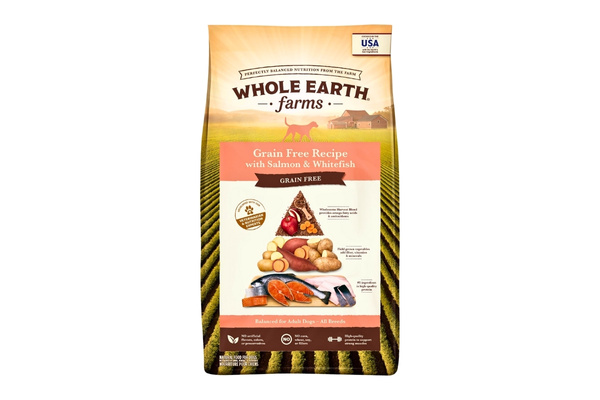
Whole Earth Farms includes a Wholesome Harvest Blend—carrots, apples, flaxseed—along with probiotics like Lactobacillus plantarum for gut health. You’ll also find glucosamine and chondroitin in some formulas, particularly those aimed at seniors, though levels aren’t published. The vitamin and mineral premix covers the basics to meet AAFCO standards, but there’s nothing cutting-edge here—no novel probiotics, no hydrolyzed proteins, no exotic superfoods.
No corn, wheat, soy, by-product meals, or artificial preservatives. That’s a meaningful commitment for a mid-range brand, and it’s one of the reasons Whole Earth Farms has carved out a loyal following among owners who want cleaner labels without paying super-premium prices.
| Price per pound | $3.00 – $3.50 |
| Primary protein | Chicken meal, Pork meal, Salmon meal, Turkey, Pork, Lamb, Beef |
| By-products | None |
| AAFCO compliance | Yes (formulated to meet standards) |
| Formula options | Grain-free, Grain-inclusive, Puppy, Senior, Small breed, Wet food |
| Availability | Major retailers (Chewy, Petco) + online |
Take the free nutrition check and find out in under 1 minute which food is best tailored to your dog!
In just 60 seconds, find out which food fits your dog best — for free.
Whole Earth Farms dry food typically delivers around 26–28% protein and 13–14% fat on an as-fed basis. Convert that to dry matter, and you’re looking at roughly 30% protein and 15% fat—solid for maintenance and moderately active dogs, though not as high as performance or ultra-premium formulas that push 35% protein or more.
Carbohydrates land around 34–36% in grain-free recipes, which is about average for this category. Fiber sits at 3–4%, which supports healthy digestion without being overly bulky. Caloric density hovers around 3,500–3,650 kcal/kg for dry food, meaning you’ll feed moderate portions—not the smallest, not the largest—for most dogs.
The wet food is a different story: protein drops to 7–9% as-fed (around 30–40% dry matter), fat is 4–6%, and moisture is 78%. That’s typical for canned food, and the high moisture content makes it a good option for dogs who don’t drink enough water or need extra hydration.
All formulas are formulated to meet AAFCO Dog Food Nutrient Profiles for all life stages. That means they’re suitable for puppies, adults, and seniors based on nutrient ratios, though the brand does offer a specific puppy formula with slightly higher protein and DHA for brain and eye development.
What’s missing? Published digestibility data, amino acid profiles, and third-party lab analysis. You’re trusting the brand’s internal formulation team, which has veterinary input, but there’s no independent validation to confirm exactly what you’re getting in each bag.
Whole Earth Farms works well for adult dogs with moderate activity levels who don’t have extreme nutritional needs. If your dog is healthy, maintains a good weight, and doesn’t have food sensitivities beyond grains, this food will likely meet their needs without drama.
The grain-free recipes are a good fit for dogs with wheat or corn sensitivities, though true food allergies are rare. If your dog gets itchy or has loose stools on grain-inclusive foods, switching to the grain-free line is worth a shot. The pork, beef, and lamb blend offers variety if chicken doesn’t agree with your dog.
The small breed formula uses smaller kibble, which makes it easier for little mouths to chew and digest. If you have a Chihuahua or Yorkie who struggles with standard-size kibble, this is a practical option.
The puppy formula provides higher protein and fat, along with DHA for brain development. It’s a solid choice for growing dogs, though it’s not as calorie-dense as some performance puppy foods, so very active or large-breed puppies might need larger portions.
If your dog is a serious athlete—think working dogs, agility competitors, or hunting breeds in season—Whole Earth Farms may not provide enough calories or protein to sustain peak performance. You’d be better off with a higher-fat, higher-protein formula designed for active dogs.
Dogs with chronic health issues like kidney disease, pancreatitis, or severe allergies need prescription or therapeutic diets, which Whole Earth Farms doesn’t offer. This is maintenance food, not medicine.
If your dog has a documented sensitivity to legumes or you’re particularly concerned about DCM risk, the grain-free recipes may not be ideal. The grain-inclusive line reduces legume content, but you’d need to check the specific formula’s ingredient list to be sure.
Very picky eaters can be hit-or-miss. While many owners report their dogs love the food, there are enough complaints about refusal—especially after recent formula tweaks—that I wouldn’t call this a guaranteed win for finicky dogs.
Most dogs seem to enjoy Whole Earth Farms. The wet food, in particular, gets high marks for palatability—real meat, visible chunks, and a smell that actually resembles food rather than mystery mush. Owners frequently mention their dogs lick the bowl clean and show enthusiasm at mealtime.
The dry food is more of a mixed bag. Many dogs transition smoothly and eat it without fuss, but there’s a subset of reviews where owners say their dog refused the food or lost interest after a few weeks. Some of this seems tied to recent formula changes; a few customers noticed their dogs stopped eating the food after what appeared to be a recipe tweak, though the company hasn’t been particularly transparent about when or why changes occurred.
Flavor variety is limited compared to some brands. You’ve got chicken and turkey, pork and beef and lamb, and salmon and whitefish in the dry line, plus a few wet options. If your dog thrives on novelty, you might find the lineup a bit repetitive over time.
One practical note: some owners report the kibble can be hard and dry, especially in certain batches. If your dog is older or has dental issues, adding a bit of warm water to soften it can make a big difference.
Take the free nutrition check and find out in under 1 minute which food is best tailored to your dog!
In just 60 seconds, find out which food fits your dog best — for free.
Whole Earth Farms is priced around $3.00–$3.50 per pound for dry food, depending on bag size and where you buy. That’s less expensive than Blue Buffalo, Wellness Core, or Orijen, but more than Purina Pro Plan or basic Nutro recipes. For what you’re getting—real meat first, no artificial junk, grain-free options—it’s a fair deal.
Daily feeding cost for a 30-pound dog runs about $1.10–$1.20, assuming you’re feeding the recommended amount. A 10-pound dog will cost around 40 cents per day, while a 60-pound dog might run $2.00–$2.20. That’s middle-of-the-road for natural dog food and considerably cheaper than fresh or raw options.
The wet food is competitively priced at around $2.40 per can when bought in cases, which is on par with similar brands like Nutro or Merrick’s own wet lines. If you’re using it as a topper or occasional meal, it won’t break the bank.
Where Whole Earth Farms delivers real value is in the large bags. A 24-pound bag of grain-free kibble runs about $70–$75, which brings the per-pound cost down significantly. If you have a medium to large dog and storage space isn’t an issue, buying big makes sense.
Compared to competitors, Whole Earth Farms sits in a sweet spot. It’s not the cheapest option, but it’s also not trying to be. If you’re looking for natural ingredients without the luxury markup, this brand hits that target more reliably than most. Not sure whether to choose Whole Earth Farms or another premium option? Read our Koha dog food review to see how an ultra-premium limited-ingredient brand compares.
All Whole Earth Farms dog food is manufactured in the United States, primarily at Merrick’s facilities in Hereford and Amarillo, Texas. Production stayed in these plants even after Nestlé Purina acquired the brand in 2015, which is reassuring for owners who value domestic manufacturing.
The brand claims to use trusted ingredient sources from the U.S. and around the world, but there’s no published traceability. You won’t find details about which farms supply the chicken or where the sweet potatoes come from. For a mid-range brand, that’s not unusual, but it does mean you’re taking their word on ingredient quality rather than verifying it yourself.
Whole Earth Farms has a spotless recall history—zero recalls since launch in 2009. That’s a strong safety record, especially compared to brands that have dealt with contamination or mislabeling issues. The lack of recalls suggests solid quality control, though it’s worth noting that not having a recall doesn’t guarantee every batch is perfect.
There’s no public information about third-party certifications like ISO or HACCP specific to Whole Earth Farms. Merrick and Purina likely have these in place at the plant level, but the brand itself doesn’t advertise them. Similarly, there’s no published data on batch testing, digestibility trials, or independent lab analysis. You’re relying on the parent company’s reputation and the fact that formulas meet AAFCO standards.
Whole Earth Farms doesn’t publish a sustainability report or detailed environmental policy. The brand emphasizes natural ingredients and U.S. production, but there’s no specific commitment to carbon neutrality, regenerative farming, or ethical sourcing beyond general “trusted sources” language.
Packaging is standard for the industry: plastic-lined paper bags for dry food and steel cans for wet. Neither is particularly eco-friendly, though steel cans are recyclable if your local facility accepts them. There’s no mention of biodegradable or compostable packaging, and no take-back or recycling program for empty bags.
On the ethics front, there’s no evidence of animal testing beyond standard palatability and safety trials, which are industry norms. Nestlé Purina, the parent company, has broader sustainability goals at the corporate level, but it’s unclear how much of that trickles down to Whole Earth Farms specifically.
If environmental impact and ethical sourcing are top priorities for you, this brand doesn’t offer much transparency or leadership. It’s not doing anything notably harmful, but it’s also not setting a high bar.
I work at a local dog shelter, and we regularly test different foods to see how they hold up in real-world conditions with dogs who have varied backgrounds and needs. For this review, I used Whole Earth Farms Grain-Free Chicken & Turkey with Benny, a four-year-old mixed breed—probably some Lab, maybe some hound, definitely some couch potato. Benny came to us a few months ago after his owner passed away, and he’s been a steady, easygoing presence ever since. No major health issues, no food allergies we know of, but he’s a bit overweight and tends to be picky when he’s stressed.
I transitioned Benny over about five days, mixing Whole Earth Farms with his previous food. He didn’t balk at the new kibble, which was a good sign—Benny’s the type who’ll sniff a bowl for five minutes and walk away if something’s off. By day three, he was eating the full portion without hesitation.
His energy level stayed consistent, which is about what I expected. Benny’s not a high-drive dog, so I wasn’t looking for a dramatic change, and I didn’t get one. He still enjoyed his walks and napped most of the afternoon, same as always. His coat didn’t suddenly become glossy, but it didn’t dull either—it looked the same as it had on his previous food.
What I did notice was his stool quality improved slightly. On his old food, Benny’s stools were on the softer side, not quite diarrhea but not ideal. On Whole Earth Farms, they firmed up a bit and were easier to pick up, which is a practical win for anyone managing cleanup. Volume stayed about the same, maybe slightly smaller, which suggests decent digestibility.
Benny didn’t lose weight during the few weeks he was on this food, but we also didn’t adjust his portions—he was eating the same calories as before. If we’d cut back a bit and increased his exercise, I think the food would have supported gradual weight loss just fine, but that wasn’t the focus of this test.
Overall, Benny responded to Whole Earth Farms like a dog who’s perfectly content with what’s in his bowl. No drama, no refusal, no digestive upset. It wasn’t a miracle food, but it also didn’t cause any problems. For a shelter dog with a history of being picky, that’s actually a solid result.
Whole Earth Farms has a strong track record in user reviews, with most owners reporting positive experiences around palatability, digestion, and overall health. The grain-free recipes, in particular, get high marks for dogs with sensitivities—owners frequently mention fewer itchy patches, clearer skin, and shinier coats after switching.
One recurring theme is improved stool quality. Many reviews mention firmer, smaller stools, which is a good indicator of digestibility. If your dog tends toward loose stools on other foods, there’s a decent chance Whole Earth Farms will help.
Energy and vitality improvements come up often, especially for puppies and seniors. Owners of older dogs note that their pets seem more comfortable and mobile, possibly due to the glucosamine and chondroitin in senior formulas. Puppy owners report steady growth and healthy weight gain without excessive fat.
On the flip side, there’s a vocal minority who say their dogs refused the food or developed digestive issues after a switch. Some of this seems tied to recent formula changes; a handful of reviews from late 2024 mention that dogs who previously loved the food suddenly stopped eating it or had loose stools. The company hasn’t been clear about what changed or when, which has frustrated some long-time customers.
A few owners also complain about inconsistent batches—kibble that’s harder or drier than usual, or bags with an off smell. These reports are rare, but they’re worth noting. If you buy a bag and something seems off, don’t hesitate to return it.
Price complaints are common, though they’re usually framed as “it’s gone up” rather than “it’s too expensive.” Most owners still feel the food offers good value for the quality, even if they wish it cost less.
Take the free nutrition check and find out in under 1 minute which food is best tailored to your dog!
In just 60 seconds, find out which food fits your dog best — for free.
Whole Earth Farms competes directly with brands like Nutro, Taste of the Wild, and Blue Buffalo Wilderness in the mid-range natural dog food segment. Compared to Nutro, Whole Earth Farms offers similar ingredient quality at a slightly lower price, though Nutro has a broader product lineup with more specialized formulas. Taste of the Wild is priced comparably and also emphasizes grain-free recipes, but it’s had a few recalls over the years, which gives Whole Earth Farms an edge on safety.
Blue Buffalo Wilderness is more expensive and markets itself more aggressively, but the ingredient lists are often quite similar. If you’re choosing between the two, Whole Earth Farms is the better value unless you specifically want Blue Buffalo’s LifeSource Bits or other proprietary features.
At the premium end, brands like Orijen, Acana, and Wellness Core offer higher protein, more exotic ingredients, and stricter sourcing standards, but they cost significantly more—often $4–$6 per pound or higher. If your dog thrives on those foods and you can afford them, they’re worth it. But for many dogs, Whole Earth Farms delivers 90% of the benefit at 60% of the cost.
On the budget side, Purina Pro Plan and basic Nutro recipes are cheaper, but they often include grains, by-products, or less transparent sourcing. If you’re committed to grain-free and natural ingredients, Whole Earth Farms is a step up without requiring a huge jump in budget.
For owners considering fresh or raw diets like The Farmer’s Dog or Ollie, Whole Earth Farms is a completely different category. Fresh food offers higher moisture, less processing, and often more noticeable health benefits, but it costs three to four times as much and requires freezer space. If convenience and cost are priorities, Whole Earth Farms is the smarter choice. If you want maximum nutrition and can handle the logistics, The Farmer’s Dog review is worth reading.
Whole Earth Farms works best for healthy adult dogs who need solid, everyday nutrition without special dietary requirements. If your dog is moderately active, maintains a healthy weight, and doesn’t have extreme sensitivities, this food will likely serve them well.
The grain-free recipes are a good choice for dogs who don’t tolerate wheat or corn, though keep in mind that true grain allergies are uncommon. If your dog gets itchy or has digestive upset on grain-inclusive foods, trying the grain-free line is a reasonable step.
For puppies, the dedicated puppy formula provides higher protein and DHA for growth and development. It’s not as calorie-dense as some performance puppy foods, but for most breeds, it’s more than adequate.
The senior formula includes glucosamine and chondroitin for joint support and has slightly lower calories to help older dogs maintain a healthy weight. If your dog is slowing down and needs a gentler diet, this is a solid option.
The small breed formula uses smaller kibble, which makes it easier for tiny mouths to chew and digest. If you have a small dog who struggles with standard-size kibble, this is a practical choice.
This food is not ideal for dogs with serious health conditions like kidney disease, pancreatitis, or severe allergies. Those dogs need prescription diets, which Whole Earth Farms doesn’t offer. It’s also not the best fit for high-performance dogs who need maximum calories and protein—working dogs, agility competitors, or hunting breeds in season would do better with a more energy-dense formula.
If your dog is a very picky eater, Whole Earth Farms might work, but it’s not a sure thing. Some dogs love it, others refuse it, and there’s no clear pattern to predict which way your dog will go.
Take the free nutrition check and find out in under 1 minute which food is best tailored to your dog!
In just 60 seconds, find out which food fits your dog best — for free.
Whole Earth Farms is a solid, reliable mid-range option that delivers natural ingredients and decent nutrition at a price most owners can manage. It’s not groundbreaking, and it’s not going to wow you with exotic proteins or cutting-edge formulations, but it does what it sets out to do: provide clean, straightforward food that keeps most dogs healthy and satisfied.
The ingredient list is genuinely better than most foods in this price range. Real meat comes first, there are no artificial additives or by-product meals, and the brand has a spotless recall history. That’s worth something, especially if you’ve been burned by cheaper foods that caused digestive issues or allergic reactions.
Where Whole Earth Farms falls short is in transparency and innovation. You’re not getting farm-level traceability, published digestibility data, or third-party lab results. The brand doesn’t lead on sustainability or ethics, and recent formula changes have left some customers frustrated. If you’re the type who wants to know exactly where every ingredient comes from and how it’s processed, this brand won’t satisfy you.
For most dogs, though, those gaps won’t matter. What matters is whether the food keeps your dog healthy, happy, and comfortable, and for the majority of owners, Whole Earth Farms does exactly that. The grain-free recipes work well for dogs with sensitivities, the wet food is palatable and hydrating, and the price-to-quality ratio is hard to beat in this category.
Would I buy this for my own dog? If I had a healthy adult dog with no special needs and I wanted to avoid artificial junk without spending $5 per pound, yes. I’d feel confident feeding Whole Earth Farms long-term. If my dog had chronic health issues, extreme allergies, or very high energy demands, I’d look elsewhere—but that’s not what this food is designed for.
Would I recommend it to a friend? Absolutely, with the caveat that they should monitor their dog during the transition and be prepared to switch if their dog doesn’t take to it. Some dogs love it, some are indifferent, and a small number refuse it. That’s true of almost any food, but it’s worth managing expectations.
Honestly, there are more expensive foods that aren’t meaningfully better, and there are cheaper foods that cut too many corners. Whole Earth Farms sits in the middle, and for a lot of dogs and owners, that’s exactly where they need to be.
Take the free nutrition check and find out in under 1 minute which food is best tailored to your dog!
In just 60 seconds, find out which food fits your dog best — for free.
Yes, Whole Earth Farms is a solid mid-range option that offers natural ingredients at a reasonable price. It features real meat as the first ingredient, contains no corn, wheat, or artificial preservatives, and has maintained a clean recall history since launching in 2009. While it’s not the most premium option available, it delivers good value for dogs without special dietary needs.
Whole Earth Farms is made by Merrick Pet Care, which has been owned by Nestlé Purina since 2015. The food is manufactured in the United States at facilities in Hereford and Amarillo, Texas. Despite the ownership change, the recipes and production methods have remained largely unchanged.
The grain-free recipes rely heavily on potatoes, peas, and sweet potatoes as carbohydrate sources. While no definitive link has been established, the FDA investigated potential connections between high-legume diets and dilated cardiomyopathy (DCM) in some dogs. If you’re concerned about DCM risk, consider the grain-inclusive line which uses brown rice and barley instead of heavy legume content.
Whole Earth Farms is priced around $3.00–$3.50 per pound for dry food, making it less expensive than premium brands like Blue Buffalo or Orijen, but more costly than basic options like Purina Pro Plan. Daily feeding costs run about $1.10–$1.20 for a 30-pound dog, positioning it in the middle of the natural dog food market.
Whole Earth Farms is Merrick’s more affordable line, designed to offer natural ingredients at a lower price point than their premium Merrick recipes. While both use quality ingredients, Whole Earth Farms has simpler formulations and less exotic proteins, making it accessible to budget-conscious owners who still want natural nutrition.
No, Whole Earth Farms has maintained a spotless recall history with zero recalls since its launch in 2009. This clean safety record is particularly noteworthy compared to many other pet food brands that have dealt with contamination or mislabeling issues over the years.
Yes, all Whole Earth Farms formulas are formulated to meet AAFCO standards for all life stages. The brand also offers a specific puppy formula with higher protein and DHA for development, and a senior formula with glucosamine and chondroitin for joint support. However, very active puppies or large breeds might need more calorie-dense options.
While most dogs enjoy the food, some owners report refusal, particularly after recent formula changes. Some reviews from late 2024 mention dogs who previously loved the food suddenly stopped eating it. The company hasn’t been transparent about recipe modifications, which has frustrated some long-time customers. Palatability can vary by individual dog and batch.
Whole Earth Farms avoids common allergens like corn, wheat, and soy, and offers various protein sources including pork, beef, lamb, and fish options. However, it’s not designed for dogs with severe food allergies or those requiring prescription diets. Dogs with serious sensitivities should work with a veterinarian to find appropriate therapeutic foods.
Whole Earth Farms is widely available at major pet retailers including Chewy, Petco, and many independent pet stores. The brand maintains consistent availability, making it easy to find both in stores and online. Buying larger bags (24-pound size) typically offers the best value per pound.
Take the free nutrition check and find out in under 1 minute which food is best tailored to your dog!
In just 60 seconds, find out which food fits your dog best — for free.
9 out of 10 dog owners are feeding their dog the wrong food.
Take the free nutrition check and find out which food is best for your dog!
2,847+ dog owners already did