9 out of 10 dog owners are feeding their dog the wrong food

Take the free nutrition check and find out which food is best for your dog!

Shelter manager, certified canine nutritionist, and lifelong dog lover
Perfect Safety Record: Supreme Source maintains an exceptional 50-year history without any recalls, setting it apart from competitors who’ve faced contamination issues over the decades.
DCM Heart Risk Concerns: Heavy legume content without added taurine places dogs at potential risk for dilated cardiomyopathy, especially breeds predisposed to heart conditions.
Strong Palatability Success: Consistently solves picky eating problems and digestive sensitivities, with multiple owners reporting success after trying dozens of other brands unsuccessfully.
Limited Product Range: Only six dry recipes with no life-stage specific formulas, joint support options, or breed-specific kibble sizes restricts flexibility for diverse needs.
Fair Mid-Tier Value: Priced reasonably at $2.00-$2.80 per pound with quality ingredients, but lacks the optimization and variety found in similarly priced competitors.
Take the free nutrition check and find out in under 1 minute which food is best tailored to your dog!
Supreme Source was founded in 1972 by Jack Behnken as part of a family-owned operation that emphasized quality ingredients and manufacturing transparency. Today, it’s produced by American Pet Nutrition (also called American Nutrition) in facilities located in Ogden, Utah, and Pennsylvania. The brand has maintained private, family ownership for over five decades, which it credits for staying focused on ingredient integrity rather than chasing mass-market trends.
The company’s stated mission centers on providing nutritious, high-quality food made with carefully selected ingredients that support overall pet health, free from unnecessary fillers like corn, wheat, and soy. Its founding motto—”Do It Better”—still guides the brand’s approach, and that philosophy shows up in a product line that’s intentionally small and focused rather than sprawling.
Supreme Source positions itself in the mid-tier to premium segment, aiming for the space between mass-market grocery brands and ultra-premium boutique foods. It’s not trying to compete with raw-food startups or fresh-delivery services; instead, it offers a grain-free, natural alternative at a price point that’s accessible for owners who want to move beyond budget kibble without breaking the bank. The brand emphasizes its spotless recall history—no safety incidents in nearly 50 years—as a core part of its reputation, alongside its commitment to natural ingredients and domestic manufacturing.
In terms of market presence, Supreme Source is carried primarily through online retailers like Chewy and Amazon, with some availability in grocery chains like Acme Markets and Pavilions. It doesn’t have the widespread in-store footprint of brands like Blue Buffalo or Purina, which limits visibility but also keeps distribution costs down. The brand’s reputation among consumers is solid if modest: it earns consistent 4 to 4.5-star ratings on review platforms, with praise for ingredient transparency, digestive tolerance, and palatability, though it faces scrutiny for its heavy reliance on legumes and the ongoing debate around grain-free diets and heart health.
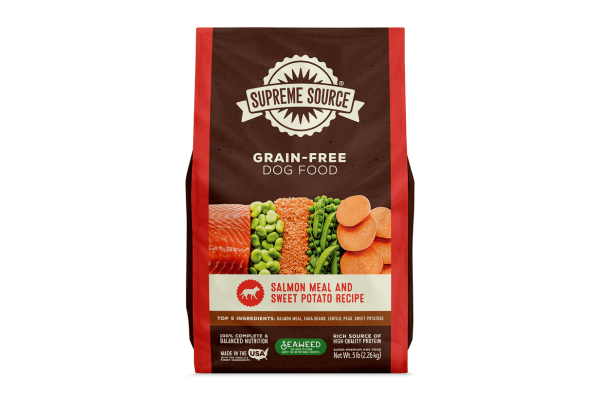
Every Supreme Source recipe lists a named meat or meat meal as the first ingredient, which is a strong starting point. Four of the six recipes—Salmon Meal & Sweet Potato, Turkey Meal & Sweet Potato, Lamb Meal & Potato, and Chicken, Apple and Carrot—use meat meal as their primary protein source. Meat meals are concentrated forms of protein, with moisture removed, meaning they contain roughly 300% more protein by weight than fresh meat. This makes them an efficient, nutrient-dense ingredient when sourced responsibly.
The other two recipes—Pork, Peas & Wild Boar and Beef, Chicken Meal & Lentil—feature real meat as the first ingredient, which appeals to owners who prefer whole-food sourcing. The Pork recipe also includes wild boar as a fifth ingredient, adding a novel protein element that can be useful for dogs with sensitivities to common proteins like chicken or beef.
One notable pattern is that several recipes include multiple protein sources. For example, the Salmon recipe contains both salmon meal and chicken meal, while the Beef recipe pairs real beef with chicken meal. This multi-protein approach can be a drawback for dogs with protein allergies, as it makes these formulas less suitable for elimination diets. On the other hand, it provides a broader amino acid profile and can improve palatability.
Supreme Source is 100% grain-free, which is both its defining feature and its most controversial aspect. Instead of grains like rice or oats, the brand relies heavily on legumes—peas, lentils, chickpeas, and fava beans—as primary carbohydrate sources. These ingredients frequently appear in the top three to five spots on the ingredient list, which means they make up a significant portion of the food’s volume and caloric content.
Sweet potatoes and regular potatoes also play a role, particularly in recipes like Salmon Meal & Sweet Potato and Lamb Meal & Potato. These starchy vegetables provide digestible energy and fiber, and they’re generally well-tolerated by most dogs. However, the legume dominance is what sets Supreme Source apart—and what raises red flags for some veterinarians and nutritionists.
Legumes are protein-rich plants that serve as both carbohydrate and plant-based protein sources. They’re not inherently bad, but their heavy use in grain-free dog foods has been linked to concerns about canine dilated cardiomyopathy (DCM), a serious heart condition. The FDA has been investigating this connection since 2018, and while no definitive causative link has been established, the data suggests that dogs eating grain-free, legume-rich diets without adequate taurine or taurine precursors may be at increased risk. This is particularly concerning because Supreme Source formulas do not list taurine as an additive and do not include organ meats (like heart or liver), which are natural dietary sources of taurine.
One of Supreme Source’s signature ingredients is organic seaweed (Ascophyllum Nodosum), sourced from the Nova Scotia coast. This single-species seaweed is rich in trace minerals like iodine and potassium, and it functions as a natural prebiotic, supporting gut health by feeding beneficial bacteria. The brand highlights this ingredient as a key differentiator, and it does add nutritional value beyond what you’d find in most mainstream kibbles.
All recipes also claim to include probiotics for digestive support, though the specific strains and colony-forming unit (CFU) counts are not disclosed. Probiotics can improve gut health and immune function, but without transparency on the types and quantities used, it’s hard to assess how effective they are. Some reviews note that probiotics are listed in marketing materials but not always clearly identified on the ingredient label, which raises questions about consistency.
Recipes also feature antioxidant-rich fruits and vegetables like blueberries, spinach, carrots, and apples. These ingredients provide vitamins, minerals, and natural antioxidants that support immune health and combat oxidative stress. They’re present in meaningful amounts—not just token inclusions—which is a positive sign.
Supreme Source uses mixed tocopherols (vitamin E) and citric acid as natural preservatives, which is standard for premium and natural-focused brands. There are no artificial colors, flavors, or preservatives, which aligns with the brand’s clean-label philosophy. The food is also fortified with essential vitamins and minerals to meet AAFCO nutritional standards, though the specific supplementation profile isn’t broken down in detail on most product pages.
One ingredient that raises eyebrows among some nutritionists is tomato pomace, a byproduct of tomato processing that includes skins, seeds, and pulp. It provides fiber, but it’s generally considered a lower-quality filler ingredient. Its inclusion suggests some cost optimization in the formulation, which isn’t necessarily a dealbreaker but does indicate the brand isn’t operating at the ultra-premium tier.
Supreme Source formulas lack glucosamine and chondroitin, which are common joint-support supplements in premium dog foods, especially those marketed for large breeds or seniors. The absence of these ingredients means the food isn’t optimized for dogs with joint issues or breeds predisposed to hip dysplasia.
More concerning is the absence of added taurine and organ meats. Taurine is an amino acid critical for heart health, and while dogs can synthesize it from other amino acids, certain diets—particularly those high in legumes—may interfere with that process. The lack of organ meats, which are natural taurine sources, compounds this concern, especially given the ongoing DCM investigation into grain-free diets.
| Price per pound | $2.00 – $2.80 |
| Primary protein | Salmon, Turkey, Lamb, Chicken, Pork, Wild Boar, Beef |
| By-products | None |
| AAFCO compliance | Yes (all life stages) |
| Formula options | 6 dry recipes + 1 mix-in topper |
| Availability | Online (Chewy, Amazon) + select grocery stores |
Take the free nutrition check and find out in under 1 minute which food is best tailored to your dog!
In just 60 seconds, find out which food fits your dog best — for free.
Supreme Source formulas are formulated to meet AAFCO standards for all life stages, meaning they’re intended to be suitable for puppies, adults, and seniors alike. However, it’s worth noting that “all life stage” doesn’t always mean “optimized” for each life stage—it just means the food meets minimum nutritional requirements across the board.
Protein content across the range averages around 26 to 29%, which is above average for dry dog food and reflects the brand’s emphasis on meat and meat meal as primary ingredients. The Salmon Meal & Sweet Potato and Pork, Peas & Wild Boar recipes both clock in at approximately 26% protein, which is solid but not exceptional compared to ultra-high-protein competitors.
Fat levels are more modest, averaging around 12%, which is on the lower end for premium foods. This can be a benefit for less active dogs or those prone to weight gain, but it may not provide enough energy density for highly active or working dogs. The lower fat content also contributes to a higher carbohydrate percentage—estimated at around 51% on average—which is above typical for grain-free foods and reflects the heavy legume content.
Fiber content and moisture levels are disclosed on the guaranteed analysis label, but specific values weren’t consistently available across all product pages in the research. Caloric density (kcal/kg) is similarly not always published, which makes it harder to compare feeding costs on a per-calorie basis. Based on typical grain-free kibble, you can estimate around 330 to 350 kcal per cup, but this varies by recipe.
The omega fatty acid profile is likely favorable in fish-based recipes like Salmon Meal & Sweet Potato, which would naturally provide omega-3s from fish. However, specific omega-3 and omega-6 levels aren’t quantified in available materials, so it’s hard to assess whether the ratios are optimized for anti-inflammatory benefits or coat health.
One gap in the nutritional profile is the lack of detailed information on calcium and phosphorus ratios, which are especially important for large-breed puppies. Improper ratios can lead to developmental orthopedic issues, and without published data, it’s difficult to confidently recommend Supreme Source for large-breed puppy growth without consulting a veterinarian.
Supreme Source is designed as an all-life-stage food, meaning it’s formulated to meet the nutritional needs of puppies, adults, and seniors. In practice, though, the lack of life-stage-specific formulations means it’s more of a one-size-fits-all approach, which has both advantages and limitations.
The food is best suited for adult dogs with grain sensitivities or owners who prefer grain-free diets for philosophical reasons. The high protein content and named meat sources make it a good fit for moderately active dogs who need solid nutrition without excessive calories. Dogs with sensitive stomachs often respond well to Supreme Source, thanks to the inclusion of probiotics, organic seaweed, and easily digestible carbohydrate sources like sweet potato.
It’s also a viable option for picky eaters, as multiple reviews highlight success with dogs who refused other brands. The palatability seems strong across the range, with recipes like Pork, Peas & Wild Boar and Chicken, Apple and Carrot earning particular praise for taste acceptance.
However, Supreme Source is not ideal for several dog profiles. Large-breed puppies are a key concern: without detailed calcium and phosphorus data and no large-breed-specific formula, there’s a risk of nutritional imbalances that could affect bone development. If you have a large-breed puppy, you’d want to verify the exact mineral ratios with your vet before committing to this food.
Senior dogs with joint issues won’t find much support here, as the formulas lack glucosamine and chondroitin. While the omega-3s in fish-based recipes can provide some anti-inflammatory benefit, it’s not a substitute for targeted joint support.
Dogs with protein allergies or sensitivities face challenges as well. Most Supreme Source recipes contain multiple protein sources—Salmon includes chicken meal, Beef includes chicken meal—which makes them unsuitable for elimination diets. The Lamb Meal & Potato recipe is the closest to a single-protein option, but cross-contamination during manufacturing is always a possibility, so it’s not a true limited-ingredient diet.
The most significant concern is for dogs at risk of DCM. Breeds predisposed to heart issues—Dobermans, Boxers, Great Danes, Golden Retrievers, and Cocker Spaniels, among others—should be fed Supreme Source only under veterinary guidance. The grain-free, legume-heavy formulation without added taurine places these dogs in a higher-risk category based on current FDA investigations. If your dog has a diagnosed heart condition or a family history of DCM, this food is not recommended.
Palatability is one of Supreme Source’s strongest suits. Across review platforms, owners consistently report that their dogs eat the food enthusiastically, even picky eaters who have rejected other brands. One reviewer mentioned trying “at least a dozen different brands” before finding success with Supreme Source, and another noted their dog continued eating it for over a year after switching from a previous food.
The brand’s use of real meat or concentrated meat meal as the first ingredient likely contributes to this. Meat meals, in particular, are highly palatable to most dogs because they’re protein-dense and flavorful. The inclusion of novel proteins like pork and wild boar in one recipe, and fruits and vegetables like apple and carrot in another, also seems to enhance taste appeal.
That said, not every dog loves it. A few reviews mention dogs who refused to eat certain recipes or showed initial reluctance during the transition period. This is normal with any food, and it underscores the importance of gradually introducing new kibble over 7 to 10 days to allow your dog’s digestive system and taste preferences to adjust.
The kibble size is small, which is a plus for small and toy breeds but has drawn some complaints from owners of large dogs. One reviewer noted that the small pieces were less satisfying for their three larger dogs, who seemed to prefer a more substantial crunch. Supreme Source doesn’t offer size-specific kibble options, so if you have a giant breed, this might be a minor drawback.
In terms of variety, Supreme Source offers six dry recipes and a beef mix-in topper. This is a limited range compared to competitors with dozens of formulas, but it does provide enough options to rotate proteins or find a recipe that works for your dog. The mix-in topper is a nice touch for owners who want to boost palatability or add moisture and protein to the kibble without switching foods entirely.
Supreme Source is positioned in the mid-tier pricing range, typically running between $2.00 and $2.80 per pound depending on the recipe and retailer. This places it well below ultra-premium brands like Orijen or Acana, which can exceed $4 to $5 per pound, but above budget options like Pedigree or Ol’ Roy, which often come in under $1.50 per pound.
For what you’re getting—named meat or meat meal as the first ingredient, grain-free formulation, organic seaweed, probiotics, and no artificial additives—the price feels fair. It’s not a bargain, but it’s not gouging you either. The value proposition is particularly strong if you’re comparing it to other grain-free brands in the same price range, many of which offer similar ingredient profiles but without Supreme Source’s spotless recall history.
That said, the limited product range means you’re paying for simplicity rather than variety. If you value having dozens of options or specialty formulations, you might feel like you’re not getting enough flexibility for the price. And if you’re concerned about the legume content and DCM risk, you might decide the price isn’t worth the potential health trade-off, especially when grain-inclusive alternatives are often cheaper and carry less controversy.
One practical consideration is feeding cost per day, which depends on your dog’s size and caloric needs. Without published caloric density data for every recipe, it’s hard to calculate exact daily costs, but based on typical grain-free kibble, a medium-sized dog (around 50 pounds) might eat 2 to 3 cups per day, translating to roughly $1.50 to $2.50 per day. That’s competitive with other mid-tier brands, though it’s significantly less than fresh-food subscriptions like The Farmer’s Dog, which can run $6 to $10 per day for the same dog.
Supreme Source is primarily sold online through platforms like Chewy and Amazon, where you can often find autoship discounts of 5% to 10%. This brings the effective price down slightly and adds convenience, though you’ll want to compare prices across retailers to ensure you’re getting the best deal. Availability in grocery stores like Acme Markets and Pavilions also gives you the option to buy in person, though selection may be limited to one or two recipes.
Take the free nutrition check and find out in under 1 minute which food is best tailored to your dog!
In just 60 seconds, find out which food fits your dog best — for free.
Supreme Source is manufactured by American Pet Nutrition in facilities located in Ogden, Utah, and Pennsylvania. The brand emphasizes that all production happens in the United States, which appeals to owners who prioritize domestic manufacturing for quality assurance and supply chain transparency.
The company states that its facilities comply with FDA, USDA, and AAFCO standards, and it claims to conduct regular quality testing of both raw ingredients and finished products. However, there’s no public disclosure of third-party certifications like ISO, HACCP, or SQF, which are common benchmarks for food safety in the pet food industry. This doesn’t necessarily mean quality is lacking, but it does leave a transparency gap compared to brands that publish detailed audit results or third-party lab testing.
One of Supreme Source’s strongest selling points is its perfect recall history. In nearly 50 years of operation, the brand has never issued a safety recall, which is exceptional in an industry where even major players have faced contamination issues. This track record suggests robust quality control processes and careful ingredient sourcing, and it’s a major reason why the brand maintains consumer trust despite its modest market presence.
Ingredient sourcing is described as coming from “trusted farmers,” though specific farm names or locations aren’t disclosed. The organic seaweed is sourced from the Nova Scotia coast, which is a specific and verifiable claim. Other ingredients, particularly meats and legumes, are less traceable, and the company acknowledges that some recipes may occasionally contain imported ingredients despite efforts to source domestically. This is a realistic approach—few brands can claim 100% domestic sourcing—but it does mean you’re not getting full farm-to-bowl transparency.
Supreme Source doesn’t publish a formal sustainability report or detailed environmental, social, and governance (ESG) metrics, which is a missed opportunity given the growing consumer interest in these issues. However, the brand does highlight a few sustainability-related practices.
The use of organic, sustainably harvested seaweed from Nova Scotia is a positive environmental choice, as seaweed cultivation has a low carbon footprint and can even help improve water quality. The brand’s emphasis on natural ingredients and avoidance of artificial additives also aligns with a more sustainable, whole-food philosophy.
On the packaging side, there’s no information available about recyclability, use of recycled materials, or efforts to reduce plastic waste. This is an area where Supreme Source lags behind competitors who are actively working on compostable or carbon-neutral packaging solutions.
The brand doesn’t disclose an animal welfare policy or testing policy, and there’s no evidence of animal testing for product development. This is typical for mainstream pet food brands, but it’s worth noting if animal welfare transparency is important to you.
There are no reported ethical controversies or labor issues associated with Supreme Source or its parent company, American Pet Nutrition. The family-owned structure and long operational history suggest a stable, responsible business, but without published CSR reports or third-party audits, it’s hard to assess the brand’s full ethical footprint.
At the shelter where I work, we tested Supreme Source with a dog named Biscuit, a four-year-old mixed-breed terrier with a history of mild digestive sensitivity. Biscuit came to us after being surrendered by an owner who couldn’t keep up with vet bills, and while he didn’t have any diagnosed conditions, he’d been on and off various foods with mixed results—some caused loose stools, others just didn’t seem to agree with him. He was eating a mid-range grocery brand when we decided to try Supreme Source, specifically the Turkey Meal & Sweet Potato recipe, to see if a grain-free, higher-protein option would settle his stomach.
We transitioned Biscuit over about 10 days, mixing increasing amounts of Supreme Source with his old food. He didn’t show much excitement at first—he’s not the type to do backflips over his bowl—but he ate it without hesitation, which was a good sign. By the end of the first week, his stools had firmed up noticeably, which was the main improvement we were hoping for. They weren’t perfect, but they were more consistent and easier to clean up, which made daily care a lot simpler.
Over the next few weeks, Biscuit’s coat seemed shinier, though it’s hard to say if that was the food or just him settling into shelter life and getting regular grooming. His energy level stayed about the same—he’s always been a moderately active dog, happy to play but not bouncing off the walls—so there wasn’t a dramatic change there. He continued eating the food without any fuss, and we didn’t notice any signs of itching, ear issues, or other allergic reactions.
The one thing I did notice was that Biscuit seemed to eat a bit faster than he had on his previous food, which suggested he found it more palatable. He’s not a picky eater by any means, but he also doesn’t usually inhale his meals, so the fact that he was finishing his bowl more quickly felt like a subtle thumbs-up.
Overall, Biscuit did well on Supreme Source. It wasn’t a miracle transformation, but it addressed the main issue we were dealing with—his digestive inconsistency—and he seemed comfortable and healthy while eating it. For a shelter dog with no major health issues, it was a solid, dependable food that made our lives easier and kept him in good shape.
Consumer feedback on Supreme Source is overwhelmingly positive when it comes to palatability and digestive tolerance. Across platforms like Chewy, Amazon, and Safeway, ratings consistently hover in the 4 to 4.5-star range, with many reviewers praising the food for resolving chronic issues like diarrhea, vomiting, or picky eating.
One recurring theme is success with picky eaters. Multiple owners report trying a dozen or more brands before finding that their dogs would actually eat Supreme Source consistently. One reviewer mentioned their dog “became uninterested in eating” other foods but responded enthusiastically to Supreme Source, describing it as “God sent.” Another noted their dog had been eating it for over a year without losing interest, which speaks to sustained palatability.
Digestive improvements are another common benefit. Owners frequently mention firmer stools, less gas, and reduced vomiting after switching to Supreme Source. One reviewer specifically highlighted that the food resolved diarrhea issues that had persisted across multiple other brands. The inclusion of probiotics and organic seaweed likely contributes to this, as both support gut health.
There are also reports of visible health improvements, particularly in coat quality and energy levels. One owner of a 16-year-old dog reported that their senior dog “is now like a puppy” after a year on Supreme Source, which is a remarkable testimonial if accurate. Others mention shinier coats, healthier skin, and better overall vitality, though these effects are harder to attribute solely to the food versus other factors like improved care or routine.
On the downside, a few reviewers mention kibble size concerns. The small pieces work well for small dogs but can be less satisfying for large breeds, and one owner noted their three larger dogs seemed to prefer a bigger crunch. This is a minor complaint but worth considering if you have a giant breed.
The most significant criticism comes from nutritionists and veterinarians rather than consumers. The heavy legume content and lack of added taurine place Supreme Source squarely within the category of grain-free foods being investigated for potential links to DCM. While no direct consumer complaints about heart issues were found in the reviews, the expert caution is clear: this food carries a higher risk for breeds predisposed to DCM, and owners should consult a vet before feeding it long-term.
A few reviews also mention palatability failures, where dogs simply refused to eat the food or showed reluctance during the transition. This is normal for any food, but it’s a reminder that no single brand works for every dog.
Supreme Source occupies a unique space in the dog food market—it’s grain-free, mid-priced, and focused on simplicity, but it’s not trying to compete with ultra-premium brands or fresh-food subscriptions. To understand where it fits, it’s helpful to compare it to a few key competitors.
Versus Abound: Abound is Kroger’s private-label dog food brand, positioned as a value option with both grain-inclusive and grain-free lines. Supreme Source and Abound are similar in price, but Supreme Source has a stronger reputation for ingredient quality and safety, with a perfect recall history compared to Abound’s more generic, private-label profile. Abound offers more variety, including wet food and life-stage-specific formulas, which gives it an edge in flexibility. However, Supreme Source’s emphasis on named meat sources, organic seaweed, and probiotics makes it feel more premium, even if the price points are comparable. If you’re deciding between the two, Supreme Source is the better choice for ingredient transparency and quality, while Abound wins on convenience and variety. Dog food from Abound is worth considering if you prioritize in-store availability and a broader product range, but Supreme Source edges ahead on reputation and formulation.
Versus Blue Buffalo: Blue Buffalo is a household name in the premium dog food space, with a massive product range that includes grain-free, grain-inclusive, life-stage-specific, and even veterinary lines. Supreme Source can’t compete on variety—Blue Buffalo offers dozens of recipes compared to Supreme Source’s six—but it does compete on price and simplicity. Blue Buffalo typically costs $2.50 to $3.50 per pound, making it slightly more expensive than Supreme Source. Ingredient quality is comparable, with both brands emphasizing real meat and natural ingredients, though Blue Buffalo has faced recalls in the past, while Supreme Source has not. If you want a focused, no-frills option with a spotless safety record, Supreme Source is a solid choice. If you need more variety or specialty formulations, Blue Buffalo is the better fit.
Versus Taste of the Wild: Taste of the Wild is another grain-free brand in the same price range as Supreme Source, known for its novel protein recipes and high meat content. Both brands use legumes as primary carbohydrate sources, so they share the same DCM concerns. Taste of the Wild offers more variety, including bison, venison, and salmon recipes, and it’s more widely available in pet specialty stores. Supreme Source differentiates itself with the inclusion of organic seaweed and a slightly lower price point in some markets. If you’re choosing between the two, Taste of the Wild offers more flavor options, but Supreme Source has a cleaner recall history and a simpler ingredient list.
Versus Fresh-Food Brands: Comparing Supreme Source to fresh-food brands like The Farmer’s Dog, Ollie, or Nom Nom is almost apples to oranges. Fresh-food subscriptions cost significantly more—often $6 to $10 per day for a medium dog versus $1.50 to $2.50 for Supreme Source—but they offer human-grade ingredients, gently cooked meals, and personalized nutrition plans. If budget is a concern, Supreme Source is a practical compromise that delivers solid nutrition without the premium price tag of fresh food. If you want the absolute best in ingredient quality and digestibility, fresh food is worth the investment, but Supreme Source is a strong mid-tier alternative.
Take the free nutrition check and find out in under 1 minute which food is best tailored to your dog!
In just 60 seconds, find out which food fits your dog best — for free.
Supreme Source is best suited for adult dogs with grain sensitivities or owners who prefer grain-free diets for personal reasons. The high protein content (26 to 29%) and named meat sources make it a good fit for moderately active dogs who need solid nutrition without excessive calories. Dogs with sensitive stomachs often respond well to Supreme Source, thanks to the inclusion of probiotics, organic seaweed, and easily digestible carbohydrate sources like sweet potato and potato.
The food is also a strong option for picky eaters, as multiple reviews highlight success with dogs who refused other brands. The palatability seems strong across the range, with recipes like Pork, Peas & Wild Boar and Chicken, Apple and Carrot earning particular praise for taste acceptance. Small to medium breeds will appreciate the small kibble size, which is easy to chew and digest.
However, Supreme Source is not ideal for several dog profiles. Large-breed puppies are a key concern: without detailed calcium and phosphorus data and no large-breed-specific formula, there’s a risk of nutritional imbalances that could affect bone development. If you have a large-breed puppy, you’d want to verify the exact mineral ratios with your vet before committing to this food.
Senior dogs with joint issues won’t find much support here, as the formulas lack glucosamine and chondroitin. While the omega-3s in fish-based recipes like Salmon Meal & Sweet Potato can provide some anti-inflammatory benefit, it’s not a substitute for targeted joint support. If your senior dog has arthritis or hip dysplasia, you’re better off choosing a food with added joint supplements or supplementing separately.
Dogs with protein allergies or sensitivities face challenges as well. Most Supreme Source recipes contain multiple protein sources—Salmon includes chicken meal, Beef includes chicken meal—which makes them unsuitable for elimination diets. The Lamb Meal & Potato recipe is the closest to a single-protein option, but cross-contamination during manufacturing is always a possibility, so it’s not a true limited-ingredient diet. If your dog has severe protein allergies, you’d be better off with a hydrolyzed protein prescription diet or a brand that offers genuine single-protein formulas.
The most important consideration is for dogs at risk of DCM. Breeds predisposed to heart issues—Dobermans, Boxers, Great Danes, Golden Retrievers, and Cocker Spaniels, among others—should be fed Supreme Source only under veterinary guidance. The grain-free, legume-heavy formulation without added taurine places these dogs in a higher-risk category based on current FDA investigations. If your dog has a diagnosed heart condition or a family history of DCM, this food is not recommended. Even for other breeds, it’s worth discussing the risks with your vet and considering periodic taurine level testing if you choose to feed Supreme Source long-term.
Here’s my honest take: Supreme Source is a solid, middle-of-the-road dog food that does a lot of things right but isn’t exceptional. It’s not bad—far from it—but it’s also not a standout in a crowded market.
The biggest strengths are the perfect recall history, transparent ingredient lists, and strong palatability. If you’re looking for a grain-free food with named meat sources, no artificial additives, and a track record of safety, Supreme Source delivers. The inclusion of organic seaweed and probiotics is a nice touch that sets it apart from some competitors, and the price point is reasonable for what you’re getting. For adult dogs with grain sensitivities or picky eaters who struggle with other brands, this food can be a genuine solution.
That said, the heavy reliance on legumes is a real concern. The ongoing FDA investigation into grain-free diets and DCM hasn’t been resolved, and Supreme Source fits the profile of foods being scrutinized—legume-rich, no added taurine, no organ meats. I’m not comfortable recommending this food for breeds at risk of heart issues without a vet’s sign-off, and even for other dogs, I’d want to see periodic taurine testing if you’re feeding it long-term. The lack of transparency on this issue—Supreme Source hasn’t addressed the DCM concerns publicly or adjusted its formulations—is frustrating.
The limited product range is another drawback. Six recipes is enough for basic variety, but it’s nowhere near what you’d get from brands like Blue Buffalo or Wellness. There are no life-stage-specific formulas, no joint-support options for seniors, no breed-specific kibble sizes, and no wet food. If you have a dog with specific needs—a large-breed puppy, a senior with arthritis, or a dog with severe protein allergies—you’ll likely need to look elsewhere.
Would I buy this for my dog? It depends. If I had a healthy adult dog with no heart issues and no protein allergies, and I wanted a grain-free food at a fair price, I’d consider it. But I’d also be watching for any signs of lethargy or breathing issues, and I’d talk to my vet about taurine testing. If I had a large-breed puppy or a dog predisposed to DCM, I’d pass. If I had a senior dog with joint issues, I’d choose a food with added glucosamine and chondroitin instead.
Would I recommend it to a friend? Maybe, with caveats. If they had a picky eater or a dog with chronic digestive issues, I’d suggest trying Supreme Source—it’s worked wonders for some dogs in those situations. But I’d also make sure they understood the DCM risks and the limitations of the product range. I’d probably also point them toward Nom Nom or another fresh-food option if budget allowed, just because the ingredient quality and digestibility are a step up.
Honestly, there are better options at similar or slightly higher price points if you’re willing to shop around. Brands like Wellness CORE, Merrick Grain-Free, or even grain-inclusive options like Purina Pro Plan offer more variety, better nutritional optimization for specific life stages, and less controversy around heart health. Supreme Source isn’t a bad choice, but it’s not the first one I’d make.
Take the free nutrition check and find out in under 1 minute which food is best tailored to your dog!
In just 60 seconds, find out which food fits your dog best — for free.
In the end, Supreme Source is a dependable, mid-tier food that works well for many dogs but isn’t without its flaws. If it fits your dog’s needs and you’re comfortable with the DCM risks, it’s worth a try. If you’re looking for the absolute best nutrition or have a dog with specific health concerns, you’ll probably want to keep looking.
Take the free nutrition check and find out in under 1 minute which food is best tailored to your dog!
In just 60 seconds, find out which food fits your dog best — for free.
Supreme Source fits the profile of foods being investigated by the FDA for potential links to canine dilated cardiomyopathy (DCM)—it’s grain-free, legume-heavy, and doesn’t include added taurine or organ meats. While no definitive causative link has been established, dogs eating similar diets may be at increased risk, particularly breeds predisposed to heart issues like Dobermans, Boxers, Great Danes, Golden Retrievers, and Cocker Spaniels. If you have a dog from a high-risk breed or any heart concerns, consult your veterinarian before feeding Supreme Source and consider periodic taurine testing if you choose to use it long-term.
Supreme Source hasn’t publicly addressed why they don’t include added taurine, despite the ongoing DCM investigation into grain-free diets. Dogs can synthesize taurine from other amino acids, but legume-rich diets may interfere with this process. The absence of taurine supplementation and organ meats (natural taurine sources) is concerning given the brand’s heavy reliance on legumes. This is one of the most significant gaps in their formulation compared to other grain-free brands that have added taurine as a precautionary measure.
Supreme Source is formulated to meet AAFCO standards for all life stages, but it’s not optimized for large-breed puppy growth. The brand doesn’t publish detailed calcium and phosphorus ratios, which are critical for proper bone development in large breeds. Improper ratios can lead to developmental orthopedic issues. If you have a large-breed puppy, you should verify the exact mineral content with your veterinarian before using Supreme Source, or consider a food specifically formulated for large-breed puppy growth.
Most Supreme Source recipes contain multiple protein sources, making them unsuitable for elimination diets. The Lamb Meal & Potato recipe is the closest to a single-protein option, but it’s still not a true limited-ingredient diet due to potential cross-contamination during manufacturing. If your dog has severe protein allergies, you’d be better off with a hydrolyzed protein prescription diet or a brand that offers genuine single-protein, limited-ingredient formulas designed specifically for food sensitivities.
Supreme Source typically costs between $2.00 and $2.80 per pound, similar to Taste of the Wild and slightly less than Blue Buffalo. Its main advantages are a perfect recall history over 50 years and the inclusion of organic seaweed. However, it offers limited variety with only six recipes compared to competitors with dozens of options. Taste of the Wild provides more novel protein choices, while Blue Buffalo offers life-stage-specific formulas. Supreme Source’s strength is simplicity and safety, but you’ll sacrifice variety and specialized formulations.
Supreme Source produces only one kibble size across all recipes, which is relatively small. This works well for small and toy breeds but has drawn complaints from owners of large dogs who prefer a more substantial crunch. The small pieces are easier for smaller mouths to chew and can be less satisfying for giant breeds. Unfortunately, Supreme Source doesn’t offer size-specific kibble options, so if you have a very large dog, this might be a minor drawback in terms of eating satisfaction.
Supreme Source formulas lack glucosamine and chondroitin, which are common joint-support supplements in premium dog foods. While fish-based recipes like Salmon Meal & Sweet Potato provide omega-3s that can offer some anti-inflammatory benefits, this isn’t a substitute for targeted joint support. Senior dogs with arthritis or hip dysplasia would be better served by a food with added joint supplements or by adding separate joint supplements to their diet.
Supreme Source was founded in 1972 by Jack Behnken and has been operating for over 50 years under private, family ownership. The brand has maintained a perfect recall history with no safety incidents in nearly five decades of operation, which is exceptional in the pet food industry. This track record suggests robust quality control processes and careful ingredient sourcing, making it one of the brand’s strongest selling points and a major reason for consumer trust.
Supreme Source has a strong reputation for palatability, with many owners reporting success with picky eaters who refused other brands. The use of real meat or concentrated meat meal as the first ingredient contributes to taste appeal. However, like any food transition, you should introduce Supreme Source gradually over 7 to 10 days to allow your dog’s digestive system and taste preferences to adjust. While most dogs accept it well, not every dog will love it, so individual results may vary.
Supreme Source is primarily sold online through retailers like Chewy and Amazon, where you can often find autoship discounts of 5% to 10%. It’s also available in some grocery chains like Acme Markets and Pavilions, though in-store selection may be limited to one or two recipes. The brand doesn’t have the widespread retail presence of larger competitors, but online availability makes it accessible, and subscription services can reduce costs and add convenience.
Take the free nutrition check and find out in under 1 minute which food is best tailored to your dog!
In just 60 seconds, find out which food fits your dog best — for free.
9 out of 10 dog owners are feeding their dog the wrong food.
Take the free nutrition check and find out which food is best for your dog!
2,847+ dog owners already did