9 out of 10 dog owners are feeding their dog the wrong food

Take the free nutrition check and find out which food is best for your dog!

Shelter manager, certified canine nutritionist, and lifelong dog lover
• America’s first holistic pet food brand (founded 1974) with a clean safety record—no recalls in the past decade, distinguishing it from competitors like Blue Buffalo.
• Mid-tier premium positioning at $2.10-$3.80 per pound offers quality ingredients without ultra-premium prices, though lacks transparency about sourcing and production facilities.
• Gut health focus with probiotics and superfoods shows real benefits in digestive improvement, with many owners reporting firmer stools and reduced gas issues.
• Extensive product range covers all life stages from puppies to seniors, including specialized formulas for weight management, small breeds, and sensitive stomachs.
• Grain-inclusive options provide safer alternative to grain-free formulas amid ongoing FDA investigation into legume-heavy diets and potential DCM connections in dogs.
Take the free nutrition check and find out in under 1 minute which food is best tailored to your dog!
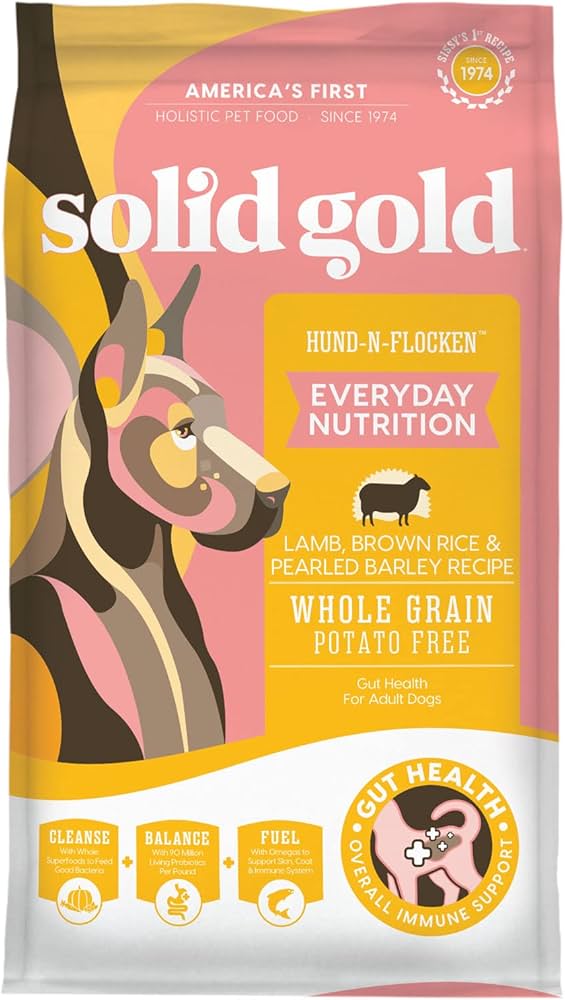
When you’re standing in the pet food aisle trying to make sense of ingredient lists and marketing claims, it helps to understand what a brand actually stands for. Solid Gold was founded in 1974 by Sissy Harrington McGill, making it America’s first holistic pet food brand. That’s not just a tagline—it’s a genuine piece of industry history. The company launched with Hund-N-Flocken, a lamb and rice formula designed around whole-body health principles at a time when most dog food was little more than corn and meat scraps.
The brand’s core philosophy centers on holistic nutrition and gut health. Solid Gold has consistently emphasized natural ingredients, superfoods, and digestive support through probiotics and carefully selected proteins. In 2020, the company was acquired by Health & Happiness Group (H&H Group) for $163 million, which brought both financial backing and a renewed focus on functional nutrition. The acquisition hasn’t dramatically changed the brand’s identity, but it has enabled expansion into new product lines and the introduction of proprietary ingredient blends like Nutrientboost.
Solid Gold positions itself in the premium-but-accessible segment. It’s pricier than grocery store brands but not as expensive as ultra-premium options like Orijen or Acana. The company targets health-conscious pet owners who want quality ingredients without breaking the bank. Their marketing emphasizes “transformative nutrition”—a phrase that sounds grand but essentially means they’re aiming to improve your dog’s overall health through better food.
From a reliability standpoint, Solid Gold has a clean safety record. There have been no major recalls in the past decade, which is notable in an industry where contamination issues periodically surface. The brand maintains AAFCO compliance across its product lines, meaning formulas meet minimum nutritional standards for dogs. Customer reviews across platforms like Chewy, Amazon, and specialty retailers generally hover around 4 to 4.3 stars, indicating solid satisfaction without overwhelming enthusiasm.
The company’s transparency could be better. While they’re open about avoiding corn, wheat, soy, and artificial preservatives, specific details about sourcing locations and production facilities are harder to find. This lack of granular information isn’t unusual for mid-tier brands, but it’s worth noting if transparency is a priority for you.
| Price per pound | $2.10 – $3.80 |
| Primary protein | Lamb, Chicken, Beef, Bison, Salmon, Ocean Fish, Turkey, Pollock |
| By-products | None |
| AAFCO compliance | Yes (formulation) |
| Formula options | Multiple product lines (Hund-N-Flocken, Barking at the Moon, Nutrientboost, Young at Heart, Love at First Bark, Wolf Cub, Holistique Blendz, Fit & Fabulous) |
| Availability | Petco, PetSmart, Chewy, Amazon |
Take the free nutrition check and find out in under 1 minute which food is best tailored to your dog!
In just 60 seconds, find out which food fits your dog best — for free.
Ingredients matter more than marketing, so let’s look at what’s actually in these bags. Solid Gold’s approach varies by product line, but there are consistent themes across their recipes.
Most Solid Gold formulas lead with real meat or meat meal as the first ingredient. You’ll see lamb meal, chicken meal, beef, bison, ocean fish meal, and occasionally novel proteins like pollock. Meat meals are concentrated protein sources—they’ve had moisture removed, so pound-for-pound they contain more protein than fresh meat. This is actually a good thing, despite what some marketing might suggest about “fresh” being superior.
The Hund-N-Flocken line, for example, typically starts with lamb meal followed by brown rice. The Barking at the Moon recipes push protein content higher with beef or salmon as the lead, often hitting 40%+ protein on a dry matter basis. The Fit & Fabulous weight management line uses chicken or pollock with lower fat content to help dogs maintain a healthy weight.
Solid Gold offers both grain-inclusive and grain-free options. The grain-inclusive recipes use brown rice, pearled barley, and oatmeal—digestible whole grains that provide steady energy without the potential DCM concerns linked to legume-heavy grain-free diets. The grain-free formulas rely on sweet potatoes, peas, and lentils as carbohydrate sources.
If you’re wondering about the grain-free versus grain-inclusive debate, here’s my take: unless your dog has a diagnosed grain allergy (which is rare), grain-inclusive formulas are generally the safer bet. The FDA has been investigating a potential link between grain-free diets high in legumes and dilated cardiomyopathy (DCM) in dogs. While the research isn’t conclusive, I’d rather not use my dog as a test subject. Solid Gold’s grain-inclusive options give you a solid middle ground.
Fat content varies by line, ranging from around 6-8% in weight management formulas to 16-18% in high-protein recipes like Barking at the Moon. Sources include chicken fat, salmon oil, and flaxseed, which provide essential fatty acids for coat health and inflammation control. The omega-3 to omega-6 ratio isn’t explicitly listed for most formulas, but the inclusion of fish oils suggests at least some attention to this balance.
This is where Solid Gold tries to differentiate itself. Nearly every formula includes what they call “superfoods”—ingredients like pumpkin, blueberries, cranberries, spinach, and carrots. These add vitamins, antioxidants, and fiber, though the actual quantities are small enough that I’d consider them more supplemental than transformative.
The Nutrientboost line introduces bovine plasma protein, which the brand claims enhances nutrient absorption and supports immune function. Plasma proteins do have some research backing their benefits in animal nutrition, particularly for gut health and immunity. However, Solid Gold hasn’t published independent studies showing measurable improvements in dogs fed their Nutrientboost formulas versus their standard recipes. The concept is sound, but the proof is thin.
Solid Gold includes live probiotics in most formulas, listing specific strains like Lactobacillus and Bifidobacterium on the label. Probiotics can support digestive health, though their effectiveness depends on whether they survive manufacturing, storage, and your dog’s stomach acid. The brand also includes prebiotics like chicory root, which feed beneficial gut bacteria.
Solid Gold avoids the worst offenders—no corn, wheat, soy, or artificial colors, flavors, or preservatives. That said, some formulas contain peas, lentils, and potatoes as primary carbohydrates, which, as mentioned earlier, have been flagged in the FDA’s DCM investigation. If you’re feeding a grain-free formula, it’s worth monitoring your dog’s health and considering a vet visit if you notice symptoms like lethargy, coughing, or difficulty breathing.
The use of chelated minerals (minerals bound to amino acids for better absorption) is a positive. You’ll see ingredients like zinc proteinate and copper proteinate, which are more bioavailable than cheaper mineral salts.
Numbers on a bag tell you a lot, but only if you know how to read them. Solid Gold’s nutritional profiles vary widely depending on the line, so I’ll break down the key formulas.
Protein levels range from 18-20% in sensitive stomach formulas like Holistique Blendz to 41-43% in high-performance recipes like Barking at the Moon. Most adult maintenance formulas sit around 22-28%, which is adequate for the average dog. Puppies and active dogs benefit from the higher-protein options, while seniors or dogs with kidney concerns might do better with moderate protein.
Fat ranges from 6-8% in weight management formulas to 16-18% in performance recipes. Moderate-fat formulas (10-14%) work well for most adult dogs. Fat is calorie-dense, so if your dog is prone to weight gain, you’ll want to stick with the lower end of this range. Active or working dogs, on the other hand, need the extra calories that higher fat provides.
Solid Gold doesn’t list carbohydrate percentages on the label (most brands don’t), but you can estimate them by subtracting protein, fat, moisture, and ash from 100%. Most formulas land around 38-48% carbohydrates, which is typical for dry dog food. Fiber content ranges from 3-6%, with weight management and senior formulas on the higher end to promote satiety and digestive regularity.
Calories per kilogram range from around 3,010 kcal/kg in Holistique Blendz to 4,100 kcal/kg in puppy formulas like Love at First Bark. This matters because caloric density determines how much you need to feed. A highly active dog might do well on a calorie-dense food, while a couch potato needs something lighter to avoid weight gain.
All Solid Gold formulas meet AAFCO nutritional standards, either through formulation or feeding trials. However, the company doesn’t specify which products have undergone actual feeding trials—the gold standard for proving a diet is nutritionally complete. Most likely, the majority of their recipes are formulated to meet AAFCO profiles rather than tested in live dogs. This isn’t a red flag, but feeding trials provide stronger evidence of adequacy.
When comparing dog foods, price per pound doesn’t tell the whole story. You need to look at cost per 1,000 calories to account for differences in caloric density. For Solid Gold, this ranges from around $0.69 for Holistique Blendz to over $1.00 for small-breed formulas. Mid-range options like Hund-N-Flocken come in around $0.72 per 1,000 calories, which is reasonable for a premium brand but not a bargain.
Not every dog needs the same food, and Solid Gold’s range reflects that. Here’s how I’d match their formulas to different dogs.
The Love at First Bark line is formulated for puppies, with higher protein (29-30%), moderate fat (14-16%), and added DHA for brain development. The Wolf Cub formula targets large-breed puppies specifically, with controlled calcium and phosphorus to support healthy bone growth without encouraging too-rapid development. Both are solid choices if you want a holistic puppy food without going ultra-premium.
Barking at the Moon is the clear pick here. With 41-43% protein and 16-18% fat, it’s built for dogs with high energy demands. Think working breeds, agility competitors, or dogs that spend hours hiking or running. The caloric density and protein content support muscle maintenance and endurance.
The Young at Heart formula is designed for older dogs, with moderate protein and fat, plus added joint support ingredients like glucosamine and chondroitin. Protein levels around 26-28% help maintain muscle mass without overloading kidneys, and the lower calorie content suits less active seniors.
Small dogs have faster metabolisms and often pickier appetites. Solid Gold’s Toy & Small Breed line offers smaller kibble pieces and calorie-dense formulas (around 3,700 kcal/kg) to meet their needs. Protein runs high (28-30%), and flavor options include beef, lamb, chicken, and turkey to appeal to finicky eaters.
Holistique Blendz is the go-to for dogs with digestive sensitivities. It’s based on ocean fish meal and oatmeal, with lower protein (18-20%) and fat (6-8%) to ease digestion. The Nutrientboost line also markets itself as gut-friendly, thanks to the added plasma proteins and probiotics, though it’s pricier.
The Fit & Fabulous line keeps protein relatively high (26-28%) to preserve muscle while cutting fat to 6-8% and boosting fiber. This helps dogs feel full without excess calories. It’s a good option for dogs prone to weight gain, though you’ll still need to measure portions carefully.
Solid Gold doesn’t offer true limited-ingredient diets, so if your dog has multiple food allergies, this might not be the best fit. However, formulas like Holistique Blendz (fish-based) or the lamb-based Hund-N-Flocken can work for dogs with chicken or beef sensitivities. Just check the full ingredient list to make sure there aren’t hidden triggers.
If your dog has been diagnosed with dilated cardiomyopathy (DCM) or is at high risk (breeds like Golden Retrievers, Dobermans, or Great Danes), I’d steer clear of the grain-free formulas until more research clarifies the legume connection. Also, if you’re on a tight budget, Solid Gold’s pricing might stretch too far—there are more affordable options that still meet nutritional standards.
Take the free nutrition check and find out in under 1 minute which food is best tailored to your dog!
In just 60 seconds, find out which food fits your dog best — for free.
A nutritionally perfect food is useless if your dog won’t eat it. Solid Gold generally scores well on palatability, but there are some nuances worth discussing.
Customer reviews suggest that the Nutrientboost and Toy & Small Breed lines tend to be the most enthusiastically received. The added palatants and higher fat content in these formulas make them appealing even to picky eaters. Barking at the Moon also gets high marks, likely because of the meat-forward composition.
The grain-inclusive formulas like Hund-N-Flocken are hit-or-miss. Some dogs devour them, while others show less interest. This seems to correlate with individual taste preferences—dogs that prefer poultry or beef might not be thrilled with lamb, and vice versa.
Kibble size varies by line. The Toy & Small Breed formulas feature small, easy-to-chew pieces suitable for tiny mouths. The Wolf King line for large breeds uses larger kibble to encourage chewing and slow down fast eaters. Most formulas have a standard medium-sized kibble that works for average dogs.
Texture-wise, Solid Gold kibble is fairly crunchy, which helps with dental health by scraping plaque as your dog chews. Some owners report that their dogs prefer softer kibble, in which case you might try mixing in a bit of warm water or wet food to make it more appealing.
Solid Gold offers a decent range of flavors: lamb, beef, chicken, bison, turkey, salmon, and ocean fish. This variety helps if your dog gets bored with the same protein or develops a sensitivity over time. However, the flavor selection within each product line is more limited—you can’t get every protein in every formula, so you might need to switch lines to switch proteins.
Most dogs adapt to Solid Gold without major issues if you transition gradually over 7-10 days. Start by mixing 25% new food with 75% old, then increase the ratio every few days. Some owners report initial digestive upset (loose stools, gas) during the transition, which is common when changing any food. If issues persist beyond two weeks, the formula might not be the right fit.
If you have a notoriously picky dog, the Nutrientboost or Toy & Small Breed lines are your best bet. The higher fat and added palatants make them more enticing. You can also try topping the kibble with a small amount of Solid Gold’s wet food or meal toppers to boost appeal.
Let’s talk money. Solid Gold sits in the premium price range, typically running $2.10 to $3.80 per pound for dry food, depending on the formula and where you buy it. Wet food costs around $2.99 to $3.49 per can. Is that worth it?
For a rough estimate, here’s what you’d spend per day feeding Solid Gold:
These figures assume you’re feeding one of the mid-range formulas like Hund-N-Flocken. High-protein or small-breed formulas push costs higher, while budget-friendly options like Holistique Blendz bring them down slightly.
At $2.50-$3.50 per pound, Solid Gold is more expensive than brands like Purina Pro Plan ($1.80-$2.60/lb) and Hill’s Science Diet ($2.00-$2.80/lb), but less expensive than ultra-premium brands like Orijen or Acana. It’s roughly on par with Blue Buffalo and Wellness, both of which occupy a similar market position.
Not sure whether to choose Solid Gold or Pure Balance? Read our Pure Balance review to see how this Walmart-exclusive brand compares in terms of ingredients and value.
Here’s where I have mixed feelings. Solid Gold uses quality ingredients—real meat, whole grains, and functional add-ins like probiotics and superfoods. The AAFCO compliance and clean safety record add to the value. However, the lack of transparency around sourcing and the absence of published feeding trials or digestibility studies make it harder to justify the premium over brands with more scientific backing.
If you’re looking for the absolute best value in this price range, I’d point you toward Purina Pro Plan, which has extensive research, feeding trials, and a veterinary-recommended reputation at a lower price. But if you prefer the holistic angle and want to avoid some of the ingredients Pro Plan uses (like corn and animal by-products), Solid Gold is a reasonable choice.
You’ll find Solid Gold at Petco, PetSmart, Chewy, and Amazon. Prices are fairly consistent across retailers, though Chewy and PetSmart often offer autoship discounts of 5-10%. Buying larger bags (24-28 pounds) reduces the per-pound cost slightly, though not dramatically. Watch for seasonal sales, especially around holidays, when you might find 15-20% discounts.
Take the free nutrition check and find out in under 1 minute which food is best tailored to your dog!
In just 60 seconds, find out which food fits your dog best — for free.
Knowing where and how your dog’s food is made matters, especially if you’re paying a premium. Unfortunately, Solid Gold is not particularly transparent about its production facilities or supply chain.
The company doesn’t publicly disclose which facilities manufacture its products or where those facilities are located. This is frustrating, because production transparency has become a standard expectation in the premium pet food market. We know that some Solid Gold products are made in the USA, but specifics about whether all formulas are domestic or if some ingredients or production steps happen overseas are unclear.
Solid Gold states that it follows AAFCO guidelines and industry standards, but there’s no public information about third-party testing, batch testing frequency, or certifications like HACCP, ISO 22000, or SQF. This lack of detail is a weak point, especially compared to brands that openly discuss their quality assurance protocols.
The good news: Solid Gold has had no recalls in the past 10 years. This is a strong indicator of consistent quality control and safety. In an industry where even major brands occasionally face contamination issues, a clean record is worth noting.
Solid Gold emphasizes natural, high-quality ingredients but doesn’t provide specifics about where those ingredients come from. Do they source chicken from the U.S.? Are the fish meals from sustainable fisheries? We don’t know. If ingredient traceability is a priority for you, you might prefer brands like The Farmer’s Dog, which offers full transparency about sourcing and production.
Sustainability is becoming a bigger consideration for pet owners, and Solid Gold’s approach here is underwhelming.
The brand doesn’t publish sustainability reports or make strong public commitments to reducing its environmental footprint. Packaging is mostly plastic bags, which aren’t widely recyclable. Wet food comes in metal cans, which can be recycled, but there’s no mention of using recycled materials or reducing packaging waste.
Solid Gold markets itself as a holistic, natural brand, but there’s no information about animal welfare standards for the meat they source. Do they use cage-free chicken or grass-fed beef? Are their fish sustainably caught? Without answers to these questions, it’s hard to evaluate the brand’s ethical standing.
Since being acquired by H&H Group in 2020, Solid Gold has aligned with the parent company’s “health and happiness” mission, but there’s little evidence of meaningful corporate social responsibility initiatives. No published CSR reports, no partnerships with animal welfare organizations, and no transparency scores from watchdog groups.
If sustainability and ethics are deal-breakers for you, brands like Open Farm or The Honest Kitchen might be better matches—they’re upfront about sourcing, sustainability, and animal welfare.
I work at a local dog shelter, which gives me the chance to test foods with dogs who have a range of backgrounds, health issues, and temperaments. For this review, I tried Solid Gold Hund-N-Flocken Lamb & Brown Rice with a dog named Benny, a seven-year-old Beagle mix who came to us after his owner passed away.
Benny is a pretty easygoing dog with no major health problems, though he’s slightly overweight—about five pounds over his ideal weight—and has a tendency to scarf down his food without chewing. He’d been eating a grocery-store brand before arriving at the shelter, and we wanted to see if switching to something with better ingredients would make any noticeable difference.
We transitioned Benny to Solid Gold over the course of a week, starting with a 25/75 mix and gradually increasing the ratio. He didn’t seem to care one way or the other—he ate the new food just as enthusiastically as his old kibble, which is pretty typical for Beagles. No hesitation, no sniffing suspiciously and walking away. He just ate.
Throughout the three weeks we fed Benny the Solid Gold formula, he ate it consistently without any signs of boredom or refusal. He’s not what I’d call a picky eater, so this wasn’t a huge surprise, but it was reassuring that the food seemed palatable enough to keep his interest. The kibble size was appropriate for him—not too large, not too small—and he didn’t choke or gulp it down any faster than usual.
Honestly, we didn’t see dramatic changes, which is probably a good thing. Benny’s energy level stayed about the same—he’s a moderately active dog who enjoys walks but isn’t bouncing off the walls. His coat looked a bit shinier after a couple of weeks, though it’s hard to say if that was the food or just regular grooming and care at the shelter.
The most noticeable difference was in his stool quality. On his previous food, Benny’s stools were somewhat soft and bulky. After switching to Solid Gold, they firmed up and became smaller and more consistent. This made cleanup easier and suggested that he was digesting the food more efficiently. No issues with gas or upset stomach during the transition, which was a relief.
From a practical standpoint, feeding Benny Solid Gold was straightforward. The kibble didn’t have a strong smell, which is nice when you’re working in a shelter environment with multiple dogs. Portion sizes were easy to measure, and the feeding guidelines on the bag seemed accurate—we didn’t need to adjust his portions to maintain his weight.
Overall, Benny did well on Solid Gold. It wasn’t a transformative experience, but it also wasn’t a problem. He ate it, digested it well, and maintained his health. For a middle-aged dog with no specific issues, that’s about what you’d hope for.
Real-world feedback from other dog owners paints a picture that’s mostly positive but not without some caveats.
The most common praise centers on digestive improvements. Owners frequently mention firmer stools, less gas, and fewer digestive upsets after switching to Solid Gold. This aligns with the brand’s emphasis on gut health and probiotics.
Coat and skin quality also get frequent mentions. Many reviewers report shinier coats, less shedding, and reduced itching or hot spots. This likely reflects the omega fatty acids and antioxidant-rich superfoods in the formulas.
Picky eaters seem to respond well to the Nutrientboost and small-breed lines, with owners noting that their dogs show more enthusiasm at mealtime. Some even report that dogs who previously refused multiple brands finally found something they’d eat consistently with Solid Gold.
On the flip side, there are complaints worth noting. Some dogs experience digestive upset during the transition or even after fully switching. This includes loose stools, diarrhea, or increased gas. These reports are more common with grain-free formulas, which might relate to the legume content.
A handful of owners report allergic reactions, typically increased itching or scratching. This is always tricky to pin down—it could be a specific ingredient in Solid Gold, or it could be unrelated. But it’s worth monitoring if your dog has a history of food sensitivities.
Price complaints are common, especially from owners of large dogs who go through bags quickly. At $3+ per pound, feeding a 70-pound dog gets expensive, and some people feel the quality doesn’t justify the cost compared to other options in the same range.
There are also occasional reports of inconsistent batches—bags that smell off or seem stale—though these are rare. A few reviewers mentioned receiving expired or near-expired products when ordering online, which is more of a retailer issue than a manufacturer problem, but it’s still frustrating.
Owners who’ve fed Solid Gold for months or years generally report sustained satisfaction. Dogs maintain healthy weights, consistent energy levels, and good coat condition. However, some owners note that their dogs eventually lose interest in a particular flavor, requiring a switch to keep meals exciting.
Take the free nutrition check and find out in under 1 minute which food is best tailored to your dog!
In just 60 seconds, find out which food fits your dog best — for free.
To really understand Solid Gold’s place in the market, you need to see how it stacks up against similar brands.
Blue Buffalo is probably Solid Gold’s closest competitor in terms of market position and price. Both emphasize natural ingredients, avoid corn/wheat/soy, and include antioxidant-rich additions. Blue Buffalo has a slightly broader product range and more aggressive marketing, which gives it higher brand recognition. However, Blue Buffalo has had recalls, including a 2016 recall for excess vitamin D, while Solid Gold’s record is clean. Nutritionally, they’re comparable, though Blue Buffalo’s LifeSource Bits (their proprietary kibble blend) are more of a marketing gimmick than a meaningful nutritional advantage.
Wellness is another strong competitor, with a focus on natural, protein-rich formulas. Wellness tends to have higher protein content across their lines and offers more variety in terms of flavors and specialty diets. They’re also slightly more transparent about sourcing and production. Price-wise, they’re similar to Solid Gold. If you’re choosing between the two, Wellness might edge ahead for active dogs or those needing higher protein, while Solid Gold’s emphasis on gut health and superfoods appeals to owners focused on digestion.
Purina Pro Plan is less expensive and backed by extensive research and feeding trials. It’s a veterinarian-recommended brand with a proven track record. However, Pro Plan uses ingredients like corn and animal by-products, which some owners prefer to avoid. Solid Gold positions itself as a more holistic, natural alternative. If science and vet endorsements matter most to you, Pro Plan wins. If you prioritize ingredient lists and holistic philosophy, Solid Gold is the better fit.
Orijen is ultra-premium, with extremely high protein content (38-40%+), biologically appropriate formulas, and a focus on fresh, regional ingredients. It’s also significantly more expensive than Solid Gold—often $4-$6 per pound. Orijen publishes detailed sourcing information and uses a wider variety of proteins. If budget isn’t a concern and you want the highest protein, most meat-forward diet available, Orijen is superior. But for most dogs, Solid Gold offers a more balanced and affordable option.
Pure Balance is a Walmart-exclusive brand that offers natural ingredients at a much lower price—around $1.30-$2.00 per pound. It’s AAFCO-compliant and avoids corn, wheat, and soy, making it a solid budget option. However, Pure Balance lacks the added probiotics, superfoods, and gut-focused formulations that Solid Gold emphasizes. If you’re on a tight budget, Pure Balance is worth considering. If you can afford the extra cost, Solid Gold offers more functional ingredients and a stronger holistic approach.
Solid Gold’s range is broad enough to suit most dogs, but certain formulas are better matches for specific needs.
For puppies, Love at First Bark and Wolf Cub provide the protein, fat, and DHA needed for healthy growth. Large-breed puppies especially benefit from Wolf Cub’s controlled calcium and phosphorus, which support steady bone development without encouraging too-rapid growth that can lead to joint problems.
Active and working dogs thrive on Barking at the Moon, which delivers high protein and fat to fuel endurance and muscle maintenance. If your dog competes in agility, herds livestock, or joins you on long trail runs, this formula is built for that lifestyle.
Senior dogs do well with Young at Heart, which balances moderate protein to maintain muscle without overloading aging kidneys, plus joint-supporting ingredients like glucosamine. The lower calorie content suits less active older dogs who need to avoid weight gain.
For small and toy breeds, the Toy & Small Breed line offers appropriately sized kibble and calorie-dense formulas to meet faster metabolisms. Picky eaters in this size range often respond well to the higher fat and palatability of these recipes.
Dogs with sensitive stomachs benefit from Holistique Blendz or the Nutrientboost line. The fish-based Holistique formula is gentle and easy to digest, while Nutrientboost’s added plasma proteins and probiotics support gut health. If your dog struggles with frequent diarrhea, gas, or food sensitivities, these are good starting points.
For weight management, Fit & Fabulous keeps protein high to preserve muscle while cutting fat and calories. Combined with portion control and regular exercise, it helps overweight dogs slim down without feeling deprived.
Dogs with allergies might find relief with Solid Gold if their triggers are common proteins like chicken or beef. The lamb-based Hund-N-Flocken or fish-based Holistique Blendz can work for dogs with those sensitivities. However, if your dog has multiple or severe allergies, you’d be better served by a true limited-ingredient diet from a brand like Natural Balance or Zignature.
Dogs at high risk for DCM—particularly Golden Retrievers, Dobermans, Great Danes, and other large or giant breeds—should stick with grain-inclusive formulas rather than grain-free options until the FDA’s investigation into legume-heavy diets is resolved. Solid Gold’s grain-inclusive lines are safer choices for these dogs.
Here’s my honest take: Solid Gold is a solid, middle-of-the-road premium dog food. It’s not the best on the market, but it’s far from the worst.
The ingredients are quality—real meat, whole grains or thoughtful grain-free alternatives, and functional add-ins like probiotics and superfoods. The clean safety record over the past decade is reassuring. The range of formulas means you can find something appropriate for puppies, adults, seniors, small breeds, large breeds, and dogs with specific needs like weight management or sensitive stomachs.
That said, Solid Gold doesn’t blow me away. The lack of transparency around sourcing and production is frustrating. The absence of published feeding trials or independent digestibility studies makes it harder to justify the premium price over brands with more scientific backing. The Nutrientboost line sounds impressive on paper, but without independent research showing measurable benefits, I’m skeptical that it’s worth the extra cost.
Would I buy this for my own dog? Probably, but not as my first choice. If I had a dog with digestive sensitivities or a picky eater who needed something more palatable than standard kibble, I’d give Solid Gold a try. The gut health focus and probiotics are genuine positives. But if I had an average, healthy adult dog, I’d likely go with Purina Pro Plan for the research backing and lower cost, or spend a bit more on a brand with better transparency like Wellness or Open Farm.
For senior dogs or those with joint issues, I think Solid Gold’s Young at Heart is a reasonable option, though I’d also consider Hill’s Science Diet or Royal Canin for their veterinary-backed formulations. For puppies, Love at First Bark is fine, but I’d feel more confident with a brand that publishes feeding trial results.
If you’re drawn to the holistic philosophy and want to avoid certain ingredients that brands like Purina use, Solid Gold is a legitimate choice. Just know that you’re paying for the holistic angle and ingredient list more than for proven, published results. It’s a food that will keep most dogs healthy and happy, but it’s not revolutionary.
In the end, the best dog food is the one your dog does well on—consistent energy, healthy weight, good coat, firm stools, and no signs of allergies or digestive upset. If Solid Gold checks those boxes for your dog, then it’s a good food. If you try it and see problems, or if the price doesn’t fit your budget, there are plenty of other options that might work better. Trust your observations and your dog’s response more than any marketing claim or review, including mine.
Take the free nutrition check and find out in under 1 minute which food is best tailored to your dog!
In just 60 seconds, find out which food fits your dog best — for free.
Solid Gold sits in the premium price range at $2.10-$3.80 per pound, which translates to roughly $0.60-$5.80 per day depending on your dog’s size. Whether it’s worth it depends on your priorities. You’re paying for quality ingredients like real meat, probiotics, and superfoods, plus a clean safety record with no recalls in the past decade. However, you’re not getting the extensive research backing that cheaper brands like Purina Pro Plan offer. If you value holistic ingredients and can afford the cost, it’s reasonable. If you’re budget-conscious or want maximum scientific validation, there might be better options.
It depends on your dog’s life stage and specific needs. For puppies, go with Love at First Bark or Wolf Cub (for large breeds). Active dogs do well on Barking at the Moon with its high protein content. Seniors benefit from Young at Heart’s moderate protein and joint support. Dogs with sensitive stomachs should try Holistique Blendz or the Nutrientboost line. For weight management, Fit & Fabulous is the right choice. Small breeds need the Toy & Small Breed line for appropriate kibble size and caloric density.
Solid Gold offers both options. Their grain-inclusive formulas use brown rice, pearled barley, and oatmeal, while grain-free options rely on sweet potatoes, peas, and lentils. Given the FDA’s ongoing investigation into a potential link between legume-heavy grain-free diets and dilated cardiomyopathy (DCM) in dogs, I generally recommend the grain-inclusive formulas unless your dog has a diagnosed grain allergy. The grain-inclusive options are safer and provide steady energy without the potential DCM concerns.
Many owners report improvements in stool quality, reduced gas, and fewer digestive upsets after switching to Solid Gold. This likely reflects the brand’s emphasis on probiotics, prebiotics, and easily digestible proteins. The Holistique Blendz formula, in particular, is designed for sensitive stomachs with its fish-based protein and lower fat content. However, results vary by individual dog, and serious digestive issues should always be discussed with a veterinarian before making food changes.
No, Solid Gold has maintained a clean safety record with no recalls in the past 10 years. This is particularly impressive in an industry where even major brands occasionally face contamination issues. The clean record suggests consistent quality control and manufacturing standards, which adds value to the premium price point.
The Nutrientboost line includes bovine plasma protein, which Solid Gold claims enhances nutrient absorption and supports immune function. Plasma proteins do have some research backing their benefits in animal nutrition, particularly for gut health. However, Solid Gold hasn’t published independent studies showing measurable improvements compared to their standard formulas. The concept is sound, but the proof is thin, and you’ll pay extra for it. Unless your dog has specific digestive challenges, the regular formulas are probably sufficient.
Solid Gold can work for dogs with single-protein sensitivities like chicken or beef allergies. The lamb-based Hund-N-Flocken or fish-based Holistique Blendz might be good alternatives. However, Solid Gold doesn’t offer true limited-ingredient diets, so if your dog has multiple food allergies or severe sensitivities, you’d be better served by specialized brands like Natural Balance or Zignature that focus specifically on elimination diets.
Both brands target the premium-but-accessible market with natural ingredients and no corn, wheat, or soy. They’re similarly priced and emphasize antioxidant-rich additions. The key differences: Blue Buffalo has had recalls (including a 2016 vitamin D excess issue) while Solid Gold’s record is clean. Blue Buffalo has broader brand recognition and product variety, while Solid Gold focuses more specifically on gut health and probiotics. Nutritionally, they’re comparable, though Blue Buffalo’s LifeSource Bits are more marketing than meaningful nutrition.
You’ll find Solid Gold at major pet retailers including Petco, PetSmart, Chewy, and Amazon. Prices are fairly consistent across retailers, though Chewy and PetSmart often offer autoship discounts of 5-10%. Buying larger bags reduces the per-pound cost slightly. Watch for seasonal sales around holidays when you might find 15-20% discounts. Just be cautious about expiration dates when buying online, as some customers have reported receiving near-expired products.
The FDA is investigating a potential link between grain-free diets high in legumes and dilated cardiomyopathy (DCM) in dogs. While the research isn’t conclusive, I’d recommend caution, especially for breeds at higher DCM risk like Golden Retrievers, Dobermans, and Great Danes. If you’re currently feeding a Solid Gold grain-free formula, monitor your dog for symptoms like lethargy, coughing, or difficulty breathing, and consider switching to a grain-inclusive option. The grain-inclusive Solid Gold formulas are safer choices until more research clarifies the legume connection.
Most dogs adapt within 7-10 days if you transition gradually, mixing increasing ratios of new food with the old. Digestive improvements like firmer stools often appear within the first week or two. Coat and skin changes typically take 4-6 weeks to become noticeable, as it takes time for new nutrition to affect hair growth and skin cell turnover. Energy level changes might be apparent within a few weeks. If you don’t see any positive changes after 6-8 weeks, or if your dog experiences ongoing digestive upset, the formula might not be the right fit.
Solid Gold states that some products are made in the USA, but the company is not transparent about specific manufacturing locations or which formulas are produced where. This lack of transparency is frustrating, especially for a premium brand. If knowing exactly where your dog’s food is made is important to you, you might prefer brands that are more open about their production facilities and supply chain details.
Take the free nutrition check and find out in under 1 minute which food is best tailored to your dog!
In just 60 seconds, find out which food fits your dog best — for free.
9 out of 10 dog owners are feeding their dog the wrong food.
Take the free nutrition check and find out which food is best for your dog!
2,847+ dog owners already did