9 out of 10 dog owners are feeding their dog the wrong food

Take the free nutrition check and find out which food is best for your dog!

Shelter manager, certified canine nutritionist, and lifelong dog lover
• Breed-specific formula targets Boxer health concerns with taurine, L-carnitine, and EPA/DHA for cardiac support, plus specialized kibble shape for brachycephalic anatomy.
• Moderate nutrition profile delivers 24% protein and 15% fat with grain-heavy carbohydrates, adequate for average activity but potentially insufficient for highly active dogs.
• Premium pricing at $221 monthly for typical 60-pound Boxer makes it significantly more expensive than competitors like Taste of the Wild at half the cost.
• Strong customer satisfaction with 4.7-star rating and consistent reports of improved coat condition, digestion, and palatability across major retail platforms.
• Controversial ingredient choices including chicken by-product meal and corn-based carbohydrates meet nutritional standards but don’t align with premium ingredient expectations at this price point.
Take the free nutrition check and find out in under 1 minute which food is best tailored to your dog!
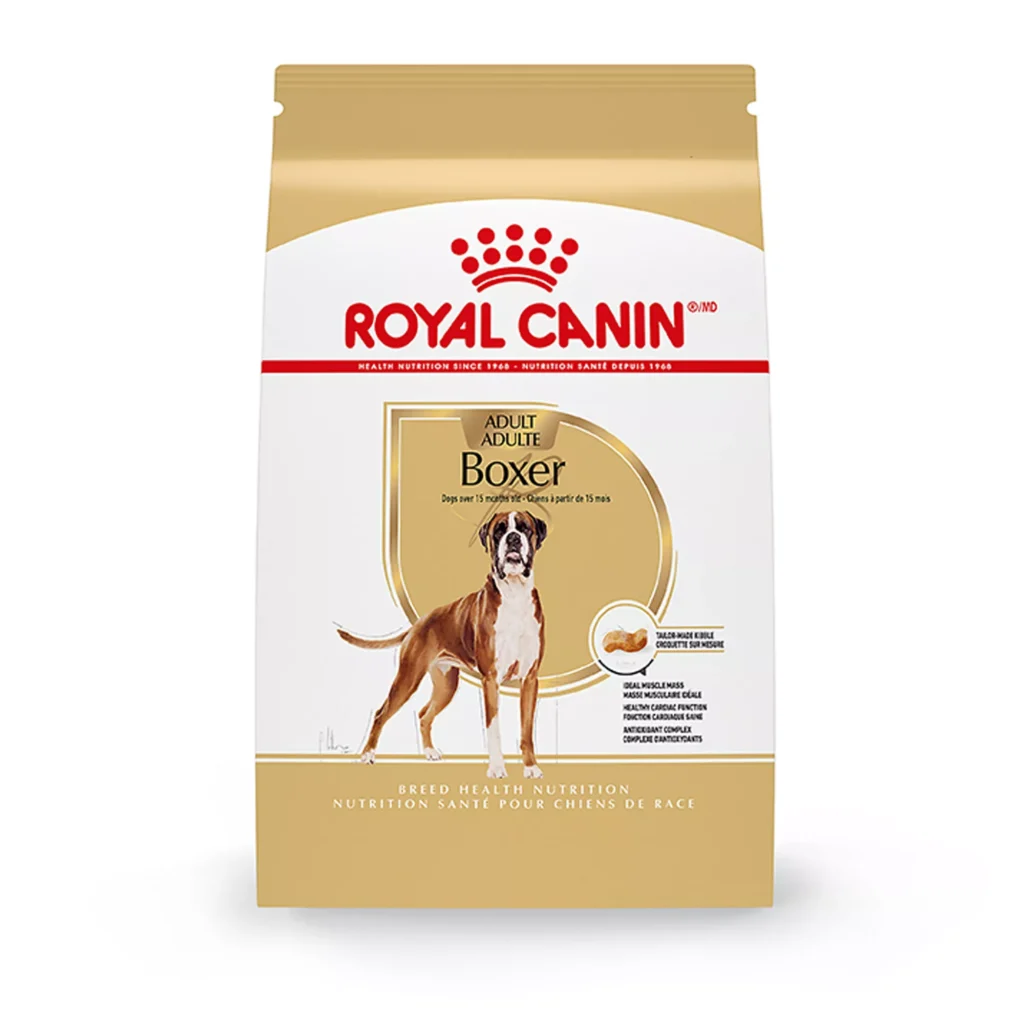
Royal Canin positions this formula as a breed-specific solution designed exclusively for adult Boxers aged 15 months and older. The brand emphasizes several key features that supposedly set this food apart from generic large-breed formulas.
First, there’s the kibble shape and size. Royal Canin designed the pieces to accommodate a Boxer’s distinctive jaw structure and brachycephalic (short-nosed) facial anatomy. The goal is to make it easier for Boxers to pick up and chew their food, which theoretically encourages slower eating and better digestion.
Second, the formula includes targeted nutrients for cardiac health. Boxers are genetically predisposed to heart conditions, particularly dilated cardiomyopathy (DCM), so Royal Canin adds taurine, L-carnitine, and EPA/DHA to support heart muscle function. These aren’t gimmicks—there’s solid research backing the role of these nutrients in canine cardiovascular health.
Third, the recipe aims to support muscle mass and skin health. With a moderate protein level (24% as-fed) and added omega fatty acids, the food is formulated to maintain lean muscle and promote a healthy coat. Many Boxer owners report noticeable improvements in coat shine and texture after switching to this food.
The dry formula comes in 17 lb and 30 lb bags, with feeding guidelines tailored to your Boxer’s weight and activity level. Royal Canin also offers a complementary wet food (loaf in sauce, 13.5 oz cans) if you prefer to mix or rotate textures.
| Price per pound | $8.98 (approx.) |
| Primary protein | Chicken by-product meal |
| By-products | Yes (chicken by-product meal) |
| AAFCO compliance | Yes (nutrient profiles) |
| Formula options | Dry kibble + wet food (loaf in sauce) |
| Availability | Major retailers + online |
Take the free nutrition check and find out in under 1 minute which food is best tailored to your dog!
In just 60 seconds, find out which food fits your dog best — for free.
The first ingredient in Royal Canin Boxer Adult Dry Food is chicken by-product meal. This is a rendered product made from chicken parts excluding muscle meat—think organs, bones, and other tissues. It’s AAFCO-recognized and provides concentrated protein, but it’s often viewed as lower quality compared to fresh chicken or chicken meal.
By-product meal isn’t inherently bad. It’s a cost-effective protein source that many dogs digest well, and it meets nutritional standards. However, if you’re the type of owner who prefers seeing “deboned chicken” or “chicken meal” at the top of the ingredient list, this might give you pause.
The formula also includes corn gluten meal, which contributes additional protein but is plant-based rather than animal-based. This raises the total protein percentage but doesn’t offer the same amino acid profile as meat.
Royal Canin relies heavily on grains for carbohydrates. You’ll find brown rice, brewers rice, corn, and oat groats prominently featured in the ingredient list. These are common, affordable carb sources that provide energy and help bind the kibble during manufacturing.
While grains aren’t harmful to most dogs, they’re often criticized as “fillers” by owners who prefer grain-free or high-meat formulas. In this case, the estimated carbohydrate content on a dry matter basis is around 44%—significantly higher than many premium competitors that emphasize meat over grains.
If your Boxer has no grain sensitivities or allergies, these ingredients shouldn’t cause problems. But if you’re looking for a low-carb, grain-free option, this formula won’t meet your expectations.
Chicken fat and fish oil provide the primary fat sources, delivering 15% crude fat (about 16.7% on a dry matter basis). This is moderate for a large-breed adult food and supports energy needs without pushing into high-fat territory that could contribute to weight gain.
The inclusion of fish oil brings EPA and DHA, omega-3 fatty acids linked to skin health, coat quality, and anti-inflammatory benefits. However, the specific amounts aren’t disclosed on the label, so it’s hard to know if the levels are truly therapeutic or just nominal.
Other functional ingredients include dried beet pulp (a fiber source that supports digestion), sodium tripolyphosphate (helps reduce tartar buildup), and a full vitamin and mineral premix to ensure nutritional completeness.
A few ingredients might raise eyebrows depending on your priorities:
None of these ingredients are linked to recalls or safety issues for Royal Canin. They’re simply less desirable from a “premium ingredient” standpoint. If you’re okay with a functional, cost-effective formula rather than a boutique recipe, these won’t be dealbreakers.
Here’s how Royal Canin Boxer Adult stacks up nutritionally, both as-fed and on a dry matter basis (assuming typical 10% moisture for kibble, since the label doesn’t specify):
This macro profile is moderate protein, moderate fat, and carb-rich. It meets AAFCO standards for adult maintenance comfortably, but the protein level is on the lower end compared to many high-performance or grain-free competitors that hover around 30-35% protein on a dry matter basis.
For an adult Boxer with moderate activity, this balance is adequate. However, if your Boxer is highly active, working, or athletic, you might want to consider a higher-protein option to support muscle maintenance and energy demands.
Royal Canin doesn’t list the caloric density on the product page or label for the dry food, which is frustrating for owners who like to calculate feeding costs per calorie. Based on typical kibble formulations with similar macros, you can estimate around 380-390 kcal per 100g, but this is an educated guess rather than confirmed data.
The wet food, by contrast, lists 948 kcal/kg, which translates to about 94.8 kcal per 100g. This is typical for canned loaf-style food and makes it easy to mix with kibble for variety or hydration.
AAFCO requires adult maintenance dog food to contain at least 18% protein and 5.5% fat on a dry matter basis. Royal Canin Boxer Adult exceeds both minimums easily, so there’s no concern about nutritional adequacy from a regulatory standpoint.
That said, meeting minimums doesn’t mean the food is optimal for every dog. Active Boxers or those recovering from illness might benefit from higher protein, while less active or senior Boxers might do fine with this moderate level.
Take the free nutrition check and find out in under 1 minute which food is best tailored to your dog!
In just 60 seconds, find out which food fits your dog best — for free.
Royal Canin’s recall history is relatively clean in recent years, but it’s not spotless. The brand experienced two significant recalls in the mid-2000s:
Since 2010, there have been no recalls or safety advisories involving Royal Canin in the United States. The Boxer-specific formula has never been subject to a recall, which is reassuring for safety-conscious owners.
Royal Canin operates company-owned manufacturing facilities in the US, including plants in Rolla, Missouri; Lebanon, Tennessee; and a new state-of-the-art facility in Lewisburg, Ohio, which opened in 2025. The Ohio plant is a $450 million investment and produces the Boxer formula for the US market.
The brand emphasizes process control, automated quality checks, and in-house R&D labs. However, specific certifications like ISO, HACCP, or third-party testing results for heavy metals, pathogens, or nutrient verification aren’t publicly disclosed. This lack of transparency is a minor drawback for owners who want to see independent testing data.
Royal Canin Boxer Adult is formulated to meet AAFCO Dog Food Nutrient Profiles for adult maintenance. This means it’s designed based on nutrient profiles rather than feeding trials, which is the most common approach in the industry. While feeding trials are considered the gold standard, formulation-based claims are still reliable when done by reputable manufacturers.
There are no current FDA, WSAVA, or AVMA advisories related to Royal Canin or this specific product as of 2025.
Royal Canin Boxer Adult is priced at approximately $1.98 per 100g, which translates to about $5.09 per 1,000 kcal (based on estimated caloric density). This places it firmly in the premium price range.
For comparison, here’s how it stacks up against two competitors:
If you’re feeding a 60 lb Boxer, you’ll go through about 374g of Royal Canin per day (based on feeding guidelines for moderate activity). That’s roughly $7.40 per day, or about $221 per month. This is a substantial ongoing expense, especially compared to mid-range brands.
Whether Royal Canin Boxer Adult justifies its price depends on your priorities. If you value breed-specific tailoring, veterinary backing, and a proven track record, the premium might feel worth it. Many owners report improvements in digestion, coat quality, and overall vitality after switching to this food.
However, if you’re budget-conscious or prefer high-protein, grain-free formulas, you can find nutritionally adequate alternatives for significantly less money. Taste of the Wild, for instance, offers higher protein and lower carbs at nearly half the cost per calorie.
Across major retailers like Chewy and Walmart, Royal Canin Boxer Adult maintains an impressive 4.7 out of 5-star average rating, with about 85% of reviews awarding five stars. Here’s what owners consistently praise:
While the majority of feedback is positive, a few recurring concerns appear in the roughly 4% of one-star reviews:
It’s worth noting that negative reviews often reflect individual dog sensitivities or owner preferences rather than widespread quality issues. Most Boxers tolerate and thrive on this formula.
This food is an excellent choice if your Boxer fits one or more of these profiles:
If you’re exploring other breed-specific options from the same brand, you might also want to check out our Royal Canin German Shepherd Puppy Food review to see how the formulation approach compares across breeds.
Consider alternatives if your Boxer has any of these needs or circumstances:
Royal Canin is owned by Mars, Inc., a private US conglomerate with a massive pet food portfolio including Pedigree, Nutro, Eukanuba, and Sheba. Mars operates more than 37 manufacturing facilities in the US alone, giving it extensive resources for quality control and research.
Royal Canin’s US dry foods, including the Boxer formula, are produced in company-owned plants rather than outsourced to co-packers. This vertical integration allows for tighter oversight but also means the brand is part of a large corporate structure that some consumers view as less “authentic” than smaller, independent companies.
Royal Canin doesn’t publicly disclose detailed sourcing information for the Boxer formula. You won’t find transparency about where the chicken by-product meal comes from, whether grains are US-grown, or how fish oil is harvested. This lack of visibility is a drawback for owners who prioritize traceability and ethical sourcing.
The brand makes vague claims about environmental stewardship and some use of recycled packaging, but there are no prominent third-party certifications like Marine Stewardship Council (MSC) for fish oil, USDA Organic, or carbon-neutral commitments. If sustainability and animal welfare certifications are high priorities for you, Royal Canin doesn’t offer much to work with.
Royal Canin has faced minimal legal trouble in the last decade. There was a 2025 class-action lawsuit related to prescription pet food labeling expectations (not specific to the Boxer formula), and a 2005 environmental fine for a Clean Water Act violation at the Rolla, Missouri plant. Neither case involved food safety or quality concerns.
Overall, the manufacturer’s track record is solid from a compliance and safety standpoint, even if transparency could be better.
Royal Canin markets the Boxer formula as scientifically tailored to the breed’s unique needs. While there’s no published peer-reviewed study specifically testing this formula against alternatives, the concept of breed-specific nutrition has some support in veterinary literature.
For example, research shows that Boxers are prone to dilated cardiomyopathy (DCM), and nutrients like taurine and L-carnitine have been linked to improved cardiac function in at-risk breeds. A 2021 study in Frontiers in Veterinary Science (DOI: 10.3389/fvets.2021.640049) found that taurine supplementation can help mitigate DCM progression in certain dogs.
Similarly, the inclusion of EPA and DHA from fish oil supports skin health and reduces inflammation, which is relevant for Boxers prone to allergies and dermatitis.
The World Small Animal Veterinary Association (WSAVA) emphasizes that pet food manufacturers should demonstrate accountability through quality control, routine testing, and evidence-based formulation. Royal Canin’s compliance with AAFCO standards and its veterinary partnerships align with these principles, even if the brand doesn’t publish independent testing results.
AAFCO doesn’t require breed-specific formulations—nutritional adequacy is judged by life stage (puppy, adult, senior) rather than breed. So while Royal Canin’s breed-specific approach goes beyond regulatory requirements, it’s not a regulatory necessity.
Royal Canin is widely recommended by veterinarians, often grouped with Hill’s and Purina as the “Big Three” in clinical nutrition. This endorsement stems from the brand’s long history, research investment, and consistent quality control rather than specific clinical trials for every formula.
However, it’s worth noting that veterinary recommendations can be influenced by corporate partnerships, continuing education sponsorships, and familiarity rather than solely evidence-based superiority. Royal Canin is a trusted choice, but it’s not the only option backed by solid science.
Royal Canin Boxer Adult Dry Dog Food is a reliable, veterinarian-backed option that delivers on its promise of breed-specific nutrition for most adult Boxers. The formula supports cardiac health, digestive stability, and coat quality with targeted nutrients like taurine, L-carnitine, and omega fatty acids. Real-world feedback is overwhelmingly positive, with most owners reporting visible improvements in their dogs’ health and vitality.
That said, the premium price is hard to ignore, especially when you consider the moderate protein level and reliance on by-products and grains. If you’re looking for maximum protein, whole-food ingredients, or grain-free options, you’ll find better value elsewhere. Similarly, the lack of transparency around ingredient sourcing and sustainability might be a dealbreaker for ethically minded buyers.
For Boxers with moderate activity, no severe allergies, and owners who trust veterinary guidance, this food is a solid choice. Just be prepared to pay for it. If budget or ingredient philosophy are sticking points, alternatives like Taste of the Wild or other high-protein brands might serve you better without sacrificing nutritional adequacy.
In the end, Royal Canin Boxer Adult earns a 77 out of 100 in my assessment. It’s good at what it does, but it’s not perfect for every dog or every budget.
Take the free nutrition check and find out in under 1 minute which food is best tailored to your dog!
In just 60 seconds, find out which food fits your dog best — for free.
The premium price (around $221 per month for a 60 lb Boxer) is justified if you prioritize breed-specific nutrition, veterinary backing, and proven results. Most owners report improvements in coat quality, digestion, and overall health. However, if you’re budget-conscious or prefer high-protein formulas, you can find nutritionally adequate alternatives like Taste of the Wild for nearly half the cost per calorie. The value depends on your specific priorities and your dog’s individual needs.
Chicken by-product meal is a concentrated protein source made from organs, bones, and other chicken parts excluding muscle meat. While it’s AAFCO-recognized and nutritionally adequate, it’s often viewed as lower quality than fresh chicken or chicken meal. Royal Canin uses it because it’s cost-effective and provides consistent protein content, but if you prefer seeing whole meat as the first ingredient, this formula won’t align with your preferences.
The 24% protein content might be insufficient for highly active, working, or athletic Boxers. While it meets basic adult maintenance requirements, active dogs typically benefit from higher protein levels (30-35%) to support muscle recovery and energy demands. Consider a performance or high-protein formula if your Boxer has intense exercise routines or demanding work schedules.
No, this formula is not suitable for dogs with grain sensitivities or allergies. It contains corn, corn gluten meal, brown rice, and brewers rice as prominent ingredients. If your Boxer has confirmed grain intolerances, you’ll need to look for grain-free alternatives. However, if your dog has no grain sensitivities, these ingredients are safe and digestible.
The specially designed kibble accommodates a Boxer’s brachycephalic (short-nosed) facial anatomy and distinctive jaw structure. The shape and size are intended to make it easier for Boxers to pick up and chew their food, which can encourage slower eating and better digestion. While this sounds like marketing, many owners do report that their Boxers seem to eat more comfortably with this formula.
Yes, the formula includes taurine, L-carnitine, and EPA/DHA specifically to support cardiac health. Since Boxers are genetically predisposed to dilated cardiomyopathy (DCM), these nutrients are backed by research showing benefits for heart muscle function. However, this food isn’t a treatment for existing heart conditions—it’s preventive nutrition that should be used alongside regular veterinary monitoring.
For a 60 lb Boxer with moderate activity, you’ll use approximately 374g per day based on feeding guidelines. A 30 lb bag (13.6 kg) will last about 36 days, while a 17 lb bag (7.7 kg) will last roughly 21 days. Feeding amounts vary based on your dog’s weight, activity level, and individual metabolism, so always follow the package guidelines and consult your vet if needed.
Yes, mixing is fine and Royal Canin offers a complementary Boxer wet food (loaf in sauce, 13.5 oz cans) designed to pair with the dry formula. Mixing can add variety, increase moisture content, and enhance palatability. Just remember to adjust portions accordingly to avoid overfeeding—the wet food contains about 94.8 kcal per 100g compared to an estimated 380-390 kcal per 100g for the kibble.
The Boxer-specific formula has never been subject to a recall. Royal Canin experienced two significant recalls in the mid-2000s (2006 and 2007) affecting other formulas, but there have been no recalls or safety advisories involving any Royal Canin products since 2010. The brand’s recent safety record is clean, which is reassuring for safety-conscious owners.
If your Boxer is thriving on their current food with good digestion, healthy weight, shiny coat, and normal energy levels, there’s no compelling reason to switch. The “if it ain’t broke, don’t fix it” principle applies to dog nutrition. However, if you’re dealing with digestive issues, coat problems, or your vet specifically recommends breed-specific nutrition, this could be worth trying during a gradual transition period.
9 out of 10 dog owners are feeding their dog the wrong food.
Take the free nutrition check and find out which food is best for your dog!
2,847+ dog owners already did