9 out of 10 dog owners are feeding their dog the wrong food

Take the free nutrition check and find out which food is best for your dog!

Shelter manager, certified canine nutritionist, and lifelong dog lover
• Single-protein specialization: Pure Vita’s limited-ingredient approach with one protein source per recipe makes it exceptionally valuable for dogs with food allergies and sensitivities, enabling effective elimination diets.
• Outstanding safety record: Zero major recalls in the past decade from this family-owned Minnesota facility demonstrates superior quality control compared to many premium competitors with multiple recall incidents.
• Premium pricing with targeted benefits: At $3-4 per pound, Pure Vita costs roughly double mainstream premium foods but delivers meaningful health improvements for dogs with digestive issues and skin problems.
• Exceptional palatability for specialty food: Unlike many limited-ingredient diets that sacrifice taste, Pure Vita achieves high acceptance rates even among picky eaters, with salmon and duck formulas being particularly popular.
• Real-world performance validation: Customer feedback consistently reports firmer stools, reduced scratching, shinier coats, and resolution of chronic digestive issues within 3-6 weeks of switching to Pure Vita.
Take the free nutrition check and find out in under 1 minute which food is best tailored to your dog!
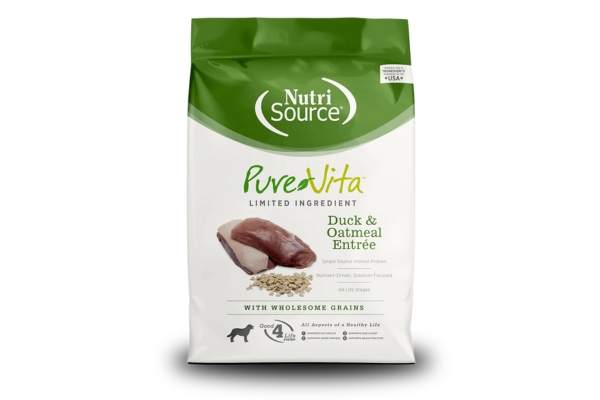
Pure Vita is part of the NutriSource family, produced by Tuffy’s Pet Foods—a third-generation, family-owned company that’s been in business since 1964. The brand was launched in the mid-2000s specifically to address the growing demand for limited-ingredient diets and holistic nutrition for dogs with food sensitivities.
The company’s core philosophy centers on single-source animal protein, meaning each recipe contains just one type of meat or fish. This approach minimizes the risk of triggering food allergies and makes it easier to identify problem ingredients if your dog does react. Pure Vita also avoids corn, wheat, soy, and animal by-products across all formulas.
All Pure Vita products are manufactured in Perham, Minnesota, in a state-of-the-art facility built in 2015 with a $70 million investment. The company maintains direct control over the entire production process, from ingredient testing to finished product, which is relatively rare in the pet food industry. This level of vertical integration contributes to strong traceability and quality control.
Pure Vita sits firmly in the premium specialty segment. You won’t find it in grocery stores or big-box retailers—it’s sold primarily through independent pet stores and online specialty retailers. This distribution strategy reinforces the brand’s positioning as a step above mainstream options.
The brand has built a solid reputation among dog owners dealing with allergies, sensitive stomachs, and chronic digestive issues. Customer ratings consistently hover around 4.7 out of 5 stars across major platforms, with particularly strong feedback on palatability and digestibility.
What’s notable is Pure Vita’s clean safety record. The brand has had no major recalls in the past decade, which stands in contrast to several competitors in the premium segment. For a family-owned operation, this track record reflects both careful sourcing and rigorous quality control.
When you’re paying premium prices, ingredient quality matters. Let’s break down what’s actually in Pure Vita formulas and whether the ingredient list lives up to the brand’s marketing.
Pure Vita’s defining feature is its commitment to single animal protein per recipe. If the bag says Turkey & Sweet Potato, you’ll only find turkey—no chicken meal, no fish meal, no “poultry by-product” hedging. This makes Pure Vita particularly valuable for elimination diets when you’re trying to pinpoint food allergies.
The protein sources include both fresh meat and concentrated meat meals. For example, the Turkey & Sweet Potato formula lists turkey as the first ingredient, followed by turkey meal further down. This combination provides both moisture and concentrated protein. The use of named meals (turkey meal, salmon meal) rather than generic “poultry meal” is a quality indicator—you know exactly what animal the protein comes from.
Protein variety is solid. Beyond standard chicken, beef, and lamb, Pure Vita offers novel proteins like kangaroo, duck, and pork. These alternatives can be valuable for dogs with multiple protein sensitivities or for rotation feeding to prevent new allergies from developing.
Pure Vita offers both grain-free and grain-inclusive lines, giving you flexibility based on your dog’s needs and your comfort level with the grain-free debate.
The grain-free recipes use sweet potatoes, peas, and lentils as primary carbohydrate sources. These ingredients provide digestible energy and fiber without common allergens. The grain-inclusive formulas feature brown rice, oatmeal, and barley—whole grains that offer steady energy and additional fiber for digestive health.
One thing I appreciate is that Pure Vita doesn’t rely heavily on white potatoes, which some brands use as cheap filler in grain-free formulas. The carbohydrate sources chosen here have nutritional value beyond just caloric density.
| Price per pound | $3.00 – $5.00 |
| Primary protein | Turkey, Salmon, Chicken, Duck, Lamb, Pork, Beef, Kangaroo |
| By-products | None |
| AAFCO compliance | Yes (formulation method) |
| Formula options | Grain-free and grain-inclusive lines (10+ recipes) |
| Availability | Independent pet stores + online specialty retailers |
Take the free nutrition check and find out in under 1 minute which food is best tailored to your dog!
In just 60 seconds, find out which food fits your dog best — for free.
Pure Vita uses canola oil and menhaden fish meal as primary fat sources, providing both omega-6 and omega-3 fatty acids. The guaranteed analysis shows omega-6 at around 2.3% and omega-3 at 0.8%, which creates a reasonable ratio for skin and coat health.
The inclusion of menhaden fish meal—even in poultry-based recipes—adds EPA and DHA, the specific omega-3s that support brain function, joint health, and anti-inflammatory processes. This is a thoughtful addition that goes beyond just hitting minimum fat requirements.
Beyond the basics, Pure Vita includes what they call the “Good 4 Life” system—a proprietary blend of prebiotics, probiotics, and chelated minerals designed to support digestive health and nutrient absorption.
Specific additions include:
These additions are standard in premium foods but worth noting. The glucosamine content (around 1,321 mg/kg) and chondroitin (2,146 mg/kg) are respectable levels that may genuinely support joint health, especially in larger or aging dogs.
Pure Vita’s exclusion list is just as important as what it includes. You won’t find:
For dogs with sensitivities, these omissions matter. Corn and wheat are common allergens, while by-products and generic meals can introduce proteins from multiple sources, defeating the purpose of a limited-ingredient diet.
Premium ingredients mean little if the nutritional profile doesn’t support your dog’s health. Let’s examine whether Pure Vita delivers balanced nutrition that meets or exceeds industry standards.
Taking the Turkey & Sweet Potato formula as a representative example, here’s what you’re getting on a dry matter basis:
The protein level is moderate to high for an all-life-stages formula. It comfortably exceeds AAFCO minimums (18% for adult maintenance, 22.5% for growth and reproduction) while staying below the very high protein levels (30%+) that some active or working dogs might need.
The fat content at around 17-18% dry matter is similarly moderate. This provides adequate energy without being so rich that it causes digestive upset in sensitive dogs. For highly active dogs or those living in cold climates, you might want slightly higher fat, but for most household dogs, this level supports healthy weight maintenance.
Calculated carbohydrate content comes in around 35-36%, which is reasonable for a premium food. Some ultra-high-protein foods drop carbs to 25-30%, but Pure Vita’s level still prioritizes protein and fat while providing digestible energy from quality carbohydrate sources.
Pure Vita meets AAFCO requirements for all essential vitamins and minerals. The use of chelated minerals—where minerals are bound to amino acids for better absorption—is a quality touch that distinguishes premium foods from budget options.
Key micronutrients include:
The inclusion of taurine across all formulas is worth highlighting. While dogs can synthesize taurine (unlike cats), supplementation supports heart health and has become more common in quality dog foods, especially grain-free formulas, following concerns about DCM (dilated cardiomyopathy).
Pure Vita formulas typically provide around 3,600-3,900 kcal/kg (roughly 350-430 kcal per cup), depending on the specific recipe. This is moderate caloric density—not as concentrated as some high-performance foods, but more energy-dense than weight management formulas.
For a 30-pound adult dog with moderate activity, you’re looking at roughly 1.5 cups per day. For a 60-pound dog, around 2.5 cups. These are reasonable feeding volumes that won’t leave your dog constantly hungry but also won’t require massive portions that blow through bags quickly.
All Pure Vita formulas are formulated to meet AAFCO nutritional standards for “All Life Stages,” meaning they’re nutritionally complete for puppies, adults, and seniors. However, it’s important to note that Pure Vita uses the formulation method rather than feeding trials to establish nutritional adequacy.
The formulation method means the recipes are calculated to meet AAFCO nutrient profiles on paper, which is perfectly acceptable and how most premium foods are validated. Feeding trials—where dogs actually eat the food in controlled conditions—provide additional assurance but are expensive and not required. Given Pure Vita’s strong real-world performance and customer feedback, the formulation method appears adequate here.
Pure Vita’s limited-ingredient, single-protein approach makes it particularly well-suited for specific situations and dog types.
Dogs with food allergies or sensitivities are the primary target audience. If your dog has chronic itching, ear infections, digestive upset, or skin issues that haven’t responded to basic diet changes, Pure Vita’s single-protein formulas make it easy to identify and avoid problem ingredients. The kangaroo and duck recipes are especially useful for dogs who’ve developed sensitivities to more common proteins.
Dogs with sensitive stomachs often do well on Pure Vita. The limited ingredient list reduces the potential for digestive irritation, while the probiotic and prebiotic additions support healthy gut flora. Many customer reviews specifically mention improvements in stool quality and reduced gas.
Small and medium breeds are well-served by Pure Vita’s standard kibble size, and the brand offers Small Bites versions of popular recipes for toy and small breeds. The moderate caloric density works well for less-active dogs or those prone to weight gain.
Puppies and growing dogs can safely eat Pure Vita, as all formulas meet AAFCO standards for growth and reproduction. The Puppy Lamb & Pumpkin formula is specifically designed for young dogs, with appropriate calcium and phosphorus levels for skeletal development. The single-protein approach can also help prevent food sensitivities from developing during the critical growth period.
Senior dogs benefit from the glucosamine and chondroitin additions, which support joint health as dogs age. The moderate protein and fat levels are appropriate for less-active older dogs, and the digestibility focus becomes increasingly important as dogs’ digestive systems become less efficient with age.
Pure Vita might not be the best fit for highly active or working dogs who burn massive calories. While the formulas are nutritionally complete, very active dogs often need higher fat content (20%+) and greater caloric density than Pure Vita provides. You’d end up feeding very large portions to meet energy needs.
Large and giant breed puppies have specific calcium and phosphorus requirements to prevent developmental orthopedic disease. While Pure Vita’s all-life-stages formulas are technically appropriate, foods specifically formulated for large breed puppy growth (with controlled calcium levels around 1.2-1.5%) might be a safer choice for breeds expected to exceed 70 pounds as adults.
Dogs requiring prescription diets for specific medical conditions—kidney disease, liver disease, certain types of stones, etc.—need veterinary-formulated foods that Pure Vita doesn’t offer. The brand focuses on wellness and sensitivity management, not therapeutic nutrition.
Dogs with multiple protein allergies might eventually run out of Pure Vita options if they react to several of the available proteins. At that point, a hydrolyzed protein prescription diet might be necessary.
Take the free nutrition check and find out in under 1 minute which food is best tailored to your dog!
In just 60 seconds, find out which food fits your dog best — for free.
Premium ingredients and careful formulation mean nothing if your dog won’t eat the food. Palatability is where Pure Vita consistently earns high marks from customers.
Approximately 75% of positive customer reviews specifically mention that their dog loves the food. This is notably high for a limited-ingredient diet—these formulas typically sacrifice some palatability compared to foods loaded with flavor enhancers and multiple protein sources.
The success rate with picky eaters is particularly impressive. Many reviewers report that Pure Vita was one of the few foods their selective dogs would consistently eat. The salmon and duck formulas seem to be especially popular, followed by the pork and lamb recipes.
Pure Vita offers reasonable variety within its single-protein constraint:
This variety allows for rotation feeding—switching between proteins every few months to prevent sensitivity development and provide nutritional variety. Since each formula is single-protein, rotating is straightforward and safe for sensitive dogs.
The standard kibble is medium-sized and relatively dense, which most dogs handle well. The Small Bites versions use lighter, smaller pieces that toy and small breeds can more easily crunch. I appreciate that Pure Vita offers size-appropriate options rather than expecting a Chihuahua to tackle the same kibble as a Golden Retriever.
The kibble has a noticeable smell—not unpleasant, but distinctly meaty or fishy depending on the protein source. This is normal for premium foods without artificial flavoring, and it actually seems to attract dogs rather than put them off.
Most dogs transition to Pure Vita smoothly when you follow the standard gradual introduction—mixing increasing amounts of new food with decreasing amounts of old food over 7-10 days. Some dogs with particularly sensitive stomachs might need a slower transition (10-14 days), but this is true of any diet change.
A small percentage of reviews mention initial digestive upset (loose stools, gas) during transition, but this typically resolves within a week. If your dog has a history of dietary sensitivity, consider an even more gradual transition and possibly adding a probiotic supplement during the switch.
Pure Vita sits firmly in the premium price bracket. Whether it offers good value depends on what you’re comparing it to and what you prioritize.
Based on current retail pricing for the popular Turkey & Sweet Potato grain-free formula:
The novel protein formulas (kangaroo, duck) command even higher prices, often approaching $4.50-5.00 per pound even in larger bags. The grain-inclusive recipes are slightly less expensive, typically $3.50-4.00 per pound.
To put this in practical terms, here’s what you’d spend per day feeding Pure Vita Turkey & Sweet Potato (25-lb bag at $75):
For a medium-sized dog (30 pounds), you’re looking at roughly $55 per month. For a large dog (60 pounds), around $90 per month. These costs are significantly higher than mainstream premium brands like Purina Pro Plan ($0.80-1.20 less per day) but similar to other specialty limited-ingredient foods like Blue Buffalo Basics.
Compared to other premium limited-ingredient diets, Pure Vita’s pricing is competitive. Natural Balance L.I.D. and Blue Buffalo Basics typically fall in a similar price range, while ultra-premium options like Acana Singles or Orijen can cost 20-40% more.
What you’re paying for with Pure Vita:
If your dog has genuine food sensitivities or allergies, the premium price makes sense—you’re paying for careful ingredient selection and formulation that addresses real health issues. The cost of managing chronic allergy symptoms (vet visits, medications, special shampoos) often exceeds the difference between budget and premium food.
However, if you’re feeding Pure Vita simply because it seems healthier, but your dog has no sensitivity issues, you might not see enough practical benefit to justify the cost difference. A solid mainstream premium food like Diamond Naturals would provide complete nutrition at roughly half the price.
If you want to feed Pure Vita but need to manage costs:
Take the free nutrition check and find out in under 1 minute which food is best tailored to your dog!
In just 60 seconds, find out which food fits your dog best — for free.
Understanding where and how dog food is made gives important context for evaluating quality and safety.
All Pure Vita products are manufactured at a single facility in Perham, Minnesota, operated by Tuffy’s Pet Foods. The company built a state-of-the-art production plant in 2015 with a $70 million investment, which demonstrates serious commitment to quality and capacity.
The facility is owned and operated by the same family that owns the Pure Vita brand, which is relatively unusual in the pet food industry. Many brands contract manufacturing to third-party facilities, which can create quality control challenges and supply chain complexity. Pure Vita’s vertical integration means the company has direct control over every step from ingredient receiving to finished product.
Pure Vita implements several quality control measures:
The company claims full compliance with FDA and AAFCO standards, though specific certifications like HACCP or ISO are not publicly disclosed. This isn’t necessarily a red flag—such certifications aren’t required for US pet food manufacturing—but transparency on this front would be welcome.
Pure Vita sources ingredients from what they describe as “dedicated, traceable vendors” who must meet ethical and regulatory standards. The company uses both domestic and international ingredients, though specific country-of-origin information for each ingredient isn’t publicly detailed beyond general statements about traceability.
The use of named meat meals (turkey meal, salmon meal) rather than generic meals is a quality indicator—these meals come from specific, identifiable protein sources rather than mixed animal proteins. Fresh meat is also used, though the exact ratio of fresh meat to meal isn’t disclosed.
Pure Vita’s safety record is one of its strongest selling points. The brand has had no major recalls in the past decade, which is genuinely impressive given the number of recalls affecting both large and small pet food companies during this period.
The parent company, Tuffy’s Pet Foods, did have a recall in 2019 for potential Salmonella contamination, but this affected a different product line and was handled promptly with voluntary recall and consumer notification. Since then, no further safety issues have been reported.
This clean track record reflects both careful ingredient sourcing and effective quality control processes. It’s one of the factors that justifies Pure Vita’s premium pricing.
For many dog owners, how food is made matters as much as what’s in it. Pure Vita’s approach to sustainability and ethics is mixed—strong in some areas, less transparent in others.
Pure Vita collaborates with Alltech on sustainable agriculture practices, particularly around the “Good 4 Life” supplement system that includes prebiotics and probiotics. This partnership focuses on gut health supplements that can improve nutrient absorption and potentially reduce waste.
However, detailed information about the company’s overall environmental footprint—energy use, water consumption, waste management, carbon emissions—is not publicly available. This lack of transparency is common among mid-sized pet food companies but falls short of what some consumers expect from premium brands.
Pure Vita uses standard poly-lined bags for dry food, which are not readily recyclable through most municipal programs. Some specialty recycling programs accept pet food bags, but this requires extra effort from consumers. The bags are not certified biodegradable or compostable.
This is an area where Pure Vita could improve. Some competitors are moving toward more sustainable packaging options, and given Pure Vita’s premium positioning, customers might reasonably expect more environmental consideration.
Pure Vita claims not to conduct animal testing on finished products, which is standard practice in the industry. However, specific policies regarding animal welfare in ingredient sourcing—farm conditions, humane slaughter practices, wild-caught vs. farmed fish—are not detailed publicly.
The use of novel proteins like kangaroo raises questions about sustainable sourcing and population management, but Pure Vita doesn’t provide transparency on these supply chains.
The parent company, Tuffy’s Pet Foods, is noted for community involvement including donations to schools, food pantries, healthcare causes, and animal rescue organizations. This family-owned company appears to maintain strong local ties in Minnesota.
The company also offers a 100% satisfaction guarantee, which demonstrates confidence in product quality and commitment to customer service.
Pure Vita/Tuffy’s Pet Foods has no documented ethical controversies or scandals as of 2025. The company remains family-owned, which means it’s not subject to the same quarterly profit pressures that can compromise quality at publicly traded companies.
The company’s stated mission emphasizes “compassion, integrity, and a deep-rooted sense of community,” with a focus on decisions that benefit employees, community, and pets rather than maximizing shareholder returns.
I volunteer regularly at a local shelter, where we occasionally test different foods with dogs who have specific dietary needs. We recently tried Pure Vita Salmon & Peas with a dog named Benny, a four-year-old Beagle mix who’d been surrendered by his previous owner due to chronic skin issues and persistent itching.
Benny had been at the shelter for about three weeks when we started the Pure Vita trial. His previous owner reported trying multiple foods without success, and the shelter had been feeding him a basic maintenance kibble that met his nutritional needs but wasn’t addressing the skin problems. He had noticeable redness around his ears and paws, and spent a good portion of his day scratching.
We transitioned Benny gradually over ten days, mixing increasing amounts of Pure Vita with his existing food. He took to the new food immediately—no hesitation, no sniffing and walking away. The salmon formula has a distinctive fishy smell that some dogs find irresistible, and Benny was clearly in that camp.
During the transition period, his stools remained normal, which was encouraging. Some dogs with sensitive systems show digestive upset when switching foods, but Benny handled the change smoothly.
Once fully transitioned, Benny ate Pure Vita enthusiastically at every meal. He’s not a particularly picky eater—Beagles rarely are—but he showed clear preference for the Pure Vita over his previous food. He’d finish his bowl quickly and lick it thoroughly, which isn’t something he’d done consistently before.
The feeding volume was reasonable for his 35-pound frame—about 1.75 cups per day split into two meals. He seemed satisfied after meals and didn’t show the constant food-seeking behavior that sometimes indicates a dog isn’t getting adequate calories or satiety from their food.
The most noticeable change was in Benny’s skin condition. Within about three weeks, the redness around his ears had visibly decreased, and he was scratching significantly less—maybe 30-40% less than when he arrived. His coat didn’t transform dramatically, but it did look slightly shinier and felt softer when you petted him.
His energy level remained consistent—Benny was already a fairly active, playful dog, so there wasn’t a dramatic shift, but he maintained good stamina during play sessions and walks. He didn’t seem lethargic or overly hyper, just steady and engaged.
Stool quality was excellent—well-formed, consistent, and smaller in volume than with his previous food. This is often a sign of good digestibility, meaning more of the food is being absorbed and used rather than passing through. For shelter staff managing cleanup, this was a practical benefit.
From a practical standpoint, feeding Pure Vita was straightforward. The kibble didn’t crumble excessively, the bag sealed well, and measuring portions was easy. The fishy smell was noticeable when pouring the food but not overwhelming.
For Benny specifically, the most meaningful change was the reduction in scratching. He seemed more comfortable and spent more time playing and resting rather than obsessively scratching. This made him more appealing to potential adopters—a dog who’s constantly scratching and has visible skin irritation is harder to place.
After six weeks on Pure Vita, Benny was adopted by a family who was informed about his food sensitivities and chose to continue feeding him the salmon formula. The improvement in his skin condition was significant enough that it likely contributed to his successful adoption.
Customer feedback on Pure Vita is consistently positive across multiple platforms, with ratings typically ranging from 4.6 to 4.9 out of 5 stars.
Improved digestive health is the most frequently mentioned benefit. Owners report firmer stools, reduced gas, and resolution of chronic diarrhea or soft stool issues. One customer wrote, “My dogs have sensitive stomachs, and this dog food was the only one they could eat. I would highly recommend this dog food.”
Skin and coat improvements appear in roughly 20% of positive reviews. Customers describe shinier coats, reduced shedding, and most importantly, relief from chronic itching and skin irritation. “PureVita is the only food that cleared up our pup’s constant scratching and ear issues. We’re so grateful!” is representative of many reviews.
High palatability is noted by about 75% of reviewers. Many specifically mention that their picky dogs eat Pure Vita consistently, sometimes after refusing other premium brands. The salmon and duck formulas seem to be particular favorites.
Long-term success stories are common. Multiple reviewers report feeding Pure Vita for years with continued good results: “Had my dog on this food for over 6 years. She’s 12 and people constantly ask what I feed her—her coat’s still shiny and she’s as spry as a puppy.”
Price is the most frequent criticism, with about 4% of reviews mentioning that Pure Vita is expensive and some questioning whether the quality justifies the cost. “Price keeps going up, but I don’t see improvement in my dog’s health the way I did in the past” reflects this concern.
Formula changes have upset some long-time customers. About 3% of reviews mention noticing differences after recipe updates, with some dogs refusing the new formula: “My dog ate PureVita for years but refused the new formula after the change. Not sure what’s different.”
Individual sensitivities affect a small percentage of dogs. About 2-3% of reviews report that their dog developed loose stools, vomiting, or continued itching on Pure Vita, despite the food working well for most dogs with sensitivities. This is a reminder that no food works for every dog—individual variation in digestion and allergies means some trial and error is inevitable.
Quality control issues are rare but documented. A very small number of reviews mention receiving bags with unusual odor or, in isolated cases, visible mold. These appear to be outliers rather than systemic problems, and retailers typically replace affected products promptly.
Pure Vita isn’t as commonly recommended by veterinarians as prescription brands like Hill’s or Royal Canin, but some vets do suggest it for dogs with food sensitivities who don’t require therapeutic diets. The limited-ingredient, single-protein approach makes it useful for elimination diets when trying to identify food allergies.
Some veterinary nutritionists appreciate Pure Vita’s transparency about ingredients and its AAFCO compliance, though they note the lack of feeding trials (the brand uses the formulation method rather than actual feeding studies to establish nutritional adequacy).
Take the free nutrition check and find out in under 1 minute which food is best tailored to your dog!
In just 60 seconds, find out which food fits your dog best — for free.
Pure Vita occupies a specific niche in the premium dog food market. Understanding how it compares to alternatives helps clarify whether it’s the right choice for your situation.
Diamond Naturals offers a value-premium alternative at roughly half the price of Pure Vita ($1.20-1.60 per pound vs. $2.50-3.75). Both brands are family-owned with US manufacturing, but they target different customers.
Diamond Naturals provides good nutritional value with named meat meals, fruits, vegetables, and probiotics, but uses multiple protein sources in most formulas and includes more carbohydrates. This broader ingredient profile works well for dogs without sensitivities but isn’t suitable for elimination diets. If your dog has no food allergies or digestive issues and you’re simply looking for quality nutrition at a reasonable price, Diamond Naturals offers better value. If you’re managing confirmed sensitivities, Pure Vita’s single-protein approach justifies the premium.
Diamond Naturals has a more complicated recall history, with several incidents between 2012-2013, though none recently. Pure Vita’s clean safety record over the past decade is a meaningful advantage. Still curious about this comparison? Read our detailed Diamond Naturals review for a complete breakdown.
Blue Buffalo Basics is Pure Vita’s most direct competitor—both focus on limited-ingredient, single-protein formulas for sensitive dogs. Pricing is similar, and both brands avoid corn, wheat, soy, and by-products.
The main differences: Blue Buffalo is more widely available in mass-market pet stores, while Pure Vita focuses on specialty retailers. Blue Buffalo is owned by General Mills (a corporate conglomerate), while Pure Vita remains family-owned. Some customers prefer supporting smaller, family-owned companies, while others value Blue Buffalo’s wider distribution and frequent sales.
Nutritionally, the brands are comparable. Choice between them often comes down to which specific protein sources your dog tolerates and which is more readily available in your area.
Natural Balance pioneered limited-ingredient diets and offers similar single-protein formulas at comparable prices. Natural Balance has broader protein variety, including more exotic options like bison and venison.
Natural Balance has had several recalls over the years, most recently in 2019 for potential elevated vitamin D levels. Pure Vita’s cleaner safety record gives it an edge for risk-averse consumers. Both brands perform well for sensitive dogs, so the choice often comes down to which specific proteins and formulations your dog prefers.
Fresh food services like The Farmer’s Dog, Ollie, and Nom Nom represent a different approach to premium dog nutrition—human-grade ingredients, fresh preparation, and home delivery. These services typically cost significantly more than Pure Vita (often $150-300+ per month for a medium dog vs. $55 for Pure Vita).
Fresh food offers maximum ingredient quality and digestibility, with even simpler ingredient lists than Pure Vita. However, the price difference is substantial, and you need dedicated freezer space. If budget allows and you want the highest-quality option, fresh food is worth considering. If you want premium nutrition at a more manageable price point, Pure Vita provides strong value as a high-quality kibble.
Brands like Orijen and Acana offer even higher protein content (38-40%+) with extensive fresh meat inclusion and premium pricing (often $4-6 per pound). These ultra-premium foods target peak performance and “biologically appropriate” nutrition.
For highly active dogs or those with specific performance needs, these ultra-premium options might be worth the extra cost. For dogs with sensitivities or more moderate activity levels, Pure Vita’s formulation is more appropriate—high protein isn’t always better, especially for dogs with certain health conditions. Pure Vita provides excellent nutrition at a somewhat more accessible price point.
Pure Vita’s limited-ingredient, single-protein design makes it particularly valuable for dogs with food sensitivities, allergies, or digestive issues. If your dog has chronic itching, ear infections, digestive upset, or skin problems that haven’t responded to basic diet changes, Pure Vita’s focused formulas make it easier to identify and avoid problem ingredients.
The food works well across all life stages—puppies, adults, and seniors can all safely eat Pure Vita, as the formulas meet AAFCO standards for growth and reproduction as well as adult maintenance. The Puppy Lamb & Pumpkin formula is specifically designed for growing dogs, while the glucosamine and chondroitin additions in all formulas support joint health in aging dogs.
Small and medium breeds are well-served by both the standard kibble and the Small Bites versions, which offer size-appropriate pieces for toy and small dogs. The moderate caloric density (350-430 kcal per cup) works well for less-active dogs or those prone to weight gain.
Dogs with sensitive stomachs often see noticeable improvements on Pure Vita, with firmer stools, reduced gas, and better overall digestive comfort. The probiotic and prebiotic additions support healthy gut flora, which becomes increasingly important as dogs age or after antibiotic treatments.
Pure Vita is less ideal for highly active or working dogs who burn massive calories—the moderate fat content (16-17%) and caloric density mean you’d need to feed large portions to meet extreme energy demands. Similarly, large and giant breed puppies might be better served by foods specifically formulated for their unique developmental needs, with carefully controlled calcium and phosphorus ratios.
If your dog requires a prescription therapeutic diet for kidney disease, liver disease, or other specific medical conditions, Pure Vita doesn’t offer those specialized formulations—you’ll need a veterinary-recommended brand like Hill’s Prescription Diet or Royal Canin Veterinary.
Yes, Pure Vita is genuinely good dog food, particularly if you’re dealing with food sensitivities or allergies. The single-protein, limited-ingredient approach isn’t just marketing—it’s a thoughtful design that makes real sense for dogs with digestive issues or skin problems related to diet.
What I genuinely appreciate about Pure Vita is the ingredient integrity. You’re getting named meat proteins, no by-products, no corn/wheat/soy filler, and a clean safety record with no recalls in the past decade. For a family-owned company operating a single facility, that track record reflects serious attention to quality control. The addition of functional ingredients—probiotics, joint support, taurine—shows that the brand is keeping pace with nutritional research rather than just meeting minimum standards.
The real-world performance backs up the ingredient quality. Customer feedback is consistently positive, with specific improvements in digestive health, skin condition, and coat quality reported by a large percentage of users. The high palatability is notable for a limited-ingredient food—these formulas often sacrifice taste, but Pure Vita seems to have found a good balance.
That said, Pure Vita isn’t perfect. The price point is genuinely high—roughly double what you’d pay for solid mainstream premium foods like Diamond Naturals or Purina Pro Plan. If your dog doesn’t have sensitivities or allergies, you might not see enough practical benefit to justify that cost difference. Pure Vita makes the most sense when you’re solving a specific problem, not just looking for “healthy” food in general.
The lack of transparency on sustainability—packaging, environmental practices, detailed sourcing—is disappointing for a premium brand. Consumers paying $3-4 per pound increasingly expect this information, and Pure Vita falls short compared to some competitors. The standard poly-lined bags aren’t recyclable through most programs, which is a missed opportunity.
Would I buy this for my own dog? If I had a dog with confirmed food sensitivities or chronic digestive issues, absolutely. The single-protein approach makes Pure Vita one of the most practical options for elimination diets, and the quality is there to back up the premium price. The clean safety record would give me confidence feeding it long-term.
If I had a healthy dog with no sensitivity issues, I’d probably choose a less expensive premium food and invest the savings in other aspects of dog care—training, vet visits, quality toys and enrichment. Pure Vita is excellent at what it does, but what it does is specifically valuable for a subset of dogs.
Would I recommend it to a friend? Yes, with context. If their dog is constantly scratching, has chronic ear infections, or cycles through digestive upset, I’d suggest Pure Vita as a strong option worth trying. The money-back guarantee and responsive customer service reduce the risk of trying it. If their dog is thriving on a less expensive food, I’d say stick with what’s working—there’s no need to fix what isn’t broken just because Pure Vita is “more premium.”
Bottom line: Pure Vita is thoughtfully formulated, well-made dog food with a clear purpose and strong track record. It’s priced as a premium specialty food, and for dogs who need what it offers—limited ingredients, single proteins, digestive support—it delivers real value. For dogs without those specific needs, the premium price is harder to justify, but the quality is genuinely there.
Take the free nutrition check and find out in under 1 minute which food is best tailored to your dog!
In just 60 seconds, find out which food fits your dog best — for free.
Yes, Pure Vita is specifically designed for dogs with food allergies and sensitivities. Each formula contains only one animal protein source, making it easier to identify and avoid problem ingredients. The brand excludes common allergens like corn, wheat, soy, and by-products. Many customers report significant improvements in itching, skin irritation, and digestive issues after switching to Pure Vita. However, if your dog has multiple protein allergies, you may eventually run out of Pure Vita options and need to consider a hydrolyzed protein prescription diet.
All Pure Vita products are manufactured at a single facility in Perham, Minnesota, operated by Tuffy’s Pet Foods. The company built this state-of-the-art production plant in 2015 with a $70 million investment. Unlike many pet food brands that contract manufacturing to third parties, Pure Vita maintains direct control over the entire production process, which contributes to their strong quality control and clean safety record.
Pure Vita typically costs $3.00-4.00 per pound for standard recipes, with novel proteins like kangaroo and duck reaching $4.50-5.00 per pound. For a 30-pound dog, expect to spend roughly $55 per month, while a 60-pound dog would cost around $90 per month to feed. This places Pure Vita in the premium price bracket, significantly higher than mainstream brands but competitive with other specialty limited-ingredient foods.
Pure Vita has an excellent safety record with no major recalls in the past decade. This clean track record is particularly impressive given the number of recalls affecting both large and small pet food companies during this period. The parent company, Tuffy’s Pet Foods, did have a recall in 2019 for a different product line, but Pure Vita itself has maintained a spotless safety record.
Pure Vita’s grain-free recipes use sweet potatoes, peas, and lentils as primary carbohydrate sources, while the grain-inclusive formulas feature brown rice, oatmeal, and barley. Both lines maintain the single-protein approach and exclude corn, wheat, and soy. The grain-inclusive options are typically $0.50-1.00 less per pound and may be preferable for dogs who don’t have grain sensitivities, especially given recent discussions about grain-free diets and heart health.
Yes, all Pure Vita formulas are formulated to meet AAFCO standards for all life stages, including puppies. The brand also offers a specific Puppy Lamb & Pumpkin formula designed for growing dogs, with appropriate calcium and phosphorus levels for skeletal development. However, large and giant breed puppies (expected to exceed 70 pounds as adults) might benefit from foods specifically formulated for their unique developmental needs with more controlled calcium levels.
Pure Vita offers both common and novel protein options. Standard proteins include chicken, turkey, salmon, beef, lamb, and pork. For dogs with multiple sensitivities, they offer novel proteins like kangaroo, duck, and various fish options. Each recipe contains only one animal protein source, making it easy to rotate between different proteins or identify which ones your dog tolerates best.
Follow a gradual transition over 7-10 days, mixing increasing amounts of Pure Vita with decreasing amounts of your current food. Start with 25% Pure Vita and 75% old food for days 1-2, then 50/50 for days 3-4, then 75% Pure Vita for days 5-6, and finally 100% Pure Vita by day 7. Dogs with particularly sensitive stomachs may need a slower transition over 10-14 days. If digestive upset occurs, slow down the transition process.
Yes, Pure Vita has an unusually high success rate with picky eaters for a limited-ingredient food. Approximately 75% of positive customer reviews specifically mention that their dog loves the food. The salmon and duck formulas seem to be especially popular with selective dogs. The brand manages to maintain high palatability despite avoiding flavor enhancers and multiple protein sources that many brands use to increase taste appeal.
No, Pure Vita is sold primarily through independent pet specialty stores and online retailers. You won’t find it in grocery stores or big-box retailers like Walmart or Target. This distribution strategy is part of Pure Vita’s positioning as a premium specialty food. You can locate authorized retailers through Pure Vita’s website or purchase from online specialty pet food retailers.
Pure Vita justifies its premium price if your dog has genuine food sensitivities, allergies, or digestive issues. The single-protein, limited-ingredient approach, US manufacturing, clean safety record, and strong real-world performance results make it worthwhile for dogs who need what it offers. However, if your dog is healthy and thriving on a less expensive food, the premium price is harder to justify—there’s no need to fix what isn’t broken just because Pure Vita is “more premium.”
Pure Vita offers a 100% satisfaction guarantee, demonstrating confidence in their product quality. If your dog doesn’t do well on the food, you can typically return it to the retailer where you purchased it. Many independent pet stores that carry Pure Vita also offer satisfaction guarantees on premium foods, reducing the financial risk of trying a new brand for your dog.
Take the free nutrition check and find out in under 1 minute which food is best tailored to your dog!
In just 60 seconds, find out which food fits your dog best — for free.
9 out of 10 dog owners are feeding their dog the wrong food.
Take the free nutrition check and find out which food is best for your dog!
2,847+ dog owners already did