9 out of 10 dog owners are feeding their dog the wrong food

Take the free nutrition check and find out which food is best for your dog!

Shelter manager, certified canine nutritionist, and lifelong dog lover
• High palatability but poor nutritional quality – Dogs love the taste due to added sugars and soft texture, but the food relies heavily on by-products, soy protein, and high fructose corn syrup instead of quality animal protein sources.
• Extremely high carbohydrate content at 54% – The dry matter analysis reveals this is essentially a high-carb food with significant sugar content, making it unsuitable for weight-prone dogs and potentially contributing to long-term health issues.
• Ideal for seniors with dental issues and picky eaters – The soft, semi-moist texture solves real problems for dogs who struggle with kibble, but it’s not formulated for puppies, active dogs, or those with health conditions.
• Convenience comes at a premium price – Single-serve pouches cost roughly $3-4 daily for a 50-pound dog ($90-120 monthly), significantly more expensive than quality kibble while offering inferior nutritional value per dollar spent.
• Clean safety record but lacks transparency – No recalls in the past decade and manufactured in FDA-regulated facilities, yet Purina provides no sourcing details, batch tracking, or independent testing verification for ingredient quality.
Take the free nutrition check and find out in under 1 minute which food is best tailored to your dog!
Purina Moist & Meaty has been around since the late 1970s or early 1980s, though Purina itself has never published an exact launch date. It emerged during a wave of innovation in semi-moist dog foods, designed to bridge the gap between dry kibble and canned wet food. The idea was simple: give dog owners a shelf-stable, ready-to-serve option that didn’t require refrigeration but still offered the soft texture many dogs prefer.
The brand is owned by Nestlé Purina PetCare, one of the largest pet food manufacturers in the world. Purina itself dates back to 1894, when it started as an animal feed company, and over the decades it became a pioneer in pet nutrition science. In 2001, Nestlé merged its pet food operations with Ralston Purina to form the current entity. That merger brought together massive resources, global reach, and decades of research—but it also cemented Purina’s position as a mainstream, volume-driven brand.
Moist & Meaty sits squarely in Purina’s mid-range, convenience-focused lineup. It’s not positioned as a premium food like Pro Plan, nor is it a budget option like some store brands. Instead, it targets everyday dog owners who want something easy to serve, palatable for picky eaters, and widely available. The brand leans heavily on flavor variety—think Burger with Cheddar Cheese, Chopped Burger, Steak Flavor, and Rise & Shine (Bacon & Egg)—to appeal to dogs and owners looking for variety and excitement at mealtime.
In terms of reputation, Purina as a whole is a trusted name with a long history, but Moist & Meaty specifically occupies a more divisive space. On one hand, it’s beloved by owners of senior dogs with dental issues, picky eaters, and anyone who values the convenience of single-serve pouches. On the other hand, ingredient-conscious buyers and independent reviewers have raised consistent concerns about the use of by-products, soy as a primary protein source, and added sugars like high fructose corn syrup.
The brand doesn’t position itself as cutting-edge or health-focused. There are no grain-free options, no limited-ingredient recipes, and no formulas tailored for puppies, seniors, or specific health conditions. It’s a one-size-fits-most approach aimed at adult dogs in maintenance mode, and that simplicity is both a strength and a limitation. If your dog has special dietary needs or you’re looking for transparency around sourcing and ingredient quality, Moist & Meaty isn’t built for that. But if you need something that works, tastes good to dogs, and doesn’t require a freezer or can opener, it delivers on that promise.
Purina’s overall mission emphasizes “enriching the lives of pets and the people who love them,” and the company invests heavily in research, quality control, and compliance with AAFCO standards. All Moist & Meaty recipes are formulated to meet AAFCO Dog Food Nutrient Profiles for adult maintenance, meaning they’re nutritionally complete on paper. But formulated doesn’t mean tested—there’s no published evidence of AAFCO feeding trials for this specific line, which is a common shortcut in the mass-market pet food world.
From a brand reliability standpoint, Moist & Meaty has a clean recall history. There have been no documented recalls for this specific line in the past decade, even as other Purina brands have faced occasional issues. That’s a point in its favor, especially for owners who prioritize food safety and consistency. Manufacturing happens in the United States at Purina facilities, with standard quality controls and FDA oversight, though the brand doesn’t publish detailed sourcing information or batch-level transparency.
So what does Moist & Meaty stand for? In short: convenience, palatability, and accessibility. It’s not trying to be the healthiest food on the market, and it doesn’t pretend to compete with fresh or raw diets. It’s a practical, everyday option for mainstream dog owners who want their dogs to eat enthusiastically without breaking the bank or making mealtime complicated. Whether that’s enough depends entirely on what you value most in your dog’s food.
Let’s get into the specifics of what you’re feeding when you open a pouch of Moist & Meaty. The ingredient list tells you a lot—and in this case, it raises some important questions. I’m going to walk through the main components, explain what they do, and give you my honest take on quality and functionality.
The first thing you’ll notice is that most Moist & Meaty recipes list beef by-product or chicken as the primary protein source. By-products are parts of the animal that aren’t muscle meat—think organs, bones, and other tissues. Legally, they can’t include hair, horns, teeth, or hooves, but they’re still a step down from named meat or meat meal in terms of digestibility and amino acid profile.
In the Steak Flavor and Chopped Burger varieties, beef by-product is the lead ingredient. In the With Real Chicken recipe, chicken takes the top spot, which is a modest improvement. The High Protein line bumps the protein percentage to 23% (compared to 18% in standard recipes) and uses a blend of chicken and beef, but by-products are still prominent.
Here’s the issue: by-products are inconsistent. One batch might include nutrient-dense liver and heart; another might lean heavily on less digestible connective tissue. Without transparency about which by-products are used and in what proportions, you’re trusting Purina to maintain quality across batches—and that’s a leap of faith for a mid-range product.
The second ingredient in nearly every Moist & Meaty recipe is soy grits or soy flour. This is a plant-based protein used to boost the overall protein percentage without adding more expensive animal protein. Soy is a complete protein in the sense that it contains all essential amino acids, but it’s less bioavailable for dogs than animal protein, meaning your dog’s body can’t use it as efficiently.
Soy is also a common allergen for dogs. If your dog has food sensitivities, itchy skin, or digestive issues, soy is often one of the first ingredients vets recommend eliminating. For a food that markets itself as convenient and palatable, relying this heavily on soy feels like a cost-cutting move rather than a nutritional choice.
Moist & Meaty uses a mix of wheat flour, corn syrup, and high fructose corn syrup as carbohydrate sources. Let’s break that down. Wheat flour provides bulk and structure, but it’s a refined grain with limited nutritional value compared to whole grains or vegetables. It’s fine in moderation, but it’s not adding much beyond calories.
The corn syrup and high fructose corn syrup are more concerning. These are added for palatability and moisture retention—they make the food taste sweet and help maintain that soft, semi-moist texture. But dogs don’t need added sugars in their diet, and over time, high sugar intake can contribute to weight gain, dental issues, and even insulin resistance. For a food marketed to adult dogs, many of whom are already prone to weight management challenges, this feels like an unnecessary risk.
The fat content comes primarily from animal fat (preserved with BHA and BHT, which I’ll get to in a moment) and vegetable oil. Animal fat is a decent source of energy and helps with coat health, but the type of fat isn’t specified—it could be beef, pork, or poultry fat, and the quality can vary. Vegetable oil is fine but not particularly nutritious compared to named sources like chicken fat or salmon oil.
Flavor enhancers include cheese in the Burger with Cheddar Cheese variety and bacon-like flavoring in Rise & Shine. These are there to make the food more appealing to dogs, and they work—most dogs find Moist & Meaty highly palatable. But again, they’re adding flavor, not nutrition.
Moist & Meaty uses BHA (butylated hydroxyanisole) and BHT (butylated hydroxytoluene) as preservatives. Both are FDA-approved for use in pet food, and they’re effective at preventing fat from going rancid. But they’re also controversial. Some studies have linked BHA and BHT to potential health risks in high doses, and while the amounts in dog food are regulated and considered safe, many premium brands have moved away from them in favor of natural preservatives like mixed tocopherols (vitamin E).
The food also contains artificial colors—Red 40, Yellow 5, Yellow 6, and Blue 2. These are purely cosmetic. They make the food look more appealing to humans, but dogs don’t care what color their food is. Artificial colors have been linked to hyperactivity and allergic reactions in some dogs, and while the risk is low, it’s another ingredient that feels unnecessary in a food that’s supposed to be nutritionally complete.
Moist & Meaty is fortified with a standard vitamin and mineral premix to meet AAFCO requirements. This includes vitamins A, D, E, and B-complex, as well as minerals like calcium, phosphorus, and zinc. The supplementation is adequate for maintenance, but there’s nothing special here—no added omega-3s for joint health, no glucosamine or chondroitin, no probiotics for digestion. It’s the bare minimum to qualify as complete and balanced.
| Price per pound | $1.98 – $2.33 |
| Primary protein | Beef by-products, Chicken, Soy grits |
| By-products | Yes (primary ingredient) |
| AAFCO compliance | Yes (formulated, no feeding trials) |
| Formula options | 6 flavors (adult maintenance only) |
| Availability | Widely available (grocery stores + online) |
Take the free nutrition check and find out in under 1 minute which food is best tailored to your dog!
In just 60 seconds, find out which food fits your dog best — for free.
Equally telling is what’s not in Moist & Meaty. There are no whole vegetables or fruits listed, no named sources of omega fatty acids, no functional ingredients like prebiotics or antioxidants. The fiber content is low at 3%, which is fine for most dogs but not ideal for those needing digestive support. And there’s no transparency about where the ingredients come from—no mention of sourcing, no farm-to-bowl storytelling, no batch-level traceability.
Compare this to a brand like Natures Menu, which emphasizes human-grade ingredients, named protein sources, and full transparency around sourcing. The difference in ingredient philosophy is stark. Moist & Meaty is built for cost efficiency and shelf stability, not for ingredient quality or nutritional optimization.
Ingredient lists tell you what’s in the food, but nutritional analysis tells you whether those ingredients are doing their job. Let’s look at the numbers and see how Moist & Meaty stacks up against AAFCO standards and real-world canine nutrition needs.
The standard Moist & Meaty recipes (Steak, Burger, Chicken) contain 18% protein, 7% fat, and 3% fiber on an as-fed basis. With 33% moisture, that means the dry matter analysis—what your dog actually absorbs—looks like this: approximately 27% protein, 10.5% fat, and 54% carbohydrates.
Let’s put that in perspective. AAFCO’s minimum protein requirement for adult dog maintenance is 18% on a dry matter basis, so Moist & Meaty exceeds that comfortably. But the protein quality matters as much as the quantity, and with a significant portion coming from soy rather than animal sources, the biological value is lower than you’d get from a meat-first food.
The fat content is on the low side. Most adult dogs do well with 12-18% fat on a dry matter basis, especially active dogs. At 10.5%, Moist & Meaty is adequate but not generous. If your dog is highly active, working, or prone to weight loss, this might not provide enough energy.
The carbohydrate content is where things get concerning. At 54%, this is a high-carb food by any standard. Dogs are facultative carnivores—they can digest carbs, but they don’t need them in large amounts. High-carb diets can contribute to weight gain, blood sugar fluctuations, and digestive issues, especially in less active dogs. And remember, a significant portion of those carbs comes from sugars like high fructose corn syrup, not from nutrient-dense whole grains or vegetables.
The High Protein Real Chicken & Beef recipe offers 23% protein and 9% fat on an as-fed basis, which translates to roughly 34% protein, 13.5% fat, and 44% carbohydrates on a dry matter basis. This is a meaningful improvement, especially for active dogs, but the carb load is still higher than most premium kibbles, and the soy and sugar issues remain.
Moist & Meaty provides approximately 2,714 kcal/kg for the standard recipes and 2,850 kcal/kg for the High Protein line. That’s moderate—not as calorie-dense as high-fat kibbles or fresh foods, but enough for most adult dogs. For a 50-pound adult dog, you’re looking at roughly 3.5 to 4 pouches per day, which adds up quickly in both cost and convenience.
The vitamin and mineral fortification meets AAFCO standards, but there’s nothing beyond the basics. No omega-3 fatty acids for joint or skin health, no glucosamine or chondroitin for aging joints, no prebiotics or probiotics for gut health. If your dog has specific health needs—sensitive digestion, joint stiffness, skin allergies—this food isn’t going to address them.
There’s no published digestibility data for Moist & Meaty, which is a red flag. Digestibility measures how much of the food your dog can actually absorb and use, and it’s one of the most important markers of quality. Premium brands often publish digestibility figures in the 80-90% range for protein and fat. Without that data, you’re left guessing.
Anecdotally, owner reviews mention variable stool quality—some dogs produce firm, small stools, while others experience loose stools or increased volume. That suggests digestibility may vary depending on the individual dog and the specific batch, which isn’t ideal for a food that’s supposed to be consistent.
Moist & Meaty isn’t a one-size-fits-all food, and that’s okay. But it’s important to know where it fits and where it falls short. Let me walk you through the scenarios where this food makes sense and where you’d be better off looking elsewhere.
If you have a senior dog with dental issues, Moist & Meaty can be a lifesaver. The soft, semi-moist texture is easy to chew and swallow, and many older dogs with missing teeth or gum sensitivity eat it enthusiastically. It’s also convenient—no need to soak kibble or worry about choking hazards. Just open a pouch and serve.
It’s also a solid choice for picky eaters. If your dog turns up their nose at kibble or has inconsistent appetite, the strong flavor and soft texture often do the trick. Owners of small breeds who struggle with mealtime frequently report success with Moist & Meaty, and the single-serve pouches make portion control easy.
For dogs who are healthy, active, and not prone to weight gain or food sensitivities, Moist & Meaty can work as a convenient everyday meal or as a topper to make kibble more appealing. If you’re traveling, camping, or just need something grab-and-go, the shelf-stable pouches are hard to beat.
If your dog has food allergies or sensitivities, this is not the food for you. The soy, wheat, beef by-products, and artificial colors are all common triggers. There’s no limited-ingredient option, no novel protein recipes, and no transparency around sourcing. If your dog has itchy skin, ear infections, or digestive upset, Moist & Meaty is more likely to make things worse than better.
It’s also a poor choice for dogs prone to weight gain or obesity. The high carbohydrate content, added sugars, and moderate calorie density mean it’s easy for less active dogs to pack on pounds. If your dog is a couch potato or already overweight, the sugar and carb load here is a problem.
For puppies, pregnant, or nursing dogs, Moist & Meaty is not formulated to meet their needs. It’s AAFCO-approved for adult maintenance only, which means it doesn’t provide the higher protein, fat, and calcium levels growing or reproducing dogs require. Don’t use this for puppies—it’s not safe or appropriate.
And if you’re looking for a food to support specific health conditions—joint problems, kidney disease, diabetes, sensitive digestion—Moist & Meaty doesn’t offer anything functional. There are no joint supplements, no low-phosphorus options, no low-glycemic recipes. You’d need a veterinary diet or a premium brand with targeted formulas.
Take the free nutrition check and find out in under 1 minute which food is best tailored to your dog!
In just 60 seconds, find out which food fits your dog best — for free.
Moist & Meaty is designed for adult dogs in maintenance mode. That means dogs aged roughly 1 to 7 years who are healthy, moderately active, and free from major health issues. If your dog fits that profile and you value convenience and palatability over ingredient quality, it’s a reasonable option.
For highly active dogs—working breeds, agility dogs, dogs who run or hike regularly—the standard recipes may not provide enough fat and calories. The High Protein line is a better fit, but even then, you might find your dog needs more food than you’d expect, which drives up the cost.
For senior dogs, the soft texture is a win, but the lack of joint support and the high sugar content are drawbacks. If your older dog has arthritis, kidney concerns, or weight management issues, you’re better off with a senior-specific formula from a brand that takes those needs seriously.
Nutrition on paper doesn’t matter if your dog won’t eat the food. The good news? Moist & Meaty scores high on palatability. The bad news? That palatability comes with trade-offs.
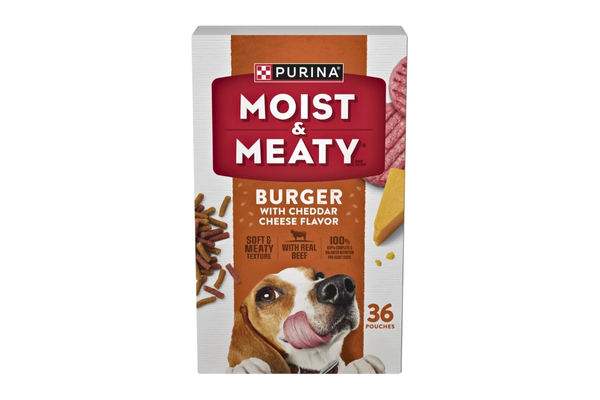
Moist & Meaty offers several flavors: Burger with Cheddar Cheese, Chopped Burger, Steak Flavor, Rise & Shine (Bacon & Egg), With Real Chicken, and High Protein Real Chicken & Beef. The beef-based recipes are the most popular, with Burger with Cheddar Cheese and Steak Flavor topping owner reviews for acceptance.
Dogs generally find the food highly appealing. The soft texture, strong aroma, and added sugars make it taste good to most dogs, even picky ones. If you’ve struggled to get your dog to eat consistently, Moist & Meaty often solves that problem quickly. But remember—just because your dog loves it doesn’t mean it’s the best choice nutritionally. Dogs also love french fries, and we don’t feed them those every day.
The semi-moist texture is somewhere between wet food and dry kibble. It’s soft and crumbly, like ground meat, and it doesn’t require refrigeration after opening. That makes it easy to serve—no can openers, no messy bowls, no need to thaw anything. You just tear open a pouch, pour it into a bowl, and you’re done.
For owners, the convenience is unbeatable. The single-serve pouches mean no measuring, no guessing, and no leftovers. If you’re feeding multiple dogs or dealing with a busy schedule, that simplicity is a real advantage. But the flip side is that you’re locked into those portions. If your dog needs more or less food than a standard pouch provides, you’ll have to adjust by feeding partial pouches or adding extra, which can get wasteful.
Most dogs transition to Moist & Meaty without major issues, but some owners report loose stools or increased gas during the switch. This is likely due to the high carbohydrate content and the shift in texture and moisture. If you’re transitioning from dry kibble, go slowly—mix a small amount of Moist & Meaty with your current food and gradually increase the proportion over 7 to 10 days.
Once adjusted, stool quality tends to stabilize, though it varies by dog. Some produce firm, small stools; others have softer, bulkier stools. If your dog has a sensitive stomach, monitor closely during the first few weeks and be prepared to switch if digestive issues persist.
One concern with highly palatable foods is that dogs can get bored or become picky if the food is too one-note. Moist & Meaty’s flavor variety helps here—you can rotate between recipes to keep things interesting. But some owners report that after months of feeding, their dogs lose interest or start refusing the food. This is more common with the chicken and bacon varieties; the beef recipes seem to have more staying power.
Let’s talk money. Moist & Meaty is priced in the mid-range, but whether it’s a good value depends on what you’re comparing it to and what you prioritize.
A 12-pouch pack (72 ounces, 4.5 pounds) typically retails for around $10.49, which works out to about $2.33 per pound. Bulk packs—like the 60-pouch box from Sam’s Club—drop the price to roughly $1.98 per pound, which is a meaningful savings if you have the storage space and a dog who eats it consistently.
For a 50-pound adult dog, you’re looking at 3.5 to 4 pouches per day, which translates to about $3 to $4 per day or $90 to $120 per month. That’s more expensive than budget kibble (which typically runs $1 to $1.60 per pound) but cheaper than premium kibble or fresh food subscriptions like The Farmer’s Dog or Nom Nom.
Against other semi-moist or wet foods, Moist & Meaty is competitively priced. Freshpet, for example, costs around $3 to $4 per pound, and premium canned foods often run $2.50 to $5 per pound. So if you’re looking for something soft and convenient without paying premium prices, Moist & Meaty fits the bill.
But here’s the catch: those premium options typically offer better ingredient quality, higher meat content, and fewer fillers. You’re paying less with Moist & Meaty, but you’re also getting less. If your priority is ingredient transparency and nutritional quality, spending a bit more on a brand like The Farmer’s Dog or even a high-quality canned food makes more sense.
If you’re currently feeding a mid-range kibble like Purina Pro Plan or Hill’s Science Diet, switching to Moist & Meaty will roughly double your food costs. For a large dog, that can add up to an extra $50 to $100 per month. The question is whether the convenience and palatability are worth that premium.
For some dogs—especially seniors with dental issues or picky eaters—the answer is yes. If Moist & Meaty solves a real problem and your dog thrives on it, the extra cost is justified. But if your dog eats kibble just fine and doesn’t have special needs, it’s hard to argue that Moist & Meaty offers better nutritional value per dollar.
One thing to consider is that Moist & Meaty’s high carb and sugar content may lead to weight gain, dental issues, or health problems down the line—and those come with their own costs. If your dog gains weight and needs a diet food or develops dental disease and requires cleanings or extractions, you’re paying for those consequences later.
There’s also the opportunity cost. If you’re spending $100 a month on Moist & Meaty, that’s $100 you’re not putting toward a food with better ingredients, more functional benefits, or long-term health support. For dogs with no special needs, a high-quality kibble at a similar price point might deliver better overall value.
Take the free nutrition check and find out in under 1 minute which food is best tailored to your dog!
In just 60 seconds, find out which food fits your dog best — for free.
Understanding how a food is produced gives you insight into consistency, safety, and overall quality. Moist & Meaty is manufactured in the United States at Purina facilities, which are subject to FDA oversight and AAFCO compliance. That’s a baseline level of safety and reliability, but it doesn’t tell the whole story.
Purina operates multiple manufacturing plants across the U.S., though the company doesn’t specify which facilities produce Moist & Meaty. The food is made using a semi-moist extrusion process, which involves cooking the ingredients at lower temperatures than traditional kibble, then forming them into the soft, burger-like crumbles. This process preserves some moisture and creates the texture dogs find appealing, but it also requires preservatives like BHA and BHT to keep the food shelf-stable.
The lack of transparency around specific facilities and sourcing is a limitation. Premium brands often publish detailed information about where their food is made, where ingredients come from, and how batches are tracked. Purina provides general assurances about quality control but doesn’t offer the batch-level traceability or farm-to-bowl storytelling that more transparency-focused brands do.
Purina has a strong track record of compliance and safety. Moist & Meaty has had no recalls in the past decade, which is a significant point in its favor. The company conducts regular testing for pathogens, contaminants, and nutritional adequacy, and all facilities are subject to FDA inspection.
That said, there’s no evidence of third-party testing, independent lab analysis, or participation in programs like the Clean Label Project. You’re trusting Purina’s internal quality controls, and while those are generally reliable, they’re not independently verified. For owners who want extra assurance, that’s a gap.
Purina states that they source ingredients from both U.S. and global suppliers, but they don’t publish detailed sourcing information for Moist & Meaty. You won’t find information about which farms provide the chicken or beef, where the soy is grown, or how the ingredients are transported and stored. That’s standard for mass-market brands, but it’s a stark contrast to companies that emphasize transparency and ethical sourcing.
If you care about knowing where your dog’s food comes from—whether the meat is humanely raised, whether the crops are sustainably grown—Moist & Meaty doesn’t give you that information. It’s a black box, and you’re left trusting the brand’s reputation rather than verifying the details yourself.
For many dog owners, how a food is produced and its impact on the world matter as much as what’s in the bowl. Moist & Meaty’s sustainability and ethical profile are mixed—there are some positives, but also notable gaps.
Moist & Meaty comes in single-serve pouches packaged in cardboard boxes. The pouches are poly-laminate, which means they’re not easily recyclable in most municipal programs. The cardboard boxes are recyclable, and Purina participates in the How2Recycle labeling program to help consumers dispose of packaging responsibly. But the reality is that most of the packaging—especially the pouches—ends up in landfills.
Compared to dry kibble in large bags, the per-serving packaging waste is significantly higher. If you’re feeding a 50-pound dog, you’re going through 3 to 4 pouches a day, which adds up to a lot of plastic waste over the course of a year. For environmentally conscious owners, that’s a real drawback.
Nestlé Purina has corporate-level sustainability goals, including reducing greenhouse gas emissions, sourcing renewable electricity, and ensuring 95% of packaging is recyclable by 2025. Those are meaningful commitments, but they’re company-wide rather than specific to Moist & Meaty. There’s no product-specific sustainability report or data showing how this particular line contributes to those goals.
The use of by-products is a sustainability plus in some ways—it makes use of parts of the animal that might otherwise go to waste. But without transparency about sourcing and processing, it’s hard to know whether that’s genuinely reducing waste or just a cost-saving measure.
Purina conducts animal testing at in-house research facilities for nutritional efficacy and palatability studies. The company states that it follows high standards of animal welfare and focuses on non-invasive testing, but it does use live animals in its research. For owners who prefer brands that don’t conduct animal testing, that’s a consideration.
There’s no information about the welfare standards for the animals used to produce the meat in Moist & Meaty. No mention of humane slaughter, cage-free poultry, or grass-fed beef. If those issues matter to you, you’ll need to look elsewhere.
Nestlé Purina publishes annual corporate social responsibility reports that cover labor practices, community engagement, and charitable giving. The company supports animal welfare organizations and disaster relief efforts for pets, which are positive contributions. But again, these are corporate-level initiatives, not specific to Moist & Meaty.
I work at a dog shelter, and part of my role is evaluating different foods to see how they work for the variety of dogs we care for. A few months ago, we decided to test Moist & Meaty with one of our longer-term residents, a six-year-old Beagle mix named Chester.
Chester came to us after his owner passed away, and he’s been with us for about four months. He’s a sweet, easygoing dog with no major health issues, but he’s always been a somewhat picky eater. He’d pick at his kibble, leaving half of it in the bowl, and we’d often have to coax him to finish his meals. It wasn’t a medical issue—the vet gave him a clean bill of health—he just wasn’t enthusiastic about food. For a Beagle, that’s unusual, and it made him less appealing to potential adopters who worried he might be sick or stressed.
When we switched Chester to Moist & Meaty, the change was immediate. The first time we opened a pouch of the Burger with Cheddar Cheese flavor, he was at the bowl before we even set it down. He ate the entire portion in under a minute, licked the bowl clean, and looked up like he wanted more. After weeks of watching him nibble halfheartedly at kibble, it was a relief to see him eat with that kind of enthusiasm.
Over the next two weeks, Chester continued to eat Moist & Meaty eagerly. We rotated between the Burger and Steak flavors, and he liked both equally. There was no hesitation, no picking through the food—he just ate it. For a dog who’d been frustratingly picky, that was a win. We also noticed he seemed more excited at mealtime, wagging his tail and pacing near the food storage area when he knew it was time to eat.
The soft texture worked well for him. Chester has good teeth, so that wasn’t the primary reason we chose it, but the semi-moist crumbles were easy for him to chew and swallow. There was no mess, no need to add water or toppers—it was straightforward and convenient for the shelter staff.
After about three weeks, we started noticing some changes. Chester’s energy level picked up a bit—not dramatically, but he was more playful during yard time and more engaged with staff and volunteers. His coat didn’t change much; it was already in decent condition, so we weren’t expecting a transformation there.
The main concern we had was his weight. Chester is a stocky Beagle, and he’s already prone to packing on pounds. Within a month, we noticed he’d gained about two pounds, which is significant for a 30-pound dog. We adjusted his portions slightly, but it was clear that the high carb and calorie content of Moist & Meaty was easy for him to overeat, even with controlled portions.
His stool quality was mostly fine—firm and consistent—but we did notice a slight increase in volume compared to when he was on kibble. That’s likely due to the higher carbohydrate content and the way his body processed the food. It wasn’t a problem, just something we observed.
From a practical standpoint, Moist & Meaty was easy to work with. The single-serve pouches made portioning simple, and the shelf-stable format meant we didn’t have to worry about refrigeration or spoilage. For a shelter environment where we’re feeding multiple dogs with different needs, that convenience mattered.
But the cost added up. At roughly $3 per day for Chester, we were spending significantly more than we would on a mid-range kibble. For a shelter operating on donations and tight budgets, that’s not sustainable long-term. We used Moist & Meaty as a short-term solution to help Chester regain his appetite and enthusiasm, but we eventually transitioned him to a high-quality kibble that he also ate well once we found the right brand.
Chester ended up being adopted a few weeks later, and his new family continued feeding him a mix of kibble and Moist & Meaty as a topper. For him, it solved a real problem—he went from a picky, uninterested eater to a dog who enjoyed his meals, and that made a difference in his overall well-being and adoptability. But it also reinforced for me that Moist & Meaty is best used strategically, not as a long-term staple, especially for dogs prone to weight gain.
Take the free nutrition check and find out in under 1 minute which food is best tailored to your dog!
In just 60 seconds, find out which food fits your dog best — for free.
Chester’s experience was positive overall, but he’s just one dog. To get a fuller picture, I looked at hundreds of owner reviews across Chewy, Amazon, Walmart, and independent sites like Dog Food Advisor. The feedback is consistent in some ways and divided in others.
The most common praise for Moist & Meaty centers on palatability. Owners of picky eaters, senior dogs, and dogs recovering from illness frequently mention that their dogs love the taste and eat it enthusiastically. Many say it’s the first food their dog has consistently finished in months or even years.
The convenience factor also gets high marks. The single-serve pouches, shelf-stable format, and no-mess serving are repeatedly cited as major advantages, especially for busy owners, travelers, and people feeding multiple dogs.
Some owners report improvements in energy and coat quality, though these are less common than the palatability feedback. A few mention that their senior dogs seem more comfortable and engaged after switching to the soft texture, which makes sense given the reduced chewing effort.
The most frequent complaints focus on ingredients and health concerns. Owners who read labels closely are bothered by the soy, by-products, and high fructose corn syrup. Many say they feel conflicted—their dog loves the food, but they’re not comfortable with what’s in it.
Weight gain is another recurring issue. Multiple reviews mention that dogs gained weight quickly on Moist & Meaty, even with controlled portions. This is particularly common among less active dogs and senior dogs with slower metabolisms.
Digestive issues—loose stools, gas, occasional vomiting—are reported by a minority of owners. These seem to be most common during the transition period or in dogs with pre-existing sensitivities. Once adjusted, most dogs tolerate the food fine, but it’s not universally gentle on digestion.
There are also scattered reports of formula changes in 2025, with some owners saying the food looks or smells different and their dogs are less interested. Purina hasn’t publicly acknowledged any recipe changes, but the consistency of these complaints suggests something may have shifted in production or sourcing.
Owners who’ve fed Moist & Meaty for years tend to fall into two camps. Some are loyal fans who say their dogs have thrived on it and they’ve had no issues. Others say they’ve noticed gradual weight gain, dental problems, or declining enthusiasm over time and have switched to other foods.
The lack of long-term health benefits—no joint support, no digestive aids, no functional ingredients—means that for dogs with emerging health issues, Moist & Meaty doesn’t grow with them. It works fine when everything is going well, but it doesn’t offer the targeted support that older or more health-challenged dogs need.
Moist & Meaty occupies a specific niche, but it’s far from the only option. Let’s compare it to a few key competitors to see where it excels and where it falls short.
Freshpet is a fresh, refrigerated dog food sold in rolls and slices. It uses whole ingredients—real chicken, beef, vegetables—and avoids by-products, artificial preservatives, and fillers. The protein content is higher, the ingredient list is cleaner, and the food requires refrigeration, which some owners see as a sign of quality.
The trade-off? Freshpet costs significantly more—often $3 to $4 per pound compared to Moist & Meaty’s $2 to $2.50. It also requires fridge space and has a shorter shelf life once opened. If you want better ingredients and are willing to pay for them, Freshpet is the clear winner. But if convenience and cost are your priorities, Moist & Meaty holds its ground.
Pro Plan is Purina’s premium line, and its wet food options offer higher protein, better-quality meat sources, and functional ingredients like probiotics and omega fatty acids. The canned food format is messier and requires refrigeration after opening, but the nutritional profile is superior to Moist & Meaty.
Pro Plan is also more expensive, typically $2.50 to $3.50 per pound. If you’re already a Purina customer and want to upgrade within the brand, Pro Plan is a logical step. But if you’re happy with Moist & Meaty and your dog is doing well, the extra cost may not feel justified.
If you’re comparing Moist & Meaty to a brand like Natures Menu, the differences are stark. Natures Menu emphasizes natural, minimally processed ingredients, high meat content, and transparency around sourcing. It offers raw, gently cooked, and freeze-dried options, with recipes designed for different life stages and dietary needs.
The ingredient quality is significantly higher—real meat, no by-products, no artificial additives. The protein content is often 30% or more, and the carb load is much lower. But Natures Menu also costs considerably more, often $4 to $6 per pound, and requires freezer space for raw options.
If you prioritize ingredient quality, transparency, and long-term health benefits, Natures Menu is the better choice. If you need something affordable, convenient, and widely available, Moist & Meaty is the pragmatic option. They’re aimed at different audiences with different priorities.
Compared to a mid-range kibble like Purina ONE or Iams, Moist & Meaty is softer, more palatable, and more convenient to serve. But it’s also more expensive per pound and offers lower nutritional density. For dogs who eat kibble just fine, there’s no compelling reason to switch unless texture or palatability is a specific concern.
For dogs who struggle with kibble—seniors with dental issues, picky eaters, dogs recovering from surgery—Moist & Meaty offers a meaningful advantage. But for healthy adult dogs with no special needs, a high-quality kibble delivers better value and more balanced nutrition.
Moist & Meaty works best for healthy adult dogs who don’t have food sensitivities, weight issues, or special dietary needs. It’s particularly well-suited for senior dogs with dental problems, picky eaters who refuse kibble, and dogs who need a soft, easy-to-chew food due to recovery from illness or surgery.
If your dog is moderately active, maintains a healthy weight easily, and has no history of allergies or digestive upset, Moist & Meaty can be a convenient, palatable option. It’s also a good choice for owners who travel frequently or need a shelf-stable food that doesn’t require refrigeration or complicated preparation.
However, it’s not suitable for puppies, as it doesn’t meet the nutritional requirements for growth. It’s also not ideal for dogs prone to weight gain, as the high carbohydrate and sugar content make it easy to overeat. Dogs with food allergies or sensitivities to soy, wheat, or beef should avoid it, and dogs with specific health conditions like diabetes, kidney disease, or pancreatitis need a more targeted diet.
For highly active dogs or working breeds, the standard recipes may not provide enough fat and calories. The High Protein line is a better fit, but even then, you may need to feed larger portions, which drives up cost. And for dogs who need joint support, digestive aids, or other functional ingredients, Moist & Meaty doesn’t offer those benefits—you’d be better off with a premium brand designed for those needs.
So, is Moist & Meaty good dog food? The answer depends on what you’re looking for. If you need a convenient, palatable option for a healthy adult dog without special dietary needs, it does the job. It’s widely available, reasonably priced for a semi-moist food, and dogs generally like the taste. For senior dogs with dental issues or picky eaters who refuse other foods, it can be a practical solution that makes mealtime easier.
But from a nutritional standpoint, I can’t call this a high-quality food. The reliance on by-products, soy, and high fructose corn syrup is a red flag. The high carbohydrate content and lack of functional ingredients mean it’s meeting the bare minimum for adult maintenance, not optimizing your dog’s health. And the lack of transparency around sourcing and ingredient quality makes it hard to trust that you’re getting consistent, reliable nutrition.
Would I feed this to my own dog? If I had a senior dog with missing teeth who was struggling to eat, yes—I’d use Moist & Meaty as a short-term solution to get them eating again. If I had a picky eater and nothing else was working, I’d try it. But I wouldn’t use it as a long-term staple for a healthy dog, and I’d be actively looking for a better-quality alternative once the immediate problem was solved.
Would I recommend it to a friend? It depends on the friend and the dog. If they’re on a tight budget and need something soft and convenient, and their dog has no health issues, I’d say it’s a reasonable option. But if they care about ingredient quality, long-term health, or have a dog with any kind of special need, I’d steer them toward a brand with better ingredients and more transparency—even if it costs a bit more.
Honestly, there are better options at this price point. A high-quality wet food or a premium kibble offers more balanced nutrition, better ingredients, and functional benefits that Moist & Meaty just doesn’t provide. And if you’re willing to spend a bit more, a fresh food subscription like Nom Nom or Ollie delivers significantly better quality and long-term health support.
Moist & Meaty isn’t bad food—it’s safe, it’s palatable, and it works for some dogs. But it’s not great food, either. It’s a middle-of-the-road option that prioritizes convenience and cost over ingredient quality and nutritional optimization. For dogs with no special needs and owners who value simplicity, it’s fine. But if you want the best for your dog and have the budget and willingness to do a bit more, you can do better.
Take the free nutrition check and find out in under 1 minute which food is best tailored to your dog!
In just 60 seconds, find out which food fits your dog best — for free.
Yes, Moist & Meaty meets AAFCO standards for adult dog maintenance and is formulated to be nutritionally complete for daily feeding. However, the high carbohydrate content (54% on dry matter basis) and added sugars like high fructose corn syrup make it less than ideal as a long-term staple, especially for less active dogs or those prone to weight gain. It’s safe, but there are more nutritionally balanced options available.
No, absolutely not. Moist & Meaty is formulated only for adult dog maintenance and doesn’t provide the higher protein, fat, and calcium levels that growing puppies require. Feeding it to puppies could lead to developmental issues and nutritional deficiencies. Stick to foods specifically labeled for puppy growth or all life stages.
Moist & Meaty contains added sugars like corn syrup and high fructose corn syrup, which make it taste sweet and highly palatable to dogs. The soft, semi-moist texture and strong meaty aroma also contribute to its appeal. Think of it like fast food for dogs—it tastes great, but the palatability comes from ingredients that aren’t necessarily the healthiest choices.
It can, especially in less active dogs. The high carbohydrate content (54%) and moderate calorie density make it easy for dogs to pack on pounds. Many owners report weight gain within weeks of switching, even with controlled portions. If your dog is prone to weight issues or is sedentary, monitor their weight closely and consider reducing portions or choosing a lower-carb food.
The soft texture makes it excellent for senior dogs with dental issues, missing teeth, or difficulty chewing. Many older dogs find it much easier to eat than hard kibble. However, the high sugar content and lack of joint-supporting ingredients like glucosamine make it less than ideal for long-term senior nutrition. It solves the immediate problem of getting older dogs to eat, but doesn’t address their specific health needs.
Each pouch is designed as a single serving, so there shouldn’t be leftovers. If you do have leftover food, it should be refrigerated and used within 24 hours. The unopened pouches are shelf-stable and don’t require refrigeration, which is one of their main convenience advantages.
Probably not. Moist & Meaty contains several common allergens including soy, wheat, beef by-products, and artificial colors. If your dog has food sensitivities or allergies, this food is more likely to trigger problems than help them. There are no limited-ingredient or hypoallergenic varieties available.
It’s an improvement but not dramatically so. The High Protein line offers 23% protein versus 18% in standard recipes, and the dry matter analysis shows about 34% protein versus 27%. However, it still contains the same problematic ingredients—soy, by-products, and high fructose corn syrup—and the carbohydrate content is still high at 44%. It’s better for active dogs but doesn’t address the fundamental ingredient quality issues.
It’s preserved with BHA and BHT, chemical preservatives that prevent the fats from going rancid and keep the food shelf-stable. The semi-moist processing also removes enough moisture to prevent bacterial growth while maintaining the soft texture. This is convenient but requires preservatives that many premium brands have moved away from in favor of natural alternatives.
It’s significantly more expensive. At roughly $2.33 per pound (or $1.98 in bulk), you’re looking at $3-4 per day for a 50-pound dog, or $90-120 per month. That’s about double what you’d spend on mid-range kibble. The convenience and palatability come with a price premium that adds up quickly for larger dogs.
No, Moist & Meaty has had no documented recalls in the past decade, which is actually a point in its favor. This suggests consistent quality control and safety standards, even if the ingredient quality isn’t premium. It’s one of the more reliable mass-market foods from a safety standpoint.
Yes, many owners use it as a kibble topper to make dry food more appealing. This can be a good compromise—you get the palatability boost without the full cost and carb load of feeding Moist & Meaty exclusively. Just adjust portions accordingly to avoid overfeeding, and make sure the combined nutrition still meets your dog’s needs.
Take the free nutrition check and find out in under 1 minute which food is best tailored to your dog!
In just 60 seconds, find out which food fits your dog best — for free.
9 out of 10 dog owners are feeding their dog the wrong food.
Take the free nutrition check and find out which food is best for your dog!
2,847+ dog owners already did