9 out of 10 dog owners are feeding their dog the wrong food

Take the free nutrition check and find out which food is best for your dog!

Shelter manager, certified canine nutritionist, and lifelong dog lover
• Koha excels for dogs with food allergies and sensitivities through single-protein, limited-ingredient formulas featuring novel proteins like kangaroo, venison, and rabbit that effectively eliminate common allergens.
• The cost is prohibitively high at $11-12 per day for a medium dog, making it three to six times more expensive than premium kibble and unsuitable for budget-conscious owners.
• Palatability is exceptional with picky eaters consistently accepting the rich, meaty flavors and varied textures, often solving long-standing feeding challenges where other brands failed.
• Ingredient transparency and quality control are industry-leading with disclosed manufacturing partners, zero recalls in ten years, and traceable protein sourcing from specific global regions.
• Limited product range focuses exclusively on wet food with only one dry formula available, making it unsuitable for owners who prefer kibble variety or convenient feeding options.
Take the free nutrition check and find out in under 1 minute which food is best tailored to your dog!
Koha Pet Food launched in 2014 as part of Nootie, a family-owned company founded by Lonnie and Jennifer Schwimmer in Boca Raton, Florida. The brand’s philosophy centers on minimal processing, maximum protein, and transparency—a response to the growing number of dogs suffering from food sensitivities and allergies. Koha’s name reflects its commitment to simplicity: fewer ingredients, clearer sourcing, and formulas built around single animal proteins.
From day one, Koha positioned itself in the premium wet food segment, deliberately avoiding kibble to focus on high-moisture, nutrient-dense canned and shredded options. The company sources proteins globally—beef from North America, kangaroo from Australia, salmon from the wild—and discloses manufacturing partners in the U.S., Canada, and Thailand. This level of transparency is rare in the pet food industry and has helped Koha build trust among owners who’ve been burned by vague labeling or mysterious ingredient origins.
Koha’s core values revolve around family, health, and honesty. The Schwimmers have maintained private ownership, avoiding the acquisitions and formula compromises that often follow corporate buyouts. The brand explicitly targets dogs with allergies, digestive issues, and picky eating habits, positioning itself as a solution rather than just another option on the shelf. Over the past decade, Koha has expanded its product lines—Limited Ingredient Diet, Minimal Ingredient Stews, Slow Cooked Stews, Pure Shreds, and the recent Bland Diet offerings—but the mission remains consistent: help pets thrive with simple, high-quality nutrition.
Reputation-wise, Koha enjoys strong credibility in the specialty pet food community. It has no recall history in the last ten years, a significant achievement that speaks to consistent quality control. Customer reviews frequently highlight the brand’s responsiveness and willingness to address concerns, and the company’s direct-to-consumer model allows for closer relationships with buyers. While Koha isn’t a household name like Blue Buffalo or Purina, it has cultivated a loyal following among urban pet owners, boutique pet store shoppers, and those willing to pay a premium for ingredient integrity.
| Price per pound | $3.69 – $8.61 |
| Primary protein | Beef, Turkey, Kangaroo, Rabbit, Venison, Duck, Salmon, Lamb |
| By-products | None |
| AAFCO compliance | Yes (all life stages) |
| Formula options | 5 product lines (wet food focus, 1 dry formula) |
| Availability | Specialty pet stores + online retailers |
Take the free nutrition check and find out in under 1 minute which food is best tailored to your dog!
In just 60 seconds, find out which food fits your dog best — for free.
Koha’s standout feature is its commitment to single-source animal protein as the first ingredient in every recipe. Whether it’s beef, turkey, venison, kangaroo, or rabbit, the meat comes first—no ambiguous “meat by-products” or generic “poultry meal.” The brand sources proteins from specific regions: beef from North America, lamb from New Zealand, kangaroo from Australia, and salmon from wild fisheries. This traceability is a major selling point for owners who’ve dealt with mystery ingredients in other brands.
The protein content in Koha’s wet food is notably high for the format. For example, the Limited Ingredient Beef Entrée lists 9.5% protein on an as-fed basis, which translates to roughly 43% protein on a dry matter basis—impressive for canned food. The brand’s use of organ meats like beef liver and pork liver adds nutritional density, providing vitamins A, B12, and iron that muscle meat alone can’t deliver.
Novel proteins like kangaroo, venison, and rabbit are particularly valuable for dogs with common protein allergies. If your dog reacts to chicken or beef, switching to a protein they’ve never encountered can eliminate the immune response triggering itching, ear infections, or gastrointestinal upset. Koha’s dedication to these less common proteins sets it apart from brands that stick to the usual chicken-turkey-beef rotation.
Koha is aggressively grain-free across its main product lines, with no corn, wheat, soy, or potatoes. Instead of starchy fillers, the brand uses minimal carbohydrate sources like pumpkin and small amounts of vegetables. Pumpkin serves a dual purpose: it’s a source of fiber for digestive health and a natural thickener that improves texture without adding unnecessary bulk.
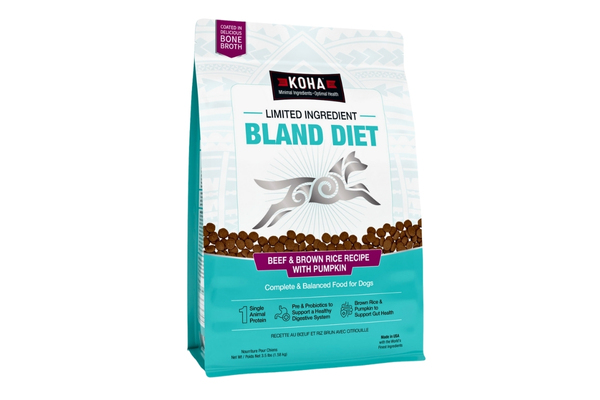
The recent Bland Diet line introduces rice—white rice in the wet formulas and brown rice in the dry option—specifically for dogs recovering from gastrointestinal upset. This is a calculated departure from Koha’s grain-free roots, reflecting a practical recognition that bland, easily digestible carbohydrates have a place in managing sensitive stomachs. For dogs without grain sensitivities, this isn’t a problem; for those with true grain allergies, the original Entrée and Stew lines remain safe options.
Koha’s avoidance of potatoes, peas, and legumes is worth noting in the context of DCM (dilated cardiomyopathy) concerns. While the FDA’s investigation into grain-free diets and heart disease remains inconclusive, Koha’s formulas don’t rely on the pea protein and lentil combinations that have drawn scrutiny. The brand’s low-carb, high-protein approach reduces the risk profile compared to grain-free kibbles heavy in pulse ingredients.
Koha goes beyond basic nutrition by including ingredients with specific health benefits. New Zealand green mussel appears in most Entrée formulas, providing natural glucosamine and chondroitin for joint support—a thoughtful addition for active dogs or those prone to arthritis. Pumpkin, as mentioned, aids digestion and helps regulate bowel movements, making it useful for dogs with chronic diarrhea or constipation.
Flaxseed contributes omega-3 fatty acids for skin and coat health, while agar agar acts as a natural gelling agent that improves texture without artificial additives. The Bland Diet dry formula includes bone broth coating for palatability and pre- and probiotics to support gut health during recovery from digestive distress.
Koha’s vitamin and mineral supplementation is standard for AAFCO compliance: taurine for heart health, vitamins A, D, E, and B-complex for metabolic function, and minerals like zinc and selenium. One minor point of discussion is the use of sodium selenite—a synthetic form of selenium that some owners prefer to avoid in favor of organic selenium from food sources. At the levels present in Koha’s formulas, this isn’t a safety concern, but it’s worth noting for those who prioritize natural-only supplementation.
Equally important as what’s in Koha is what’s missing. The brand contains no by-product meals, no artificial preservatives, no corn, soy, or potatoes, and no “junky fillers” like cellulose or wheat gluten. There are no artificial colors or flavors, and the ingredient lists are refreshingly short—often just six to eight components. For owners who’ve spent hours decoding cryptic labels, Koha’s simplicity is a relief.
Koha’s wet food formulas are high-protein, moderate-fat, and low-carbohydrate—a profile that aligns well with canine nutritional needs. Taking the Limited Ingredient Beef Entrée as an example, the guaranteed analysis shows 9.5% protein, 7.0% fat, 1.5% fiber, and 78% moisture on an as-fed basis. When you remove the moisture and calculate dry matter percentages, you get approximately 43% protein, 32% fat, and 7% fiber—ratios that mirror a carnivorous diet.
The caloric density is moderate for wet food, with the Beef Entrée providing 1,452 kcal/kg or 536 kcal per 13-oz can. This means a 30-pound dog eating roughly 1,000 kcal per day would need about two cans daily, which translates to a feeding cost of around $11–$12 per day at typical retail prices. This is significantly higher than premium kibble, where the same dog might cost $2–$4 per day to feed.
Koha’s fat content is moderate, which suits most dogs but may be too lean for highly active or underweight dogs. The Pure Shreds line is specifically marketed as lower-fat for weight management, while the Stews and Entrées offer slightly higher fat for energy. If your dog needs extra calories, you can supplement with healthy fats like fish oil or rotate in fattier proteins like duck or salmon.
Koha formulates its products to meet AAFCO nutritional standards for all life stages, meaning the food is suitable for puppies, adults, and seniors. The recent Bland Diet Dry formula explicitly states it meets AAFCO standards for growth, including large breed puppies—a detail that matters for owners of breeds prone to developmental orthopedic issues.
While Koha doesn’t publish detailed feeding trial data, the brand’s formulations are reviewed by Ph.D. animal nutritionists, and the consistent positive feedback from long-term users suggests the nutritional profiles work in practice. Feeding trials are the gold standard for proving a food supports health over time, but they’re expensive and not required for AAFCO compliance. Koha’s approach—formulation to meet nutrient profiles plus real-world customer success—is common among premium brands.
Koha’s inclusion of organ meats ensures a broader spectrum of vitamins and minerals than muscle meat alone. Liver, for example, is one of the most nutrient-dense foods available, providing vitamin A, B vitamins, iron, and copper. The addition of green mussel supports joint health, while omega-3s from flaxseed and fish oil reduce inflammation and promote a shiny coat.
The brand’s low-carb approach minimizes blood sugar spikes, which can benefit dogs with diabetes or insulin resistance. The high moisture content—78% or more—supports hydration and kidney function, particularly important for senior dogs or those prone to urinary issues. Over time, feeding a diet this rich in animal protein and low in processed carbohydrates can contribute to better muscle tone, healthier skin, and more consistent energy levels.
Koha shines for dogs with food allergies, sensitivities, or chronic digestive issues. If your dog has been on an elimination diet or struggles with itchy skin, ear infections, or soft stools, Koha’s single-protein, limited-ingredient formulas are an excellent choice. The novel proteins—kangaroo, venison, rabbit—are ideal for dogs who react to more common proteins like chicken or beef.
Picky eaters often respond well to Koha’s high palatability. The shredded textures in the Pure Shreds line and the rich, meaty aroma of the Stews and Entrées appeal to dogs who turn their noses up at kibble. If you’ve been adding toppers or mixing in wet food to entice your dog to eat, switching to Koha full-time can simplify mealtime and ensure consistent nutrition.
The Bland Diet line is specifically designed for dogs recovering from gastrointestinal upset—vomiting, diarrhea, or post-surgery digestive sensitivity. The combination of easily digestible protein (chicken or beef), rice, and pumpkin provides gentle nutrition that won’t aggravate an inflamed gut. This is also a good option for dogs transitioning off a prescription diet or needing a short-term bland regimen recommended by a vet.
Senior dogs benefit from Koha’s high moisture content, which supports hydration and kidney function, and the added green mussel for joint support. The soft texture is easier to chew for dogs with dental issues, and the nutrient density means smaller portions can meet caloric needs without overloading the digestive system.
Koha is not a budget-friendly option. If you have a large or giant breed dog, or multiple dogs, the cost of feeding Koha exclusively can quickly become prohibitive. A 70-pound dog might need three to four cans per day, which at $6–$7 per can adds up to $18–$28 daily—over $500 per month. For comparison, premium kibble for the same dog might cost $100–$150 per month. If budget is a primary concern, Koha works better as a topper or rotational option rather than a sole diet.
Dogs with no dietary sensitivities or health issues may not see dramatic benefits from Koha compared to a high-quality kibble. If your dog thrives on a grain-inclusive or standard premium food, switching to Koha’s expensive wet formulas might not deliver enough value to justify the cost. Koha is a problem-solver; if there’s no problem to solve, other brands may offer better value.
Owners who prefer dry food will find Koha’s options extremely limited. The single dry formula—Bland Diet Chicken & Brown Rice—is a recent addition and not widely available. If you’re looking for a brand with multiple kibble options across life stages and flavors, Koha isn’t it. Consider Loyall Life or other kibble-focused brands instead.
Finally, Koha’s exotic proteins can be difficult to source consistently. Kangaroo, guinea fowl, and venison formulas may go in and out of stock, and if your dog becomes accustomed to one protein, you might face challenges finding it reliably. This is less of an issue with turkey, chicken, or beef, but it’s something to consider if you’re planning long-term feeding.
Take the free nutrition check and find out in under 1 minute which food is best tailored to your dog!
In just 60 seconds, find out which food fits your dog best — for free.
Palatability is where Koha truly excels. The overwhelming majority of customer reviews mention that dogs eagerly devour Koha, with many owners reporting that picky eaters who refused other brands lick their bowls clean. The high meat content, rich aroma, and varied textures—pâté, chunks in gravy, and shredded—appeal to different preferences.
Flavor acceptance varies by protein. Turkey, rabbit, and venison consistently receive top marks, while kangaroo and duck are more hit-or-miss. Some dogs reject kangaroo outright, possibly due to its unfamiliar taste or texture, while others love it. If you’re introducing Koha for the first time, starting with turkey or beef minimizes the risk of refusal.
The Bland Diet formulas are designed for function over flavor, but most dogs accept them without issue. The addition of bone broth coating on the dry formula and the mild taste of chicken and rice make it palatable even for dogs with upset stomachs who’ve lost their appetite.
Transitioning to Koha should be gradual, especially for dogs with sensitive digestion. Start by mixing 25% Koha with 75% of their current food, then increase the ratio over 7–10 days. This reduces the risk of digestive upset and allows your dog’s gut to adjust to the richer protein content.
One practical note: Koha’s wet food has a strong, meaty smell. This is a good thing—it indicates real meat rather than artificial flavoring—but it can be off-putting for owners with sensitive noses. The shredded varieties are slightly less aromatic than the pâté-style Entrées, if that’s a concern.
Koha’s pricing places it firmly in the premium to ultra-premium category. A 13-oz can typically retails for $3–$7, depending on the protein and retailer. The Bland Diet pouches run around $7 each, and the dry formula’s price isn’t widely published but is expected to be in line with other premium kibbles.
For a 30-pound dog eating approximately 1,000 kcal per day, you’d need about two cans of the Beef Entrée (536 kcal each), costing roughly $11–$12 daily or $330–$360 per month. Compare this to premium kibble like Orijen or Acana, which might cost $80–$120 per month for the same dog, or a mid-range option like Blue Buffalo at $50–$70. Koha is three to six times more expensive than many alternatives.
The price per 1,000 kcal for Koha is approximately $11.19 (based on $6 per can), which is high even among wet foods. Brands like Wellness Core or Merrick Grain-Free often come in at $7–$9 per 1,000 kcal, making them more cost-effective without sacrificing quality. Not sure whether to choose Koha or Loyall Life? Read our Dog food from Loyall Life review for a detailed comparison of these two premium options.
Whether Koha is worth the cost depends on your dog’s needs. If your dog has severe food allergies and you’ve spent hundreds on vet visits, elimination diets, and prescription foods without success, Koha’s single-protein, novel-ingredient formulas can be a game-changer. The relief of seeing your dog’s itching stop, their coat improve, and their stools firm up can justify the expense.
For dogs with chronic digestive issues or picky eaters who refuse other foods, the palatability and digestibility of Koha can make feeding less stressful and more consistent. If your dog is underweight or losing muscle mass due to poor food acceptance, investing in a food they’ll actually eat is worth the premium.
However, if your dog has no specific health issues and eats a standard premium kibble without problems, Koha’s benefits may not outweigh the cost. The ingredient quality is excellent, but the difference between Koha and a well-formulated kibble like The Farmer’s Dog or a high-quality canned food like Wellness might not be dramatic enough to justify the price gap.
If you want to feed Koha but find the full cost prohibitive, consider using it as a topper or rotational diet. Mixing one can of Koha with a high-quality kibble can improve palatability and add moisture without breaking the bank. Rotating Koha with other premium wet foods—Merrick, Wellness, or Nutro—gives your dog variety and spreads out the expense.
Some retailers offer bulk discounts, such as “buy 4, get 1 free” promotions, which can reduce per-can costs by 15–20%. Subscribing through Koha’s website or retailers like Chewy may also unlock subscription discounts, though these vary by product and availability.
Koha manufactures its products in facilities across the U.S., Canada, and Thailand, with full transparency about which plants produce which products. Canned Entrées and Stews come from Simmons Foods in Toronto, Canada, and Iowa, USA, while the Pure Shreds and Poké Bowls are produced by Asian Alliance in Thailand. The Bland Diet dry formula is made by Muenster Milling in Texas.
The brand’s openness about manufacturing partners is uncommon in the pet food industry and builds trust. Koha discloses that it regularly audits suppliers, uses certificates of inspection and analysis, and tests all ingredients before manufacturing. The Thailand facility, in particular, is noted for stringent quality checks and numerous accreditations, though specific ISO or HACCP certifications aren’t publicly detailed.
Koha’s zero-recall history over the past decade is a strong indicator of consistent quality control. The brand’s limited ingredient approach reduces the risk of contamination—fewer ingredients mean fewer points of failure in the supply chain. The use of single-source proteins also simplifies traceability, making it easier to identify and address any issues before they reach consumers.
Ingredient sourcing is a key part of Koha’s quality story. The brand sources beef, chicken, pork, and turkey from North America; lamb from New Zealand; kangaroo from Australia; and salmon from wild fisheries. This global approach prioritizes quality over proximity, ensuring the best possible protein sources even if it means longer supply chains.
One area where Koha could improve is public disclosure of certifications. While the brand claims rigorous audits and testing, the lack of published ISO, HACCP, or third-party lab results leaves some room for skepticism. For a brand charging premium prices, more detailed quality documentation would strengthen its credibility further.
Koha’s sustainability practices are less transparent than its ingredient sourcing. The brand prioritizes quality over proximity, which means proteins are sourced globally rather than locally. This approach ensures the best possible ingredients—wild-caught salmon, free-range lamb, grass-fed beef—but it also means longer supply chains and higher carbon footprints.
There’s no public information about Koha’s packaging sustainability. The cans and pouches are standard for the industry, but details about recyclability, use of recycled materials, or efforts to reduce packaging waste aren’t readily available. This is an area where Koha lags behind brands like The Farmer’s Dog or Nom Nom, which actively promote sustainable packaging and carbon-neutral shipping.
Ethically, Koha emphasizes humane sourcing—free-range lamb, wild-caught fish, and grass-fed beef—but there’s no formal animal welfare certification or third-party verification. The brand’s commitment to single-source proteins and transparency about origin countries is a positive step, but more detailed welfare standards would strengthen its ethical positioning.
Koha does not engage in animal testing on finished products, a standard practice in the pet food industry. The brand’s focus on health through nutrition rather than testing aligns with modern ethical expectations, though this is more of a baseline than a standout achievement.
Overall, Koha’s ethical and sustainability profile is solid but not exceptional. The brand does well on ingredient quality and transparency but could improve on environmental impact and formal welfare certifications.
Take the free nutrition check and find out in under 1 minute which food is best tailored to your dog!
In just 60 seconds, find out which food fits your dog best — for free.
I work at a local dog shelter, and we’re always testing new foods to see how they work for dogs with different needs. For this review, I decided to try Koha’s Limited Ingredient Turkey Entrée with a dog named Maple—a six-year-old Beagle mix who came to us after her previous owner couldn’t manage her chronic skin issues and picky eating. Maple had been through a few different foods already, and she’d developed a habit of sniffing her bowl, walking away, and only eating when she was absolutely starving.
When I first opened the can of Koha, Maple’s reaction was immediate. She came over, tail wagging, and started licking her lips before I’d even scooped the food into her bowl. The strong, meaty smell clearly got her attention in a way her previous food hadn’t. I mixed about a quarter-can of Koha with her usual kibble for the first few days to avoid any digestive upset.
By day three, Maple was eating her meals enthusiastically and licking the bowl clean—something I hadn’t seen her do since she arrived. I gradually increased the Koha ratio, and within a week, she was on it full-time. Her energy seemed steadier throughout the day, and she was more interested in playtime and walks. The most noticeable change, though, was her skin. Maple had been scratching constantly, especially around her ears and belly, and within two weeks on Koha, the scratching had reduced significantly. Her coat started to look shinier and felt softer to the touch.
Stool quality improved as well. Maple had been dealing with occasional loose stools, but on Koha, her stools were consistently firm and smaller in volume—easier to clean up and a sign that her digestion was more efficient. She didn’t seem to have any gas or bloating, which had been an issue with some of her previous foods.
The one downside was the cost. Feeding Maple, who weighs about 35 pounds, required roughly two cans per day, which added up quickly. For a shelter environment, that’s not sustainable long-term, but for Maple’s specific needs, the results were clear. She was happier, healthier, and actually excited about mealtime for the first time in months.
Koha’s customer reviews are overwhelmingly positive, with most owners reporting significant improvements in their dogs’ health and behavior. On platforms like Chewy, the brand averages 4.6 out of 5 stars, with individual products often reaching 4.8 or higher. Common themes include improved digestion, reduced allergic reactions, shinier coats, and enthusiastic eating.
One recurring success story involves dogs with chronic skin issues. Owners frequently mention that after switching to Koha’s novel protein formulas—especially venison, rabbit, or kangaroo—their dogs’ itching stopped, ear infections cleared up, and hot spots healed. The timeline for these improvements is typically four to six weeks, which aligns with the time it takes for a new diet to fully impact skin health.
Digestive improvements are another major highlight. Many reviews describe dogs who struggled with loose stools, gas, or vomiting on other foods but stabilized completely on Koha. The Bland Diet line, in particular, receives praise from owners whose dogs recovered from gastrointestinal upset faster than expected.
Picky eaters are a frequent topic. Owners who’ve tried multiple brands without success often report that Koha is the first food their dog will eat consistently. The shredded textures and rich flavors seem to appeal even to dogs with notoriously finicky palates.
Negative reviews are rare but tend to focus on a few specific issues. Some dogs refuse certain flavors, especially kangaroo and duck. A small number of owners report that their dogs developed soft stools or diarrhea during the transition, usually because the switch was too abrupt. Gradual introductions typically resolve this issue.
Price complaints are common, though most reviewers acknowledge that the quality justifies the cost. Several mention using Koha as a topper or rotational diet to make it more affordable. Packaging issues—dented cans or occasional quality inconsistencies—are mentioned infrequently but are notable when they occur. Koha’s customer service is praised for handling these situations quickly, often offering refunds or replacements without hassle.
One owner wrote: “My dog had been on prescription food for allergies for two years, and we were spending a fortune. Switched to Koha venison, and within a month, her itching stopped completely. I wish we’d found this sooner.” Another noted: “My picky Yorkie finally eats without me having to beg. The shredded turkey is a game-changer.”
A less positive review mentioned: “My dog loved the rabbit flavor, but the kangaroo made him vomit. Had to toss half a case.” This highlights the importance of starting with more common proteins before experimenting with exotic options.
Koha occupies a unique niche in the premium wet food market, but how does it stack up against other high-quality brands? Here’s a practical comparison.
Koha vs. Merrick Grain-Free: Both brands offer limited-ingredient, grain-free wet foods with high meat content. Merrick is slightly less expensive and more widely available in big-box stores, but Koha’s novel proteins and stricter no-filler policy give it an edge for dogs with severe allergies. Merrick also offers kibble, which Koha largely avoids.
Koha vs. Wellness Core: Wellness Core is a well-established premium brand with strong nutritional profiles and broad distribution. Koha’s advantage lies in its single-protein formulas and exotic meats, which Wellness doesn’t emphasize. Wellness is more affordable and offers a wider range of formats, including kibble and freeze-dried options.
Koha vs. Ziwi Peak: Ziwi Peak is another ultra-premium brand known for air-dried, novel-protein recipes. Ziwi is even more expensive than Koha and uses a different preservation method, but both brands excel at transparency and ingredient quality. Koha’s wet food format may be more appealing for dogs who need extra hydration, while Ziwi’s air-dried options are more convenient for travel.
Koha vs. Loyall Life: Loyall Life is a premium kibble brand with a focus on science-driven formulas and broad life-stage options. Koha and Loyall Life target different needs—Koha for wet food and allergies, Loyall Life for versatile dry food. If you’re deciding between the two, consider whether your dog needs the moisture and simplicity of Koha or the convenience and variety of Loyall Life. For a detailed comparison, check out our Loyall Life dog food review.
Koha vs. The Farmer’s Dog: The Farmer’s Dog offers fresh, human-grade meals delivered frozen, with personalized plans and pre-portioned packs. Both brands prioritize transparency and quality, but The Farmer’s Dog is even more expensive and requires freezer space. Koha’s shelf-stable cans are more convenient, while The Farmer’s Dog’s fresh approach appeals to owners seeking minimal processing.
Overall, Koha’s strengths—novel proteins, limited ingredients, wet-only focus—make it ideal for dogs with specific dietary needs. For general feeding or budget-conscious owners, brands like Wellness or Merrick offer better value. For those who want the absolute best and don’t mind the cost, Koha and Ziwi Peak are top contenders.
Take the free nutrition check and find out in under 1 minute which food is best tailored to your dog!
In just 60 seconds, find out which food fits your dog best — for free.
Koha is best suited for dogs with food allergies, sensitivities, or chronic digestive issues. The single-protein, limited-ingredient formulas are ideal for elimination diets, where you need to pinpoint which ingredients are causing problems. The novel proteins—kangaroo, venison, rabbit—work well for dogs who react to more common proteins like chicken or beef.
Picky eaters often thrive on Koha. If your dog turns their nose up at kibble or refuses to eat consistently, the high palatability and rich textures of Koha’s wet food can reignite their appetite. The shredded varieties are particularly appealing to dogs who prefer texture over smooth pâté.
Senior dogs benefit from Koha’s high moisture content, which supports hydration and kidney function, and the soft texture is easier to chew for dogs with dental issues. The added green mussel provides joint support, making it a thoughtful choice for aging dogs with arthritis or mobility concerns.
Puppies can eat Koha, as the formulas meet AAFCO standards for all life stages, including growth. The Bland Diet dry formula is explicitly safe for large breed puppies. However, Koha’s wet-only focus means you’ll need to supplement with calcium-rich kibble or add bone meal if feeding wet food exclusively to a growing puppy.
Active dogs with high energy needs may require larger portions of Koha or supplementation with higher-fat foods, as the brand’s moderate fat content may not provide enough calories for highly active lifestyles. Mixing Koha with a calorie-dense kibble or adding healthy fats like fish oil can address this.
Koha is not ideal for large or giant breed dogs on a tight budget, as the cost of feeding a 70-pound dog exclusively on Koha can exceed $500 per month. It’s also not the best choice for dogs with no dietary issues who thrive on standard premium foods—there’s no need to pay the Koha premium if your dog is already healthy and happy.
Here’s my honest take: Koha is an excellent food for the right dog, but it’s not a one-size-fits-all solution. If your dog struggles with food allergies, chronic itching, ear infections, or digestive upset that other brands haven’t resolved, Koha’s limited-ingredient, novel-protein formulas can make a real difference. The ingredient quality is top-tier—real meat as the first ingredient, no fillers, transparent sourcing, and a zero-recall history over a decade. For dogs with sensitivities, this level of simplicity and quality is exactly what they need.
The palatability is outstanding. Even the pickiest eaters tend to respond well to Koha’s rich flavors and varied textures. If you’ve been fighting with your dog to eat, switching to Koha can eliminate that stress and ensure consistent nutrition. The high moisture content is also a major plus for dogs who don’t drink enough water or have kidney issues.
But—and this is important—Koha’s price is a significant barrier. At $11–$12 per day for a medium-sized dog, it’s three to six times more expensive than premium kibble. If your dog has no dietary issues and eats a standard premium food without problems, Koha’s benefits probably don’t justify the cost. You’re not getting dramatically better nutrition compared to well-formulated kibbles or other high-quality wet foods at lower price points.
The lack of dry food options is another limitation. If you prefer kibble or need a food that’s easy to travel with, Koha’s single dry formula won’t cut it. The brand’s wet-only focus is a strength for dogs who need moisture and simplicity, but it’s a weakness for owners seeking variety or convenience.
Would I buy Koha for my own dog? If they had food allergies or sensitivities that other brands couldn’t address, absolutely. The peace of mind from knowing exactly what’s in the food and seeing visible health improvements would be worth the premium. If my dog was healthy and thriving on a less expensive food, I’d probably stick with what works and use Koha as an occasional topper or rotational option.
Would I recommend it to a friend? Yes, but with caveats. If their dog has specific dietary needs—allergies, sensitivities, picky eating, or digestive issues—Koha is one of the best options on the market. If they’re looking for general feeding or have budget constraints, I’d point them toward brands like Wellness, Merrick, or Loyall Life that offer strong quality at lower prices.
In the end, Koha does what it sets out to do exceptionally well: provide simple, high-quality, allergen-friendly nutrition for dogs who need it. It’s not a budget brand, and it’s not for every dog, but for the right dog, it’s worth every penny.
Take the free nutrition check and find out in under 1 minute which food is best tailored to your dog!
In just 60 seconds, find out which food fits your dog best — for free.
Koha is worth the premium price if your dog has specific dietary needs like food allergies, sensitivities, or chronic digestive issues. The single-protein, limited-ingredient formulas and novel proteins can be game-changers for dogs who haven’t found relief with other brands. However, if your dog is healthy and thriving on a less expensive food, the cost may not be justified. Consider your dog’s specific needs and your budget—Koha excels as a problem-solver but may be overkill for dogs without dietary issues.
Yes, Koha formulas meet AAFCO standards for all life stages, making them suitable for puppies, adults, and seniors. The Bland Diet dry formula is explicitly safe for large breed puppies. Senior dogs particularly benefit from the high moisture content for kidney support and the soft texture for easier chewing. The added New Zealand green mussel provides joint support, which is valuable for aging dogs with arthritis concerns.
Transition gradually over 7-10 days to avoid digestive upset. Start by mixing 25% Koha with 75% of your dog’s current food, then gradually increase the Koha ratio every few days. This is especially important given Koha’s rich protein content. If your dog has a sensitive stomach, you can extend the transition period to two weeks. Always monitor for any changes in stool quality or appetite during the switch.
Start with turkey, beef, or rabbit for the best acceptance rates. These proteins tend to be most palatable for picky eaters. Avoid starting with kangaroo or duck, as these exotic proteins can be hit-or-miss with finicky dogs. The Pure Shreds line often appeals to dogs who prefer texture over smooth pâté. If your dog refuses the first flavor, don’t give up—try a different protein before concluding Koha isn’t right for them.
Yes, Koha’s limited-ingredient, single-protein formulas are specifically designed for dogs with food allergies. The novel proteins like kangaroo, venison, and rabbit are ideal for dogs who react to common proteins like chicken or beef. Most owners report improvements in itching, ear infections, and skin conditions within 4-6 weeks of switching. The grain-free formulation also eliminates common allergens like corn, wheat, and soy.
Absolutely. Using Koha as a topper or mixing it with high-quality kibble is an excellent way to improve palatability and add moisture without the full expense. Many owners successfully mix one can of Koha with premium kibble to create a more affordable feeding routine. This approach gives you many of Koha’s benefits—improved taste, added nutrition, higher moisture—at a fraction of the cost of feeding it exclusively.
Koha is manufactured in facilities across the U.S., Canada, and Thailand with full transparency about which plants produce which products. The brand has maintained a zero-recall history over the past decade, indicating consistent quality control. Koha discloses its manufacturing partners, regularly audits suppliers, and tests all ingredients before production. The level of transparency is uncommon in the pet food industry and builds confidence in the brand’s safety standards.
Koha deliberately focuses on wet food to maximize protein content and moisture while minimizing processing. The brand believes wet food better serves dogs with allergies and sensitivities. The recent addition of the Bland Diet dry formula shows Koha is expanding into kibble, but slowly and thoughtfully. If you need multiple dry food options, consider brands like Loyall Life or Wellness that specialize in premium kibble alongside their wet offerings.
Feeding amounts depend on your dog’s weight, age, and activity level. As a general guideline, a 30-pound dog needs approximately two 13-oz cans per day (about 1,000 kcal). A 70-pound dog might need 3-4 cans daily. Start with the feeding guidelines on the can and adjust based on your dog’s body condition. Active dogs may need more, while sedentary or senior dogs may need less. Always consult your veterinarian for personalized feeding recommendations.
Don’t give up immediately. Try a different protein or texture before concluding Koha isn’t right for your dog. Some dogs prefer the shredded Pure Shreds line over the pâté-style Entrées, or vice versa. Kangaroo and duck tend to be more polarizing, while turkey and beef have higher acceptance rates. You can also try warming the food slightly or mixing it with a small amount of bone broth to enhance palatability during the initial introduction.
Take the free nutrition check and find out in under 1 minute which food is best tailored to your dog!
In just 60 seconds, find out which food fits your dog best — for free.
9 out of 10 dog owners are feeding their dog the wrong food.
Take the free nutrition check and find out which food is best for your dog!
2,847+ dog owners already did