9 out of 10 dog owners are feeding their dog the wrong food

Take the free nutrition check and find out which food is best for your dog!

Shelter manager, certified canine nutritionist, and lifelong dog lover
• Specialized for working dogs: Joy’s high-protein (up to 32%) and high-fat (up to 24%) formulas are purpose-built for hunting dogs, herding breeds, and high-energy companions who need calorie-dense nutrition.
• Exceptional safety record: The brand has maintained 80 years of operation without a single documented product recall, which is remarkably rare in the pet food industry.
• Limited transparency and variety: Joy lacks published feeding trials, third-party certifications, and detailed quality documentation while offering only chicken and beef-based formulas with minimal flavor variety.
• Meat meals over fresh meat: Formulas rely on chicken meal and by-product meals rather than fresh meat as primary proteins, providing concentrated nutrition but less premium ingredient appeal.
• Not suitable for sedentary dogs: The high-fat content across most formulas makes Joy inappropriate for overweight, less active, or fat-sensitive dogs who need lower-calorie nutrition.
Take the free nutrition check and find out in under 1 minute which food is best tailored to your dog!
Joy Dog Food operates under Hi-Standard Pet Food, a family-run operation based in Pinckneyville, Illinois. The brand has deep roots in the working dog community, particularly among hunters, field trial competitors, and owners of cattle dogs. While Joy maintains its heritage positioning, the company has also launched premium sub-brands like Get Joy and Bundle x Joy, which focus on gut health, freeze-dried raw nutrition, and functional supplements. This multi-brand approach lets Joy serve both traditional kibble buyers and the growing segment of pet parents seeking whole-food, science-backed nutrition.
Joy was founded in 1945 as Best Feeds, a farm supply company in Washington, Pennsylvania. The business started by selling grain and feed to local farmers before transitioning to dog food formulation in 1953. By 1957, operations consolidated to a single mill in Oakdale, Pennsylvania, where the brand built its reputation through the “Jump for JOY” advertising campaign that became widely recognized in the Pittsburgh area throughout the 1950s and 1960s.
In 2011, Wade Graskewicz acquired Joy Pet Foods through his company Hi-Standard Pet Food, which he founded in 1998. This ownership change marked a return to the brand’s original business philosophy: genuine customer care, USA-sourced ingredients, and competitive pricing achieved through operational efficiency rather than cutting corners on quality. Wade’s son Skyler now serves as president, allowing Wade to focus on strategic development while maintaining the family-operated structure that defines the company culture.
Joy positions itself around three core principles. First, complete USA manufacturing and sourcing with the preferred “Made in the USA” designation on all packaging. Second, competitive pricing through lean operations—cutting out middlemen without compromising ingredient quality. Third, a family-operated structure that prioritizes long-term customer relationships over quarterly profits.
The brand maintains strong ties to the working dog community through sponsorships of beagle trials, coonhunting events, NSTRA competitions, and field trials for bird dogs and hunting breeds. This isn’t just marketing—it’s where Joy’s formulas are actually tested in real-world conditions by dogs who need serious nutrition to perform.
Joy has maintained operations for 80 years without a single documented product recall. That’s a remarkably clean safety record in an industry where even major brands have faced contamination issues. The company operates with fewer than 25 employees, which means quality control stays close to home rather than being outsourced to third-party facilities with less oversight.
However, transparency has its limits. Joy doesn’t publish detailed supply chain documentation, ingredient traceability protocols, or third-party audit results. There’s no ISO certification, no HACCP documentation available to consumers, and no independent lab testing results on their website. For a brand emphasizing USA sourcing and quality control, this lack of verification documentation is a noticeable gap compared to premium competitors who publish detailed quality reports.
Joy’s formulas center on named meat meals and by-product meals rather than fresh meat. This is an important distinction. Chicken meal, for example, is a concentrated protein source containing approximately 300% more protein than fresh chicken because moisture has been removed during processing. By-product meals include organ meats and other parts beyond muscle meat—these aren’t necessarily bad ingredients, but they’re less appealing to owners who prefer whole-meat formulas.
The High Performance 26/18 formula lists chicken meal as the first ingredient, followed by oat groats, barley, chicken fat, and dried peas. The Super Meal 30/20 follows a similar pattern with beef meal leading the ingredient list. These meat meals provide the high protein percentages Joy advertises, but the biological value and digestibility can vary depending on processing quality and the specific parts included in the meal.
Chicken fat appears prominently across Joy’s formulas, serving as both a concentrated energy source and a supplier of linoleic acid, an essential omega-6 fatty acid that supports skin and coat health. This is a quality fat source—far better than generic “poultry fat” or “animal fat” that some budget brands use.
Joy relies on grains like oat groats, barley, brown rice, and corn as primary carbohydrate sources. Oat groats and barley are whole grains that provide fiber and sustained energy, which makes sense for working dogs who need endurance rather than quick sugar spikes. However, some formulas also include wheat and yellow corn, which are less digestible and more likely to cause sensitivities in certain dogs.
The estimated carbohydrate content across Joy’s line averages around 43%, which is below average compared to many mainstream kibbles that can run 50% or higher. For active dogs burning serious calories, this carb-to-protein ratio works well. For less active dogs or those prone to weight gain, it might still be more carbohydrate than necessary.
Joy includes chelated minerals in its formulas, which means minerals are bonded to amino acids for better absorption in the digestive tract. This is a quality feature you’d expect in premium foods. Mixed tocopherols (natural vitamin E) serve as preservatives, which is preferable to synthetic preservatives like BHA or BHT.
However, Joy’s formulas don’t list probiotics, prebiotics, glucosamine, or chondroitin in most recipes. The Puppy Food 32/18 includes DHA for brain and eye development, which is appropriate for growing dogs. But for senior dogs or breeds prone to joint issues, you’d need to add supplements separately—something competitors like Ultimates build into their large breed formulas.
Joy doesn’t publish detailed ingredient sourcing information. While the brand emphasizes USA manufacturing, it doesn’t specify which farms supply chicken, where grains are grown, or how ingredients are traced through the supply chain. For comparison, some premium brands provide farm names, region-specific sourcing, and even batch-level traceability. Joy’s lack of this transparency makes it difficult to verify quality claims independently.
| Price per pound | Not publicly available (direct order only) |
| Primary protein | Chicken meal, Beef meal |
| By-products | Yes (by-product meals included) |
| AAFCO compliance | Yes (formulation-based, no feeding trials) |
| Formula options | Limited (5 core formulas, limited flavor variety) |
| Availability | Independent feed stores, phone orders (800-245-4125) |
Take the free nutrition check and find out in under 1 minute which food is best tailored to your dog!
In just 60 seconds, find out which food fits your dog best — for free.
Joy’s formulas are designed for high-energy, working dogs, and the nutritional profiles reflect that focus. Protein levels range from 22% in the Maintenance Plus formula up to 32% in the Puppy Food. Fat content spans 12% to 24%, with most formulas landing in the 18-20% range. These are significantly higher than typical maintenance kibbles, which usually sit around 18-22% protein and 10-14% fat.
The Super Meal 30/20 formula delivers 30% protein and 20% fat, creating a fat-to-protein ratio of approximately 67%. This is well-suited for hard-working dogs who need calorie-dense nutrition without eating massive volumes of food. The High Performance 26/18 and High-Energy 24/20 formulas offer similar energy density with slightly different protein-to-fat ratios depending on the dog’s specific needs.
For comparison, a typical adult maintenance kibble might provide 22% protein and 12% fat, resulting in a fat-to-protein ratio around 55%. Joy’s formulas are clearly optimized for performance, not weight management or low-activity lifestyles.
All Joy Dog Food recipes meet AAFCO “complete and balanced” nutrient profile guidelines for either adult maintenance or all life stages. This means the formulas contain minimum required levels of protein, fat, vitamins, and minerals to support a dog’s basic nutritional needs. However, Joy does not appear to conduct formal AAFCO feeding trials, which involve actually feeding the food to dogs under controlled conditions and monitoring their health over time.
Formulation-based compliance is acceptable and common in the industry, but feeding trials provide stronger evidence that a food not only contains the right nutrients on paper but also delivers them in a bioavailable, digestible form that dogs can actually use. The absence of published feeding trial data is a limitation for owners who want the highest level of nutritional verification.
Joy doesn’t publish caloric density (kcal/kg) for most formulas on readily available product information. This makes it difficult to calculate precise feeding costs or compare energy efficiency against competitors. Based on the high protein and fat levels, Joy’s formulas are likely in the 3,600-4,200 kcal/kg range, which is calorie-dense compared to standard kibbles that typically land around 3,200-3,600 kcal/kg.
Higher caloric density means you feed less volume to meet your dog’s energy needs, which can offset some of the higher per-pound cost. If your dog needs 1,200 calories per day, you might feed 10-12 ounces of Joy compared to 14-16 ounces of a lower-density food. This matters both for your wallet and for dogs who struggle to eat large volumes.
Joy’s product information lacks guaranteed analysis percentages for fiber, ash, moisture, and specific carbohydrate content. These details matter for dogs with digestive sensitivities, weight management needs, or specific health conditions. Without this information, it’s harder to make informed comparisons or to work with a veterinary nutritionist on precise dietary management.
Joy Dog Food is purpose-built for working and active dogs. If you have a hunting dog who spends hours in the field, a herding breed managing livestock, or a high-energy dog who runs, hikes, or competes in dog sports, Joy’s calorie-dense formulas make practical sense. The high protein and fat levels support sustained activity without requiring massive feeding volumes.
The brand also works well for dogs who struggle to maintain weight despite eating normal portions. If your dog is naturally lean, has a fast metabolism, or recovers from illness or surgery and needs to rebuild condition, Joy’s nutrient density helps pack more calories into each meal without overloading the digestive system.
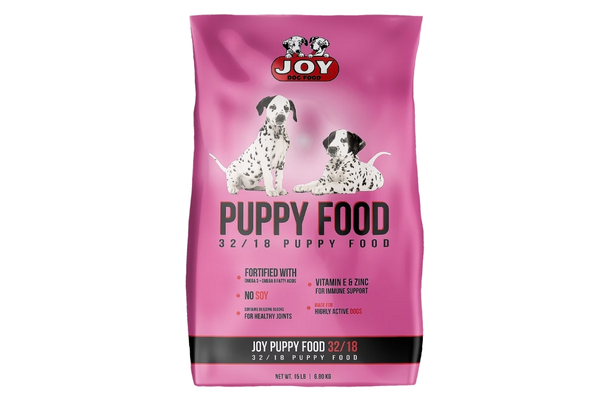
For puppy owners, the Puppy Food 32/18 formula provides appropriate nutrition for growth with 32% protein and 18% fat, plus DHA for brain and eye development. The formula is designed to support healthy growth without encouraging excessive weight gain, which is important for large-breed puppies prone to developmental orthopedic issues.
Joy is not ideal for sedentary, overweight, or senior dogs with reduced activity. The high fat content in most formulas (18-24%) can contribute to weight gain in dogs who aren’t burning significant calories. The Maintenance Plus 22/12 formula offers a lower-fat option at 12%, but even this is higher than many weight management formulas that target 8-10% fat.
Dogs with pancreatitis or fat-sensitive digestive systems should avoid Joy’s high-fat formulas entirely. Even the Maintenance Plus formula may be too rich for dogs who need strict fat restriction. For these cases, a prescription low-fat diet or a carefully selected limited-ingredient food is a better choice.
If your dog has grain sensitivities or allergies, Joy’s traditional formulas won’t work. Most recipes include corn, wheat, barley, or oats. Joy does offer a Pure Grain Free formula under its Ultimate line, but information on this product is limited and it doesn’t appear to be as widely available as the core formulas.
For dogs with specific health conditions requiring veterinary diets—such as kidney disease, urinary stones, or severe food allergies—Joy doesn’t offer prescription formulas. You’d need to work with your vet on a specialized diet from brands like Hill’s Prescription Diet or Royal Canin Veterinary.
Palatability is one area where Joy generally performs well, particularly with food-motivated dogs. The high fat content from chicken fat and meat meals creates a strong aroma that most dogs find appealing. In user reviews, owners frequently mention that their dogs “clean the bowl” and show enthusiasm at mealtimes.
Joy’s traditional kibble line focuses on chicken and beef as primary proteins, with limited flavor variety compared to brands offering lamb, fish, duck, or novel proteins like venison or bison. The core formulas—High Performance 26/18, Super Meal 30/20, High-Energy 24/20, and Adult Formula 26/18—all use similar protein sources with variations in protein and fat percentages rather than different meats.
For dogs who do well on chicken or beef, this isn’t a problem. But if your dog needs protein rotation to prevent sensitivities or simply gets bored with the same flavor, Joy’s limited options may require you to supplement with toppers or rotate with another brand.
Some owners report that Joy’s kibble size is relatively large, which can be a challenge for small or toy breeds. If you have a Chihuahua or a Yorkshire Terrier, you might need to break the kibble into smaller pieces to prevent choking or make it easier to chew. Larger breeds typically have no issue with the kibble size.
While most dogs accept Joy readily, there are isolated reports of selective eaters rejecting the food. In one case involving Get Joy’s freeze-dried raw formula, an owner reported that one of their Alaskan Klee Kais refused to eat the food consistently, leading to discontinuation despite the other dog accepting it well. This variability is common across all brands—what one dog loves, another may ignore—but it’s worth considering if your dog has a history of food refusal.
If your dog is a picky eater, starting with a smaller bag or mixing Joy with their current food during a gradual transition can help you assess acceptance without committing to a large purchase upfront.
Joy positions itself as a performance-oriented food at a competitive price point, but specific pricing information is limited in public sources. The brand is sold primarily through direct phone orders (800-245-4125) and independent feed stores, hunting supply retailers, and farm/home stores—not through major online platforms like Chewy or Amazon where pricing is transparent and easy to compare.
Based on available information, Joy is priced higher than budget kibbles like Purina Dog Chow or Pedigree, but below ultra-premium brands like Orijen or Acana. The lack of published pricing makes it difficult to calculate cost per day or cost per calorie, which are the most useful metrics for comparing value.
If you’re comparing Joy to other performance-oriented foods, the high caloric density means you’ll feed less volume per meal, which can partially offset a higher per-pound cost. For example, if Joy costs $2.50 per pound and you feed 12 ounces per day, your daily cost is approximately $1.88. If a lower-density food costs $2.00 per pound but requires 16 ounces per day, your daily cost is $2.00—making Joy slightly more economical despite the higher sticker price.
Compared to brands like Ultimates Dog Food, which offers mid-premium quality with a wider variety of recipes and more transparent pricing, Joy’s value proposition is less clear. Ultimates provides 13+ recipes including puppy, adult, large breed, sensitive, and grain-free options, with functional additives like glucosamine, chondroitin, and omega fatty acids built into specific formulas. If you’re weighing Joy against other mid-premium brands, our Ultimates review offers a detailed look at an alternative with broader product variety and clearer pricing.
Joy’s advantage lies in its specialization. If you need a high-protein, high-fat formula for a working dog and you value USA sourcing and a clean safety record, Joy delivers on those specific criteria. But if you need variety, transparent pricing, or specialized formulas for joint health or sensitive stomachs, other brands may offer better value.
Take the free nutrition check and find out in under 1 minute which food is best tailored to your dog!
In just 60 seconds, find out which food fits your dog best — for free.
Joy Dog Food is manufactured at the American Nutrition plant in Ogden, Illinois, where both Hi-Standard and Joy products are produced. This facility has been in operation since the 2011 acquisition by Wade Graskewicz, consolidating production under one roof after the closure of the original Oakdale, Pennsylvania facility in 2004.
As a domestically manufactured pet food sold across 44 U.S. states and multiple countries, Joy necessarily complies with U.S. FDA regulations for pet food manufacturing, AAFCO nutritional standards required for interstate commerce, and state-specific pet food regulations. However, the company does not publish third-party quality certifications, ISO standards, HACCP compliance documentation, or detailed audit results.
This lack of transparency is a significant limitation. Many premium brands publish their certifications, invite third-party audits, and provide detailed information about microbial testing, heavy metal screening, and ingredient traceability. Joy’s “trust us, we make good food” approach works for customers who prioritize brand heritage and word-of-mouth reputation, but it doesn’t satisfy buyers who want documented verification of quality claims.
Joy emphasizes that ingredients are sourced entirely in the United States, which is a meaningful differentiator in an industry where many brands import ingredients from China, Thailand, or other countries with less stringent quality standards. However, Joy doesn’t provide specific supplier names, region-specific sourcing details, or batch-level traceability information.
If a contamination issue were to occur, the lack of detailed traceability could make it harder to identify the source quickly and implement targeted recalls. This isn’t a theoretical concern—several major pet food recalls in the past decade have been complicated by poor traceability systems that made it difficult to determine which batches were affected.
Joy has no documented product recalls in the past 10 years or historically. This is a strong safety record, particularly given the brand’s 80-year history. There are no FDA warnings, consumer complaints about contamination, or reported illness events linked to Joy products in public databases.
However, the absence of recalls doesn’t necessarily mean the absence of quality issues—it could also reflect limited market presence, less scrutiny from regulators, or simply good luck. Without published quality control data, it’s impossible to verify whether Joy’s clean record is due to rigorous testing and prevention or simply a lack of incidents detected so far.
Joy Dog Food does not publish sustainability reports, environmental impact assessments, or detailed information about ethical sourcing practices. This is a common gap among smaller, family-operated brands that prioritize product quality and customer service over corporate social responsibility documentation.
The brand’s emphasis on USA sourcing reduces transportation emissions compared to brands that import ingredients from overseas. Shorter supply chains generally mean lower carbon footprints, though Joy doesn’t quantify this benefit with specific data.
There’s no information available about Joy’s packaging materials, recycling programs, or efforts to reduce waste in manufacturing. Many modern brands use recyclable bags, offer bag return programs, or invest in renewable energy for production facilities. Joy’s silence on these topics suggests they’re not a priority, which may matter to environmentally conscious buyers.
Joy doesn’t publish information about animal welfare standards for ingredient sourcing, such as whether chicken or beef comes from farms using humane handling practices, antibiotic-free protocols, or pasture-raised systems. For buyers who prioritize these factors, the lack of transparency is a significant limitation.
Joy maintains strong ties to the working dog community through sponsorships of beagle trials, coonhunting events, and field trials. This isn’t just marketing—it’s genuine engagement with the customers who rely on the brand. For owners involved in these communities, Joy’s presence at events and willingness to support competitions reflects a commitment that goes beyond selling dog food.
I work at a local dog shelter, where we’re constantly evaluating different foods to see what works best for the wide variety of dogs who come through our doors. We decided to test Joy’s High Performance 26/18 formula with a dog named Ranger, a three-year-old Catahoula Leopard mix who came to us after his previous owner could no longer keep up with his energy levels.
Ranger is a high-energy dog who needs serious exercise and mental stimulation. He’s lean, muscular, and always ready to go. He doesn’t have any known food sensitivities or digestive issues, but he’s also not particularly food-motivated—he’ll eat when he’s hungry, but he’s never been the type to get excited about mealtime. We thought Joy’s high-protein, high-fat formula might be a good fit for his activity level.
We transitioned Ranger from the shelter’s standard kibble to Joy over about five days, gradually increasing the proportion of Joy in his bowl. He didn’t show any digestive upset during the transition—no loose stools, no vomiting, no signs of discomfort. He accepted the food without hesitation, which was a good sign given his generally indifferent attitude toward meals.
The kibble pieces were noticeably larger than what we’d been feeding, but Ranger had no trouble crunching through them. He’s a medium-to-large dog (about 55 pounds), so kibble size wasn’t an issue. For smaller dogs, I could see this being a problem.
Ranger ate Joy consistently without any refusal or hesitation, but he didn’t show increased enthusiasm either. He approached meals the same way he always had—steady, methodical, and without much excitement. For a dog who’s never been particularly food-motivated, this was about what we expected.
The food has a strong smell from the chicken fat, which some dogs find appealing. Ranger didn’t seem to care one way or the other. He ate his portions, cleaned the bowl most days, and moved on with his day.
Over the course of three weeks, we monitored Ranger’s coat condition, energy levels, stool quality, and overall demeanor. His coat developed a slightly shinier appearance, though it wasn’t a dramatic change. His energy levels remained high, which is typical for Ranger—he’s always been an active dog, and Joy didn’t seem to increase or decrease that baseline energy.
Stool quality was consistently firm and well-formed, with no signs of digestive upset. Volume was moderate—not particularly small, but not excessive either. Ranger maintained his lean body condition without losing or gaining weight, which suggested the feeding amounts were appropriate for his activity level.
We didn’t notice any significant behavioral changes. Ranger remained his usual self: focused during training, energetic during play, and calm when resting. This isn’t necessarily a bad thing—sometimes the best outcome is simply that nothing goes wrong.
Joy worked fine for Ranger. It didn’t create any problems, and it delivered the basic nutrition he needed to maintain his condition and energy. For a shelter setting where consistency and reliability matter more than dramatic improvements, that’s a positive result. We didn’t see anything that would make us hesitate to recommend Joy for a similar dog—high-energy, healthy, without specific dietary needs.
That said, we also didn’t see anything that made Joy stand out as exceptional compared to other performance-oriented kibbles we’ve used. It did the job, and sometimes that’s exactly what you need.
Joy Dog Food receives generally positive feedback from owners of working and active dogs, with consistent praise for coat quality, energy levels, and digestive health. However, price concerns and limited flavor variety appear frequently in user comments.
Multiple Chewy reviewers note that Joy “keeps your dog looking healthy and there coat shining,” with visible improvements in coat condition attributed to the high omega fatty acid content from chicken fat and quality protein sources. Owners of hunting dogs and field trial competitors specifically mention that their dogs maintain stamina and recover well after long days of work.
Digestive health is another common theme. Users report firm, consistent stools and minimal digestive upset even during the transition period. For owners who’ve struggled with loose stools or frequent digestive issues on other foods, this consistency is a significant benefit.
Energy and vitality improvements are frequently mentioned, particularly for performance dogs. Owners note that their dogs maintain enthusiasm and endurance during hunting season or competition periods, suggesting that Joy’s calorie-dense formulas deliver the sustained energy they’re designed to provide.
Price is the most frequently cited concern. While some owners accept the higher cost as justified for quality ingredients, others find Joy “a little pricier than some other brands” and question whether the nutritional benefits justify the premium over mid-range competitors.
Palatability issues appear in isolated cases, particularly with selective eaters. In one detailed review of Get Joy’s freeze-dried raw formula, an owner reported that one of their two dogs refused to eat the food consistently, leading to discontinuation despite the other dog accepting it well. This variability reinforces that no food works for every dog, regardless of quality.
Limited flavor variety is mentioned by owners who prefer to rotate proteins to prevent sensitivities or simply provide variety. Joy’s focus on chicken and beef as primary proteins leaves fewer options for dogs who do better on lamb, fish, or novel proteins.
Owners who’ve fed Joy for extended periods—several months to multiple years—generally report sustained satisfaction. Dogs maintain healthy weight, consistent energy, and good coat condition over time. However, there’s limited discussion of long-term health outcomes like reduced veterinary visits, improved joint health, or extended lifespan, which makes it difficult to assess Joy’s impact beyond basic nutritional adequacy.
Take the free nutrition check and find out in under 1 minute which food is best tailored to your dog!
In just 60 seconds, find out which food fits your dog best — for free.
Joy occupies a specific niche in the dog food market: performance-oriented nutrition for working and active dogs, with USA sourcing and a clean safety record. However, it faces competition from brands offering broader product lines, more transparent pricing, and specialized formulas.
Ultimates, owned by Midwestern Pet Foods, offers a wider variety of recipes including puppy, adult, large breed, sensitive, and grain-free options. Ultimates builds functional additives like glucosamine, chondroitin, and DHA into specific formulas, whereas Joy keeps its recipes more straightforward without these targeted supplements.
Ultimates has faced recalls in the past—including aflatoxin and salmonella incidents in 2021 under the Pro Pac name—which raises trust concerns despite the brand’s rebranding efforts. Joy’s clean safety record is a meaningful advantage for owners prioritizing reliability.
Pricing for Ultimates is generally more transparent and slightly lower than Joy, positioning it as a better value for owners needing variety and specialized formulas. Joy’s advantage is its focus on performance dogs and USA sourcing, which may matter more to working dog owners than broad product selection.
Joy’s Get Joy sub-brand competes directly with fresh food services like The Farmer’s Dog, Ollie, and Nom Nom. Get Joy offers freeze-dried raw meals and fresh food subscriptions at premium pricing—$200-$300+ per month for multi-dog households.
The Farmer’s Dog provides human-grade, gently cooked meals with transparent ingredient sourcing and personalized meal plans based on detailed questionnaires. Get Joy differentiates through freeze-dried raw options and a focus on gut health with prebiotics, probiotics, and postbiotics. However, Get Joy’s pricing is higher than The Farmer’s Dog for equivalent fresh food services, which may make it a harder sell for budget-conscious buyers.
Brands like Orijen and Acana offer higher meat inclusion with fresh meat as the first ingredient, more protein variety (including fish, lamb, and novel proteins), and detailed transparency about ingredient sourcing. These brands also publish feeding trial data and third-party quality certifications that Joy lacks.
Joy’s advantage is lower pricing and proven performance in working dog communities. If you don’t need the absolute highest meat inclusion or extensive ingredient transparency, Joy delivers solid nutrition at a more accessible price point.
Joy Dog Food is specifically designed for working dogs, high-energy breeds, and active adults who burn significant calories through regular exercise, hunting, herding, or dog sports. If your dog spends hours in the field, competes in agility or flyball, or simply has a naturally high metabolism that makes weight maintenance a challenge, Joy’s calorie-dense formulas provide the protein and fat needed to support that lifestyle.
The Puppy Food 32/18 formula is appropriate for growing puppies, particularly medium-to-large breeds who need high protein for muscle development without excessive fat that could contribute to rapid growth and orthopedic issues. The 32% protein and 18% fat balance supports healthy development while including DHA for brain and eye function.
For adult dogs with normal to high activity levels, the High Performance 26/18, High-Energy 24/20, or Adult Formula 26/18 provide solid nutrition without being excessively rich. These formulas work well for dogs who get regular exercise but aren’t working full days in the field—think daily runs, hikes, or active family life rather than professional work.
The Maintenance Plus 22/12 formula offers a lower-fat option for less active adults or senior dogs, though even at 12% fat it’s higher than many senior-specific or weight management formulas. This could work for moderately active seniors who don’t need the calorie density of performance formulas but can still handle moderate fat levels.
Joy is not suitable for sedentary dogs, overweight dogs, or those with fat-sensitive digestive systems. The high fat content across most formulas will contribute to weight gain in dogs who aren’t burning calories through regular activity. Dogs with pancreatitis, chronic diarrhea, or other conditions requiring low-fat diets should avoid Joy entirely.
If your dog has grain sensitivities or allergies, Joy’s traditional formulas won’t work due to the inclusion of corn, wheat, barley, and oats. The Pure Grain Free option under the Ultimate line may be an alternative, but limited information makes it difficult to assess.
For dogs requiring specialized veterinary diets for kidney disease, urinary stones, liver disease, or severe food allergies, Joy doesn’t offer prescription formulas. You’d need to work with your veterinarian on a diet from brands that manufacture prescription foods.
Take the free nutrition check and find out in under 1 minute which food is best tailored to your dog!
In just 60 seconds, find out which food fits your dog best — for free.
Joy Dog Food is a solid, reliable choice for working and active dogs, but it’s not exceptional, and it’s not for everyone. If you have a hunting dog, a herding breed, or a high-energy companion who needs calorie-dense nutrition to maintain condition and stamina, Joy delivers what it promises: high protein, high fat, USA-sourced ingredients, and a clean safety record. For that specific use case, I’d recommend it without hesitation.
However, Joy doesn’t stand out in a crowded market. The ingredient quality is decent but not premium—you’re getting meat meals and by-product meals rather than fresh meat, and grains like corn and wheat that some dogs don’t tolerate well. The lack of published feeding trials, third-party certifications, and detailed quality control documentation is a significant transparency gap compared to competitors who provide that verification.
For the price, Joy competes with brands like Ultimates that offer broader product variety, more specialized formulas with functional additives like glucosamine and chondroitin, and clearer pricing. Joy’s advantage is its focus on performance dogs and its clean safety record, which matters if you’re prioritizing reliability over variety.
Would I buy Joy for my own dog? If I had a working dog who needed high-calorie nutrition and did well on chicken or beef, yes. If I had a sedentary senior, a dog with grain sensitivities, or a picky eater who needs protein variety, no. Joy works well for the dogs it’s designed for, but it doesn’t try to be everything to everyone.
Would I recommend it to a friend? That depends entirely on their dog. For a friend with a hunting dog or a high-energy breed who’s currently feeding a mid-range kibble and wants to step up to something more performance-oriented without paying ultra-premium prices, Joy is a reasonable upgrade. For a friend dealing with food sensitivities, weight management, or specific health issues, I’d point them toward brands with more specialized formulas and better transparency.
Overall, Joy is a good food for a specific type of dog, but it’s not a standout in the broader market. It’s reliable, it does what it claims to do, and it has an 80-year track record without recalls. That’s worth something. But it’s not the most innovative, most transparent, or best value option available in 2025. It’s a solid B+ food for working dogs—good enough to recommend if it fits your dog’s needs, but not exceptional enough to recommend universally.
Take the free nutrition check and find out in under 1 minute which food is best tailored to your dog!
In just 60 seconds, find out which food fits your dog best — for free.
Yes, Joy Dog Food is manufactured entirely in the USA at the American Nutrition plant in Ogden, Illinois. The company emphasizes USA sourcing for ingredients and maintains the “Made in the USA” designation on all packaging. This domestic production has been a core principle since the brand’s founding in 1945.
No, Joy Dog Food has maintained a clean safety record with no documented product recalls in its 80-year history. This is a remarkably strong safety record in an industry where even major brands have faced contamination issues. There are no FDA warnings or reported illness events linked to Joy products in public databases.
Joy is specifically designed for working dogs, high-energy breeds, and active adults who burn significant calories through regular exercise, hunting, herding, or dog sports. The high protein (22-32%) and fat (12-24%) content makes it ideal for dogs who need calorie-dense nutrition to maintain condition and stamina. It’s not suitable for sedentary, overweight, or senior dogs with reduced activity levels.
Joy’s traditional formulas contain grains like oat groats, barley, brown rice, and corn. The brand does offer a Pure Grain Free formula under its Ultimate line, but information on this product is limited and it doesn’t appear to be as widely available as the core grain-inclusive formulas.
Joy is sold primarily through direct phone orders (800-245-4125) and independent feed stores, hunting supply retailers, and farm/home stores. Unlike many brands, Joy is not readily available through major online platforms like Chewy or Amazon, which makes pricing comparison more difficult.
Protein levels range from 22% in the Maintenance Plus formula up to 32% in the Puppy Food. The popular High Performance 26/18 contains 26% protein, while the Super Meal 30/20 provides 30% protein. These levels are significantly higher than typical maintenance kibbles, which usually contain 18-22% protein.
Yes, Joy offers a Puppy Food 32/18 formula specifically designed for growing dogs. It provides 32% protein and 18% fat, plus DHA for brain and eye development. The formula supports healthy growth without encouraging excessive weight gain, which is important for large-breed puppies prone to developmental issues.
Yes, Joy’s formulas use named meat meals and by-product meals as primary protein sources rather than fresh meat. By-product meals include organ meats and other parts beyond muscle meat. While these aren’t necessarily bad ingredients, they’re less appealing to owners who prefer whole-meat formulas.
Joy’s traditional formulas contain common allergens including corn, wheat, barley, chicken, and beef, making them unsuitable for dogs with grain sensitivities or protein allergies to these ingredients. The brand doesn’t offer limited-ingredient diets or hypoallergenic formulas for dogs with severe food allergies.
Joy is priced higher than budget kibbles but below ultra-premium brands. However, specific pricing information is limited because the brand is sold primarily through direct orders and independent retailers rather than major online platforms where pricing is transparent. The high caloric density means you feed less volume per meal, which can partially offset higher per-pound costs.
Yes, all Joy Dog Food recipes meet AAFCO “complete and balanced” nutrient profile guidelines for either adult maintenance or all life stages. However, Joy does not appear to conduct formal AAFCO feeding trials, which involve actually feeding the food to dogs under controlled conditions and monitoring their health over time.
Joy’s high-fat formulas (18-24% fat) are generally not recommended for less active senior dogs as they can contribute to weight gain. The Maintenance Plus 22/12 formula offers a lower-fat option at 12%, but even this is higher than many senior-specific formulas. Senior dogs with reduced activity levels would benefit from lower-calorie options from other brands.
Take the free nutrition check and find out in under 1 minute which food is best tailored to your dog!
In just 60 seconds, find out which food fits your dog best — for free.
9 out of 10 dog owners are feeding their dog the wrong food.
Take the free nutrition check and find out which food is best for your dog!
2,847+ dog owners already did