9 out of 10 dog owners are feeding their dog the wrong food

Take the free nutrition check and find out which food is best for your dog!

Shelter manager, certified canine nutritionist, and lifelong dog lover
• Zero recalls in 30+ years – Eagle Pack has an exceptional safety record that sets it apart from many major competitors who have faced contamination issues.
• Limited but focused product range – Only four dry formulas available, all grain-inclusive with no grain-free, limited-ingredient, or exotic protein options for dogs with special needs.
• Meat meals as primary proteins – All formulas use named meat meals (chicken, pork, lamb) rather than fresh meat, which is cost-effective but less premium than whole proteins.
• Strong digestive benefits reported – Multiple owners and shelter testing confirm improved stool quality and consistency, likely due to probiotics, digestible grains, and beet pulp fiber.
• Mid-tier pricing with solid value – Costs $68-77 per 30-pound bag, positioning it between budget grocery brands and ultra-premium options while delivering reliable nutrition.
Take the free nutrition check and find out in under 1 minute which food is best tailored to your dog!
Eagle Pack occupies an interesting middle ground in the dog food market. It’s not trying to be the flashiest brand on the shelf, and it’s not chasing every new trend. Instead, it leans on a decades-long track record and a philosophy rooted in balanced, digestible nutrition for active dogs. If you’re looking for grain-free, exotic proteins, or a sprawling product line with dozens of specialized formulas, you won’t find that here. What you will find is a small, focused range of recipes built around named meat meals, wholesome grains, and functional ingredients like probiotics and glucosamine—all made in the USA with no corn, wheat, or artificial additives.
For owners who value reliability, simplicity, and a proven safety record, Eagle Pack offers a lot. For those who want cutting-edge formulations or ultra-premium ingredients, it may feel a step behind. Let’s dig into what the brand actually stands for and whether it delivers on its promises.
Eagle Pack was founded in 1985 by Joe Cocquyt in Indiana, originally designed to fuel canine athletes—specifically sled dogs competing in grueling races like the Iditarod. The brand’s early reputation was built on performance-tested nutrition, with input from trainers, veterinarians, and mushers who needed food that could sustain dogs through extreme physical demands. That heritage still shapes the brand today, even as it’s evolved into a more mainstream option for everyday dog owners.
In 2007, Eagle Pack was acquired by Berwind Industries, which later merged it with other natural pet food brands under the WellPet umbrella. By 2020, Clearlake Capital Group purchased WellPet, rebranding the parent company as Wellness Pet Company in 2022. Despite these ownership changes, Eagle Pack has maintained its core identity: natural, balanced formulas for dogs with active lifestyles, emphasizing digestibility and functional health support without the premium pricing of boutique brands.
Eagle Pack positions itself as a mid-tier natural dog food, sitting above mass-market grocery brands but below ultra-premium options like Orijen or Acana. The brand’s messaging centers on a few key pillars:
What Eagle Pack doesn’t emphasize is innovation. There are no grain-free lines, no limited-ingredient diets, no breed-specific formulas beyond “large breed,” and no wet food options. The product range is deliberately narrow, which can be either a strength (focused, reliable) or a limitation (inflexible) depending on your dog’s needs.
Eagle Pack has a solid reputation among performance dog owners—particularly those involved in sled racing, working breeds, and sporting events. It’s also well-regarded by owners looking for a digestible, grain-inclusive option at a reasonable price. Professional reviewers typically rate it 4 to 5 stars, and customer feedback on platforms like Chewy and Amazon is consistently positive, with many owners reporting improvements in coat quality, stool consistency, and energy levels.
That said, the brand isn’t without criticism. Some reviewers and owners take issue with the reliance on meat meals rather than fresh meat, arguing that it’s a cost-saving measure that compromises ingredient quality. Others point out the lack of transparency around ingredient sourcing—Eagle Pack doesn’t publish detailed information about where its proteins, grains, or supplements come from, nor does it provide third-party testing results or traceability data.
Still, the absence of recalls and consistent quality over three decades speaks volumes. For a brand in this price range, that’s a reassuring foundation.
| Price per pound | $2.27 – $2.57 |
| Primary protein | Chicken meal, Pork meal, Lamb meal |
| By-products | None |
| AAFCO compliance | Yes (method unclear) |
| Formula options | 4 dry formulas (no wet food) |
| Availability | Pet specialty stores + online retailers |
Take the free nutrition check and find out in under 1 minute which food is best tailored to your dog!
In just 60 seconds, find out which food fits your dog best — for free.
Every Eagle Pack formula uses named meat meals as the first ingredient. For example, the Original Chicken Meal & Pork Meal formula lists chicken meal and pork meal at the top, while the Lamb Meal & Brown Rice formula leads with lamb meal. These are concentrated protein sources—moisture is removed during processing, so a pound of chicken meal contains significantly more protein than a pound of fresh chicken.
This is both a strength and a trade-off. On the plus side, meat meals are protein-dense and shelf-stable, which helps keep costs down and ensures consistent amino acid profiles. On the downside, they’re not as fresh or digestible as whole meat, and there’s less transparency about the quality of the raw material used. Named meals (chicken meal, lamb meal) are far superior to generic “meat meal” or “poultry by-product meal,” but they’re still a step below fresh or deboned meat.
For a mid-tier brand, this is standard. You won’t find fresh chicken or beef as the first ingredient unless you move up to premium fresh-food brands like The Farmer’s Dog, which uses human-grade, gently cooked whole proteins.
Eagle Pack is grain-inclusive, using brown rice, oatmeal, and barley as primary carbohydrate sources. These are higher-quality grains compared to corn or wheat—they’re easier to digest and less likely to trigger sensitivities. However, grains do make up a significant portion of the formula by weight, which means carbohydrates are higher than protein on a dry-matter basis (typically 44–56% depending on the recipe).
This isn’t necessarily a problem. Dogs are omnivores and can thrive on diets that include grains, especially if those grains are digestible and nutrient-dense. But if you’re looking for a high-protein, low-carb formula, Eagle Pack won’t deliver that. It’s designed for balanced energy and sustained performance, not for mimicking a carnivorous diet.
Fat content is moderate, ranging from 6–15% depending on the formula. The Reduced Fat Adult formula sits at the lower end (6–9%), while the Original Chicken & Pork formula is at the higher end (15%). Fat sources include chicken fat and flaxseed, which provide essential omega-3 and omega-6 fatty acids for skin, coat, and immune health.
Beyond macros, Eagle Pack adds several functional ingredients:
These are all evidence-based additions that make sense for active dogs, though Eagle Pack doesn’t publish research or clinical trials demonstrating their effectiveness in its specific formulas.
Eagle Pack avoids common fillers and artificial additives, which is a plus. But there are also some notable absences:
For many dogs, these gaps won’t matter. But if your dog has specific dietary needs or sensitivities, Eagle Pack’s limited range may not offer the solution you’re looking for.
Here’s how the four main Eagle Pack formulas stack up nutritionally (on a dry-matter basis):
Across the board, Eagle Pack formulas are moderate in protein, moderate to low in fat, and high in carbohydrates. This profile is typical for grain-inclusive, maintenance-focused dog foods. It’s designed to provide steady energy without excessive calories, which works well for moderately active dogs but may not be ideal for high-performance athletes or dogs on a low-carb diet.
All Eagle Pack formulas meet AAFCO standards for their designated life stage. The Original Chicken & Pork formula is labeled for “all life stages,” meaning it’s technically suitable for puppies, adults, and seniors. The other three are formulated for adult maintenance. However, it’s unclear whether Eagle Pack has conducted AAFCO feeding trials or simply formulated to meet nutrient profiles. Feeding trials are the gold standard for proving nutritional adequacy, but many brands (including Eagle Pack) don’t specify which method they’ve used.
Eagle Pack’s caloric density is middle-of-the-road. For a 60-pound dog eating the Original Chicken & Pork formula, you’d feed roughly 2.5 cups per day (about 1.2 pounds), which works out to around $2.73 per day at the typical $68–$74 price for a 30-pound bag. That’s competitive with other mid-tier natural brands and significantly cheaper than premium kibble or fresh food subscriptions.
For comparison, a similar-sized dog on a fresh food plan like Ollie would cost roughly $6–$8 per day, while a budget kibble like Pedigree might run $1–$1.50 per day. Eagle Pack sits comfortably in the middle—affordable enough for most households, but not the cheapest option.
Take the free nutrition check and find out in under 1 minute which food is best tailored to your dog!
In just 60 seconds, find out which food fits your dog best — for free.
Eagle Pack is a strong fit for moderately active adult dogs who thrive on grain-inclusive diets. If your dog has a sensitive stomach and does better with digestible carbs like brown rice and oatmeal, Eagle Pack is worth considering. The added probiotics and fiber from beet pulp can help with stool quality, and many owners report firmer, smaller stools after switching.
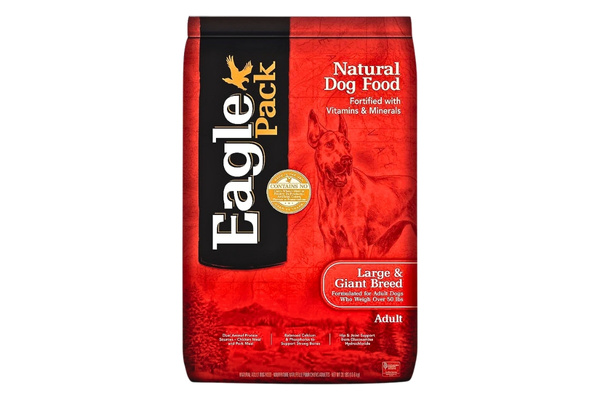
It’s also a good choice for large and giant breed dogs—the dedicated Large & Giant Breed formula includes glucosamine and chondroitin for joint support, plus a lower energy density to help prevent rapid growth and weight gain. If you have a Great Dane, Mastiff, or Bernese Mountain Dog, this formula is designed with your dog’s needs in mind.
For dogs needing weight management, the Reduced Fat formula offers a lower-calorie option without sacrificing protein. It’s not as aggressive as prescription weight-loss diets, but it’s a solid maintenance option for dogs prone to weight gain.
Eagle Pack isn’t ideal for dogs with true food allergies or sensitivities. While the Lamb & Brown Rice formula uses a single animal protein, it’s not a limited-ingredient diet—there are still multiple carbohydrate and supplement sources that could trigger reactions in sensitive dogs. If your dog has been diagnosed with a food allergy, you’ll likely need a prescription or veterinary diet.
It’s also not a good fit for owners seeking grain-free or high-protein diets. Eagle Pack’s formulas are grain-inclusive by design, and the protein-to-carb ratio leans toward carbs. If you’re looking for a biologically appropriate, carnivore-focused diet, brands like Orijen or Acana are better matches.
Finally, puppies may need more targeted nutrition. While the Original Chicken & Pork formula is labeled for all life stages, it’s not as protein- or calorie-dense as some puppy-specific formulas. If you have a growing large-breed puppy, you’ll want to ensure you’re not overfeeding calories or calcium, both of which can impact joint development.
Eagle Pack offers limited flavor variety—just chicken/pork or lamb across four formulas. There are no fish, beef, or exotic protein options, which can be a drawback for picky eaters or dogs with protein intolerances. That said, most customer reviews indicate strong acceptance, with dogs transitioning smoothly and eating consistently.
The kibble itself is standard size and texture—not small-bite or soft, which may be a challenge for toy breeds or dogs with dental issues. For medium and large dogs, the size and crunch seem to be well-tolerated.
One of the most frequently mentioned benefits is improved stool quality. Multiple owners report firmer, smaller stools after switching to Eagle Pack, which makes cleanup easier and suggests better digestibility. This is likely due to the combination of digestible grains, probiotics, and beet pulp.
There are occasional reports of dogs being initially hesitant with the food, but most adapt within a few days. One reviewer mentioned mixing Eagle Pack with another brand to improve palatability for a picky puppy, which suggests it may not be the most enticing option on the market—but it’s far from unpalatable.
Eagle Pack typically retails for $68–$77 for a 30-pound bag, which works out to roughly $2.27–$2.57 per pound. That’s competitive with other mid-tier natural brands like Nutro, Natural Balance, and Taste of the Wild. It’s more expensive than grocery brands like Purina ONE or Iams, but significantly cheaper than premium options like Blue Buffalo Wilderness or Wellness Core.
Here’s a quick comparison per 30-pound bag:
Eagle Pack delivers solid value for what you’re getting—natural ingredients, no artificial additives, functional health support, and a proven safety record—all at a price point that’s accessible for most households.
For a 30-pound dog eating the Original Chicken & Pork formula, you’d spend roughly $1.14 per day. For a 60-pound dog, that jumps to around $2.73 per day. For a 100-pound dog, you’re looking at about $4.09 per day. These costs are manageable for most budgets, especially compared to fresh food subscriptions, which can run $6–$12+ per day for medium to large dogs.
All Eagle Pack dry food is produced at a single facility in Mishawaka, Indiana. This centralized production model can be an advantage—it’s easier to maintain consistent quality and oversight compared to brands that outsource to multiple co-packers. The facility is owned by Wellness Pet Company, which also produces Wellness and Holistic Select brands.
Eagle Pack emphasizes that its suppliers must pass human food quality audits and HACCP protocols, which exceed FDA requirements for pet food. However, the brand doesn’t publish detailed quality control data—no third-party testing results, no traceability reports, no ingredient sourcing transparency. For a brand in this price range, that’s not unusual, but it does limit your ability to verify claims independently.
Eagle Pack has never been recalled in over 30 years of production. That’s an exceptional safety record and one of the brand’s strongest selling points. Many major brands—including Purina, Hill’s, and Blue Buffalo—have faced recalls due to contamination, formulation errors, or supplier issues. Eagle Pack’s clean history suggests effective quality control and consistent manufacturing practices.
Eagle Pack’s parent company, Wellness Pet Company, has made general commitments to sustainability, including efforts to increase recyclable packaging, reduce manufacturing emissions, and optimize shipping logistics. However, no specific data or targets are published for Eagle Pack itself, so it’s difficult to assess the brand’s environmental footprint.
The packaging is standard heavy-duty plastic, which is not particularly eco-friendly. Some premium brands have moved to recyclable or compostable materials, but Eagle Pack hasn’t made that shift yet.
Eagle Pack states that its ingredients are sourced in the USA, but it doesn’t provide farm-level or supplier-level transparency. You won’t find information about where the chicken or lamb comes from, whether it’s pasture-raised or antibiotic-free, or how grains are grown and processed. For owners who prioritize sourcing transparency, this is a significant limitation.
There’s no evidence that Eagle Pack conducts animal testing beyond practical feeding trials (e.g., with sled dogs during the brand’s early years). The brand doesn’t publish an explicit animal testing policy, but its heritage is rooted in real-world performance testing rather than laboratory research.
Take the free nutrition check and find out in under 1 minute which food is best tailored to your dog!
In just 60 seconds, find out which food fits your dog best — for free.
I work at a dog shelter, where we’re constantly evaluating different foods to see what works best for our residents. We recently tested Eagle Pack’s Original Chicken Meal & Pork Meal formula with a dog named Jasper, a four-year-old mixed breed (likely Lab and Shepherd) who came to us with a history of inconsistent feeding and some mild digestive sensitivity. Jasper isn’t a picky eater by any means, but he’d had soft stools on and off, and we wanted to see if a grain-inclusive, probiotic-rich formula like Eagle Pack could help.
We transitioned Jasper gradually over about a week, mixing Eagle Pack with his previous food (a generic shelter kibble). He didn’t show much reaction to the switch—no hesitation, no refusal, just steady eating. The kibble itself is fairly standard in size and texture, nothing particularly enticing, but Jasper ate it without issue.
Jasper’s enthusiasm at mealtimes didn’t change much. He’s always been a reliable eater, and Eagle Pack didn’t slow him down or speed him up. He ate it consistently, finished his bowl each time, and seemed perfectly content. It wasn’t love at first bite, but it wasn’t a struggle either—just solid, reliable acceptance.
The most noticeable change was stool quality. Within about a week, Jasper’s stools were firmer and more consistent—easier to pick up and less frequent. This was a real win for us at the shelter, where digestive issues can be a daily challenge. His coat also seemed a bit shinier after a couple of weeks, though it’s hard to say if that was entirely due to the food or just the result of consistent care and routine.
Energy-wise, Jasper stayed pretty much the same. He’s a moderately active dog—playful but not hyperactive—and Eagle Pack seemed to provide steady energy without any noticeable spikes or dips. No dramatic transformations, but no problems either.
From a practical standpoint, Eagle Pack was easy to work with. The bag sealed well, the kibble didn’t crumble or smell overly strong, and Jasper’s digestion was predictable. For a shelter setting, where consistency and digestibility matter more than novelty, it was a solid choice. Jasper didn’t seem to care one way or the other—he just ate, felt good, and went about his day, which is really all you can ask for.
Across platforms like Chewy, Amazon, and DogFoodAdvisor, Eagle Pack consistently earns 4.5 to 5 stars. The most common praise centers on coat quality, digestive health, and value. One owner wrote: “I’ve been feeding my sweet boy Moon this food for over a year now and he absolutely loves it! [I’ve] noticed a huge difference in his skin and his coat is sooooo shiny! The last dog food we bought caused him diarrhea and as soon as we got done completely switching him over, all his digestion and diarrhea problems vanished!”
Another recurring theme is long-term customer loyalty. Many reviewers mention feeding Eagle Pack for multiple years, which suggests sustained satisfaction and consistent quality. Owners of large breeds, in particular, appreciate the dedicated formula with joint support.
The most frequent criticism is the reliance on meat meals rather than fresh meat. While named meals (chicken meal, pork meal) are far superior to generic by-products, some owners feel it’s a compromise in ingredient quality. One reviewer noted: “We always prefer to see real meat as the first-listed ingredient—it’s easier for lower-quality meat to make its way into meal.”
A few recent reviews mention quality control issues, with one owner reporting that the last two bags contained “half crumbs rather than actual chunks of food.” This could indicate a manufacturing or packaging issue, though it doesn’t appear to be widespread.
Finally, the limited product range frustrates some owners. If your dog doesn’t do well with chicken, pork, or lamb, or if you need a grain-free or limited-ingredient option, Eagle Pack doesn’t offer alternatives.
If you’re weighing Eagle Pack against budget-friendly options like Kindfull (Target’s private label), there are some important differences to consider. Kindfull is positioned as a value-focused, “clean label” brand, with no corn, wheat, soy, or by-products, and over 50 SKUs covering a wide range of needs. It’s also significantly cheaper—most Kindfull products are under $10, compared to Eagle Pack’s $68–$77 for a 30-pound bag.
However, Eagle Pack has a decades-long track record and zero recalls, while Kindfull is a newer brand (launched in 2021) with less established credibility. Eagle Pack also targets active and performance dogs more explicitly, with formulas designed for sustained energy and joint support. Kindfull is more of an everyday, family-friendly option—accessible and affordable, but not necessarily optimized for working or athletic dogs.
For more on Kindfull, check out our Kindfull review to see how it stacks up.
Compared to ultra-premium brands like Orijen, Acana, or Wellness Core, Eagle Pack is less protein-dense and more grain-inclusive. Orijen, for example, uses fresh meat as the first ingredient and aims for a high-protein, low-carb profile (often 38–40% protein). Eagle Pack sits at 23–26% protein with higher carbs (44–56%), which is better suited for maintenance and moderate activity rather than peak performance.
The trade-off is price. Orijen can cost $90–$120 for a 25-pound bag, while Eagle Pack is nearly half that. If your dog thrives on a moderate-protein, grain-inclusive diet, Eagle Pack offers strong value without sacrificing safety or quality.
Take the free nutrition check and find out in under 1 minute which food is best tailored to your dog!
In just 60 seconds, find out which food fits your dog best — for free.
Eagle Pack is best suited for moderately active adult dogs who do well on grain-inclusive diets. If your dog has a sensitive stomach and benefits from digestible carbs like brown rice and oatmeal, this is a solid choice. The added probiotics and beet pulp can improve stool quality, which many owners report as a noticeable benefit.
For large and giant breed dogs, the dedicated formula with glucosamine and chondroitin is a thoughtful option, especially if you’re looking to support joint health as your dog ages. The lower energy density also helps prevent rapid growth and excessive weight gain in puppies, though you’ll want to monitor portions carefully.
For dogs needing weight management, the Reduced Fat formula offers a lower-calorie option without cutting protein too drastically. It’s not as aggressive as prescription diets, but it’s a practical maintenance option for dogs prone to weight gain.
Eagle Pack is not ideal for dogs with true food allergies, grain sensitivities, or those requiring high-protein, low-carb diets. It’s also not the best fit for picky eaters who need more enticing flavors or novel proteins. If your dog falls into any of those categories, you’ll likely need to explore specialized or prescription diets.
Honestly? Eagle Pack is a solid, reliable mid-tier dog food, but it’s not exceptional. If you’re looking for a grain-inclusive formula with a proven safety record, functional ingredients, and a reasonable price, it’s a good choice. The zero-recall history over 30+ years is a huge point in its favor, and many dogs genuinely thrive on it—better coat, firmer stools, steady energy. For moderately active dogs or large breeds needing joint support, it’s worth trying.
But let’s be clear about the trade-offs. The reliance on meat meals rather than fresh meat is a compromise, and while named meals are far better than generic by-products, they’re still not as high-quality as whole proteins. The limited product range is another drawback—if your dog needs grain-free, limited-ingredient, or a novel protein, you’re out of luck. And the lack of transparency around ingredient sourcing means you’re trusting the brand’s claims without much ability to verify them.
Would I buy this for my dog? If I had a moderately active adult dog with no special dietary needs and I wanted a dependable, affordable option, yes—I’d give it a shot. The safety record and consistent customer feedback give me confidence that it’s a well-made product. But if I had a high-performance dog, a puppy with specific growth needs, or a dog with food sensitivities, I’d look elsewhere. There are better options at both ends of the spectrum—fresh food brands like Nom Nom if you want premium quality, or more specialized formulas if you need targeted nutrition.
Eagle Pack does what it promises: balanced, digestible, functional nutrition at a fair price. It’s not flashy, it’s not cutting-edge, but it’s consistent and trustworthy. For many dogs, that’s exactly what they need.
Take the free nutrition check and find out in under 1 minute which food is best tailored to your dog!
In just 60 seconds, find out which food fits your dog best — for free.
No, Eagle Pack has maintained a perfect safety record with zero recalls in over 30 years of production. This is exceptional in the pet food industry and speaks to their consistent quality control and manufacturing practices. Many major brands have faced recalls due to contamination or formulation issues, making Eagle Pack’s clean record a significant advantage.
No, Eagle Pack is grain-inclusive by design. All formulas contain wholesome grains like brown rice, oatmeal, and barley as primary carbohydrate sources. The brand doesn’t offer any grain-free options. If you need a grain-free diet for your dog, you’ll need to look at other brands.
All Eagle Pack dry food is manufactured at a single facility in Mishawaka, Indiana. This centralized production helps maintain consistent quality control. The facility is owned by Wellness Pet Company and follows human food quality audits and HACCP protocols that exceed FDA requirements for pet food.
Eagle Pack uses named meat meals (like chicken meal and pork meal) as concentrated protein sources. Meat meals have the moisture removed, so they contain significantly more protein per pound than fresh meat. This approach helps keep costs reasonable while providing consistent amino acid profiles. While not as premium as fresh meat, named meals are far superior to generic “meat meal” or by-products.
The Large & Giant Breed Adult formula is specifically designed for bigger dogs. It includes glucosamine and chondroitin for joint support, plus a lower energy density to help prevent rapid growth and excessive weight gain. This formula is ideal for breeds like Great Danes, Mastiffs, or Bernese Mountain Dogs.
Many owners report improved stool quality and digestibility after switching to Eagle Pack. The combination of digestible grains (brown rice, oatmeal), probiotics, and beet pulp often helps with gut health. However, it’s not a limited-ingredient diet, so dogs with true food allergies may need a more specialized formula.
Eagle Pack typically costs $68-$77 for a 30-pound bag, making it competitive with other mid-tier natural brands. For a 60-pound dog, you’d spend roughly $2.73 per day. It’s more expensive than grocery brands but significantly cheaper than premium options like fresh food subscriptions, which can cost $6-$12+ per day.
The Original Chicken Meal & Pork Meal formula is labeled for all life stages, making it technically suitable for puppies. However, it’s not as protein- or calorie-dense as some puppy-specific formulas. For large-breed puppies especially, you’ll want to monitor portions carefully to avoid overfeeding calories or calcium, which can impact joint development.
Eagle Pack has limited protein variety with just chicken/pork combination or lamb options across their four formulas. There are no fish, beef, duck, or exotic protein choices. This narrow range can be limiting for dogs with protein sensitivities or owners seeking more variety.
No, Eagle Pack avoids corn, wheat, soy, by-products, and artificial additives. They use natural preservatives and focus on wholesome ingredients like named meat meals, digestible grains, and functional supplements like probiotics and glucosamine.
Eagle Pack was originally developed for sled dogs and canine athletes, so it has strong roots in performance nutrition. However, the current formulas are more suited for moderately active dogs rather than high-performance athletes. The protein levels (23-26%) and moderate fat content provide steady energy but may not meet the demands of truly elite working dogs.
While most dogs accept Eagle Pack readily, some may be initially hesitant. Try gradually mixing it with your current food over 7-10 days to help with the transition. If your dog remains uninterested, Eagle Pack’s limited flavor options (just chicken/pork or lamb) may not be appealing enough for picky eaters, and you might need to consider brands with more enticing proteins or flavors.
Take the free nutrition check and find out in under 1 minute which food is best tailored to your dog!
In just 60 seconds, find out which food fits your dog best — for free.
9 out of 10 dog owners are feeding their dog the wrong food.
Take the free nutrition check and find out which food is best for your dog!
2,847+ dog owners already did