9 out of 10 dog owners are feeding their dog the wrong food

Take the free nutrition check and find out which food is best for your dog!

Shelter manager, certified canine nutritionist, and lifelong dog lover
• Premium ingredients with transparency gaps: Features high-quality named proteins and organ meats, but lacks detailed sourcing information and third-party testing data that competitors provide.
• Exceptional palatability for picky eaters: Freeze-dried format preserves meat flavors effectively, with consistent reports of dogs showing enthusiasm and improved appetite at mealtimes.
• Cost barrier for larger dogs: At $37 per pound, feeding costs range from $6-8 daily for 30-pound dogs to $12-15 for 60-pound dogs, making it impractical for many owners.
• Real health improvements observed: Shelter testing and user reports consistently show firmer stools, shinier coats, and better digestion within 2-4 weeks of feeding.
• Limited scientific validation: Despite veterinary branding, the brand provides no published feeding trials, digestibility studies, or detailed micronutrient analyses to support premium pricing claims.
Take the free nutrition check and find out in under 1 minute which food is best tailored to your dog!
Dr. Marty Pets launched roughly a decade ago, built around the philosophy of Dr. Martin Goldstein, a Cornell-educated veterinarian with more than 40 years in integrative and holistic animal care. Goldstein co-founded Smith Ridge Veterinary Center in 1984, published The Nature of Animal Healing, and spent years advocating for species-appropriate nutrition before turning his attention to commercial pet food. The brand’s mission centers on supporting health and vitality through minimally processed, nutrient-dense meals that mirror what dogs would eat in the wild—or at least a modern, safe approximation of it.
In 2023, the company opened a dedicated manufacturing facility in Richfield, Wisconsin, under the umbrella of Golden Hippo. This move tightened supply chain control, improved ingredient traceability, and scaled up sustainability initiatives like energy-efficient equipment and product rendering to reduce waste. Dr. Marty’s product line remains focused: freeze-dried raw dog food, toppers, treats, and supplements, with no wet food, kibble, or prescription diets in the catalog. The brand positions itself squarely in the premium segment, competing with names like Stella & Chewy’s, Primal, and Instinct, and it’s grown at a steady clip alongside the broader freeze-dried market, which is forecast to reach nearly $4 billion by 2030.
What sets Dr. Marty apart—at least in its messaging—is the combination of veterinary credibility and a holistic, integrative philosophy. The brand leans heavily on Goldstein’s reputation and the idea that modern kibble processing strips away nutrients dogs need. Whether that translates to meaningfully better outcomes for your dog is something we’ll dig into throughout this review.
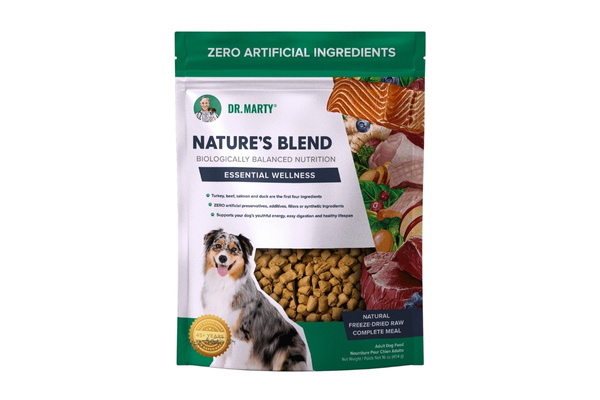
Dr. Marty’s flagship formula, Nature’s Blend Essential Wellness, lists turkey, beef, salmon, and duck as the first four ingredients, followed by organ meats like turkey liver and beef liver. This is a strong start. Named meat sources, not generic “poultry” or “meat meal,” signal transparency and quality. Organ meats add micronutrients—iron, B vitamins, vitamin A—that muscle meat alone doesn’t provide in sufficient quantities.
After the proteins come flaxseed, sweet potato, eggs, pea flour, apple, blueberry, carrot, cranberry, and pumpkin seeds. These contribute fiber, antioxidants, and some plant-based protein. Flaxseed and eggs bring omega-3 and omega-6 fatty acids, which support skin, coat, and inflammatory response. Pea flour is a mild protein booster, though it’s listed far enough down that it’s not inflating the protein percentage in a misleading way.
The formula is grain-free and gluten-free, which aligns with the raw-feeding philosophy and may be helpful for dogs with specific grain sensitivities. However, grain-free isn’t inherently superior for all dogs, and the link between grain-free diets and dilated cardiomyopathy (DCM) has been a topic of veterinary scrutiny in recent years. Dr. Marty’s recipes don’t rely on legumes as heavily as some grain-free kibbles do, which may reduce that risk, but it’s worth noting if your dog has a heart condition or breed predisposition.
Preservation is handled with mixed tocopherols, a natural vitamin E compound, rather than synthetic preservatives like BHA or BHT. The freeze-drying process itself acts as a preservative by removing moisture, which inhibits bacterial growth while keeping enzymes and nutrients intact. No artificial colors, flavors, or fillers appear on the label, which is consistent with the brand’s clean-label positioning.
Dr. Marty states that ingredients are sourced from the U.S. and select international suppliers, with improved traceability since the Richfield facility opened. However, the brand doesn’t publish a detailed breakdown of where each protein or vegetable comes from, which suppliers are used, or what third-party testing is performed on raw materials. This is a gap. Brands like Open Farm and The Honest Kitchen provide more granular sourcing transparency, including country of origin for every ingredient.
There’s also no public evidence of third-party lab testing for contaminants like heavy metals, mycotoxins, or pesticide residues. For a brand at this price point, that level of transparency should be table stakes. Without it, you’re taking the company’s word on ingredient quality.
| Price per pound | $37 |
| Primary protein | Turkey, Beef, Salmon, Duck |
| By-products | None (includes organ meats) |
| AAFCO compliance | Yes (formulated, no feeding trials) |
| Formula options | 6+ formulas (Nature’s Blend, Healthy Growth, Active Vitality, Sensitivity Select, Radiant Select, Healthy Digestion) |
| Availability | Direct-to-consumer + select retailers |
Take the free nutrition check and find out in under 1 minute which food is best tailored to your dog!
In just 60 seconds, find out which food fits your dog best — for free.
Dr. Marty doesn’t use rendered meals, meat by-products, or anonymous fats, which is a positive. But the formula also doesn’t include probiotics or prebiotics in the main Essential Wellness recipe, though the brand has since launched a Healthy Digestion variant that does. If gut health is a priority for your dog, you’d need to choose that specific formula or add a probiotic supplement separately.
On a dry matter basis, Nature’s Blend Essential Wellness delivers approximately 39% protein, 29% fat, and 24% carbohydrates. That’s a high-protein, high-fat profile typical of raw and freeze-dried diets, and it’s well above the AAFCO minimum for adult maintenance (18% protein, 5.5% fat). For active dogs, working breeds, or dogs who burn a lot of calories, this macro balance can be a good fit. For less active or senior dogs prone to weight gain, you’ll need to watch portions carefully—this is calorie-dense food.
The protein sources are diverse and complete, providing a full amino acid profile. The fat content, largely from meat and flaxseed, supplies essential fatty acids and supports energy needs. The carbohydrate fraction comes from fruits, vegetables, and seeds—whole-food sources rather than refined starches or sugars.
One thing to note: Dr. Marty doesn’t publish detailed micronutrient breakdowns or guaranteed analysis for vitamins and minerals beyond the basics. You won’t find specific levels of calcium, phosphorus, omega-3 to omega-6 ratios, or antioxidant content in the public-facing materials. For a brand that emphasizes science and veterinary formulation, this lack of detail is surprising.
Dr. Marty’s formulas are marketed as complete and balanced for adult dogs, but there’s no mention of AAFCO feeding trials in the available documentation. This suggests the recipes meet AAFCO nutrient profiles through formulation alone, which is less rigorous than actual feeding trials. Feeding trials involve real dogs eating the food over a period of time, with blood work and health monitoring to confirm nutritional adequacy. Formulated diets rely on calculations and lab analysis, which can miss real-world digestibility or bioavailability issues.
Without feeding trial data or published digestibility percentages, it’s harder to assess how much of that 39% protein your dog is actually absorbing. Freeze-dried raw foods are generally highly digestible, but that’s an assumption, not a verified fact for this specific product.
Dr. Marty is well-suited for adult dogs with high energy needs—think active breeds, working dogs, or dogs who spend a lot of time outdoors. The high protein and fat content supports muscle maintenance and endurance. It’s also a strong option for picky eaters who turn their noses up at kibble. The freeze-dried format retains flavor and aroma in a way that heavily processed foods don’t, and many owners report even stubborn dogs eating enthusiastically.
If your dog has food sensitivities or mild allergies, the limited ingredient count and absence of common fillers like corn, wheat, and soy may help. Dr. Marty offers a Sensitivity Select variant with novel proteins and even fewer ingredients for dogs with more pronounced sensitivities. The brand also has life-stage-specific formulas: Healthy Growth for puppies, Active Vitality for seniors, and Small Breed for smaller dogs who need appropriately sized kibble.
Dr. Marty is expensive, and that becomes a real barrier for owners of large or giant breeds. Feeding a 70-pound dog exclusively on freeze-dried raw can easily run $200 to $300 per month or more. If budget is a concern, you’re better off looking at high-quality kibble or using Dr. Marty as a topper rather than a complete meal.
Dogs with compromised immune systems—whether from age, illness, or immunosuppressive medications—may face higher risk with raw diets, even freeze-dried ones. While freeze-drying reduces bacterial load, it doesn’t eliminate it entirely. If your dog falls into this category, consult your vet before making the switch.
Finally, if your dog is prone to pancreatitis or needs a low-fat diet for medical reasons, this food is too rich. The 29% fat content is excellent for healthy, active dogs but inappropriate for dogs who need strict fat restriction.
Palatability is one of Dr. Marty’s strongest selling points, at least according to user reviews. The freeze-dried format preserves the smell and taste of raw meat in a way that kibble simply can’t match. Dogs with a strong prey drive or a preference for meat-forward diets tend to respond well. One owner described opening the bag and having all three of her dogs come running “from every direction,” eyes wide and tongues out, which is about as enthusiastic an endorsement as you can get from a dog.
The food can be served dry or rehydrated with warm water. Some dogs prefer the texture when it’s rehydrated, and it can make the meal feel more substantial. Others are happy to crunch it dry. Dr. Marty also works well as a topper over kibble, which can stretch the bag further and make it more affordable for larger dogs.
Dr. Marty’s main formulas all use a multi-protein blend—turkey, beef, salmon, and duck—rather than single-protein recipes. This is great for nutritional diversity but less ideal if your dog has a confirmed allergy to one of those proteins. The Radiant Select formula swaps in more fish (pollock and tuna) for omega-3 support, and Sensitivity Select uses novel proteins for dogs with more restrictive needs, but overall, the brand doesn’t offer the same level of flavor variety as competitors like Stella & Chewy’s or Primal, which have single-protein and exotic protein options.
Take the free nutrition check and find out in under 1 minute which food is best tailored to your dog!
In just 60 seconds, find out which food fits your dog best — for free.
A 16-ounce bag of Dr. Marty Nature’s Blend runs around $37 to $40, depending on the retailer. That works out to roughly $37 per pound, or about $6 to $8 per day for a 30-pound dog. For a 60-pound dog, you’re looking at closer to $12 to $15 per day. Compare that to premium kibble, which typically costs $3 to $5 per pound, or even other freeze-dried brands like Stella & Chewy’s, which average $25 to $30 per pound.
So what are you paying for? High-quality named proteins, organ meats, minimal processing, and a clean ingredient list. Those are real benefits. But you’re also paying for branding, direct-to-consumer marketing, and the premium associated with Dr. Goldstein’s name. Whether that’s worth it depends on your priorities and budget. If you’re feeding a small dog or using this as a topper, the cost is more manageable. For large dogs, it’s a significant monthly expense.
Stella & Chewy’s and Primal offer similar freeze-dried raw formulas at lower price points, with more flavor variety and comparable ingredient quality. Instinct and Nulo also compete in this space, often with better retail availability and occasional sales. Dr. Marty’s main advantage is the veterinary credibility and the holistic brand story, but from a pure ingredient and nutrition standpoint, it’s not objectively better than those alternatives—it’s just differently positioned.
If cost is a factor, consider a mixed feeding approach: high-quality kibble as the base, with Dr. Marty or another freeze-dried food as a topper. You get some of the benefits—better palatability, nutrient density, whole-food ingredients—without the full price tag.
Dr. Marty’s Richfield, Wisconsin facility opened in 2023 and is the brand’s primary production site. The company emphasizes ingredient traceability, energy-efficient equipment, and waste reduction through rendering unused product. Those are positive steps. However, there’s no public information about certifications like HACCP, ISO 22000, BRC, or SQF, which are standard in the premium pet food industry. Without those, it’s harder to verify that the facility meets rigorous food safety standards.
The freeze-drying process itself is a strength. It removes moisture at low temperatures, which preserves nutrients, enzymes, and flavor while creating a shelf-stable product. The food doesn’t require refrigeration until opened and stays fresh for up to 90 days after opening, which is convenient. Packaging includes a resealable zipper, though the bags aren’t particularly eco-friendly—something to consider if sustainability matters to you.
Dr. Marty has no recalls on record as of 2025. That’s a clean track record, though it’s worth noting the brand is relatively young. Absence of recalls is a good sign, but it’s not the same as proven long-term safety. Brands like Blue Buffalo and Hill’s have decades of history and occasional recalls, but they also have robust quality control systems in place because of that history. Dr. Marty hasn’t been tested by time in the same way.
Dr. Marty touts sustainability efforts at the Richfield facility, including energy-efficient boilers and water heaters, recycling programs, and rendering to reduce waste. The brand has also donated over $1 million to pet welfare organizations, which is a meaningful contribution. However, there’s no published sustainability report, no carbon footprint analysis, and no third-party validation of environmental claims. For a brand at this price point, that level of transparency should be expected.
The freeze-dried format itself is more resource-intensive than kibble, requiring significant energy for processing and cold storage during transport. Packaging is mostly recyclable, but the small bag sizes (16 ounces) generate more waste per pound of food than larger bags. If sustainability is a priority, this isn’t the most eco-conscious choice on the market.
I work with a local dog shelter, and we recently had the chance to test Dr. Marty Nature’s Blend with one of our residents, a four-year-old mixed-breed named Hazel. Hazel came to us about six months ago after her previous owner could no longer care for her. She’s a medium-sized dog, around 40 pounds, with a calm temperament and a bit of a sensitive stomach. She’d been eating a mid-tier grain-free kibble without major issues, but her stools were often softer than ideal, and her coat had a slightly dull, dry look to it. Nothing alarming, but not thriving either.
We transitioned Hazel over about five days, mixing increasing amounts of Dr. Marty with her regular food. She took to it immediately. On day one, she sniffed the bowl with more interest than usual and finished her meal faster than she typically does. By day three, when the bowl was mostly Dr. Marty, she was licking it clean and looking for more. That kind of enthusiasm was new for her—she’s not a picky eater, but she’s also never been particularly excited about food.
Within a week, we noticed her stools firming up. They were smaller, more consistent, and easier to pick up during walks. Her coat started looking shinier around the two-week mark, and by the end of the month, there was a noticeable improvement in texture—softer to the touch and less flaky skin when we brushed her. Her energy level stayed about the same, which was fine; she’s naturally a mellow dog, and we weren’t expecting a dramatic shift there.
The main takeaway for us was that Hazel did well on it. She enjoyed eating, her digestion improved, and her coat looked better. It wasn’t a transformative experience, but it was a solid, positive response. The cost, though, made it clear this wasn’t something we could sustain long-term for multiple dogs at the shelter. We used it for Hazel specifically because she’s been with us longer and needed a bit of extra care, but for everyday feeding across the board, it’s just not practical.
Take the free nutrition check and find out in under 1 minute which food is best tailored to your dog!
In just 60 seconds, find out which food fits your dog best — for free.
Dr. Marty enjoys strong reviews across platforms, with most users praising palatability and visible health improvements. One owner of a senior picky eater reported that her dog, who had refused multiple brands, “absolutely loves” Dr. Marty and now gets excited at mealtimes. Another noted improvements in energy and coat quality within a few weeks. These kinds of reports are common and suggest the food delivers on its core promises for many dogs.
However, the most consistent complaint is cost. Multiple reviewers describe the food as “expensive” or “overpriced,” particularly for large dogs. One user called it “a great dog food… but… overpriced for the average pet owner.” That’s a fair criticism. The quality is there, but the price creates a real barrier for a lot of people.
There are also occasional reports of dogs refusing the food or experiencing digestive upset, though these are relatively rare. Most negative feedback centers on affordability rather than product quality or efficacy. The brand’s 90-day money-back guarantee does offer some risk mitigation if your dog doesn’t take to it, which is a customer-friendly policy.
Dr. Marty competes directly with brands like Stella & Chewy’s, Primal, Instinct, and Open Farm in the freeze-dried raw category. Here’s how they compare:
Stella & Chewy’s offers more flavor variety, single-protein options, and slightly lower pricing (around $25 to $30 per pound). The ingredient quality is comparable, and the brand has a longer track record. If variety and cost matter more than brand story, Stella & Chewy’s is a strong alternative.
Primal is similar in quality and price, with a focus on raw feeding and whole-food ingredients. Primal also offers frozen raw options, which some owners prefer over freeze-dried. The main difference is that Primal leans more into the raw-feeding community, while Dr. Marty markets itself as accessible to a broader audience.
Instinct by Nature’s Variety has a wider product range, including kibble, canned, and freeze-dried, with more life-stage and breed-specific options. Pricing is slightly lower, and retail availability is better. Instinct is a good middle ground if you want flexibility and don’t need the veterinary branding.
Open Farm excels in transparency, publishing detailed sourcing information and third-party testing results. If ingredient traceability is a priority, Open Farm is the gold standard, though prices are similar to Dr. Marty.
Compared to fresh food services like The Farmer’s Dog, Dr. Marty offers shelf stability and no refrigeration requirements, but lacks the convenience of pre-portioned, personalized meal plans. Fresh food is also generally more affordable for larger dogs, making it a better value if freezer space isn’t an issue. If you’re curious about how fresh dog food compares to freeze-dried, checking out a dog food from Jinx review might also be helpful, as Jinx offers a more accessible premium option with both kibble and fresh formats.
Take the free nutrition check and find out in under 1 minute which food is best tailored to your dog!
In just 60 seconds, find out which food fits your dog best — for free.
Dr. Marty emphasizes its veterinary formulation and the credentials of Dr. Martin Goldstein, but there’s a notable absence of published research specific to the brand. No peer-reviewed feeding trials, digestibility studies, or clinical outcome data are available in the public domain. The brand doesn’t cite AAFCO feeding trials, which are considered the gold standard for proving nutritional adequacy. Instead, formulas appear to meet AAFCO nutrient profiles through calculation and lab analysis, which is less rigorous.
There’s also no evidence of third-party testing for contaminants, no published micronutrient profiles, and no collaboration with veterinary universities or nutrition organizations. For a brand that positions itself as science-based and veterinary-formulated, this lack of transparency is a weakness. You’re relying on the company’s reputation and Dr. Goldstein’s credentials, not on independently verified data.
That doesn’t mean the food is unsafe or ineffective—user reviews and the clean recall record suggest it works well for many dogs. But it does mean you’re taking more on faith than you would with brands that publish detailed testing and research.
Dr. Marty is best suited for adult dogs with moderate to high activity levels who thrive on high-protein, high-fat diets. It’s an excellent choice for picky eaters who need extra encouragement at mealtime, as the palatability is consistently praised. The formula works well for dogs with mild food sensitivities, particularly to grains or common fillers, and the brand offers specialized variants like Sensitivity Select and Active Vitality for senior dogs.
It’s also a strong option for small to medium-sized dogs, where the cost per day is more manageable. If you’re feeding a 15-pound dog, a bag will last longer, and the premium price becomes less of a barrier. For large and giant breeds, the economics are tougher unless you’re using it as a topper or rotational diet component.
Dr. Marty offers a Healthy Growth formula for puppies, which includes nutrients for development, and Active Vitality for seniors, which adds joint support and antioxidants. These life-stage formulas are thoughtfully designed, though they carry the same high price tag as the adult formulas.
This food is not ideal for dogs with compromised immune systems, those requiring low-fat diets due to pancreatitis or other conditions, or owners on a tight budget. If cost is a concern, there are more affordable ways to feed high-quality food without sacrificing too much on ingredients or nutrition.
Dr. Marty dog food is a high-quality, well-formulated product that delivers on palatability and uses genuinely good ingredients. The freeze-dried raw format preserves nutrients and flavor, the protein sources are transparent and diverse, and the brand’s clean recall record is reassuring. For dogs who struggle with picky eating, mild sensitivities, or lackluster coats, this food can make a real difference. The improvements in stool quality, coat shine, and mealtime enthusiasm that many owners report are meaningful and worth considering.
That said, the price is a serious barrier. At $37 per pound, this is one of the most expensive dog foods on the market, and for large dogs, it’s simply not sustainable for most budgets. The lack of published feeding trials, third-party testing, and detailed micronutrient data also raises questions about whether the premium price is fully justified, especially when competitors like Stella & Chewy’s and Open Farm offer similar quality with more transparency at lower cost.
Would I buy this for my own dog? If I had a small dog with picky eating habits or food sensitivities, and budget wasn’t a constraint, yes. The food works, and it works well for the dogs who need what it offers. But for an average-sized dog with no special needs, I’d probably look at Stella & Chewy’s or use a high-quality kibble with a freeze-dried topper to get similar benefits at a lower cost. For large dogs, I’d skip it entirely unless I was willing to use it sparingly as a rotational option.
Dr. Marty is a solid choice for the right dog and the right owner, but it’s not a universally superior product. It’s premium in price and quality, but whether that premium is worth it depends on your dog’s specific needs and your financial flexibility. If you’re considering it, take advantage of the 90-day money-back guarantee, try it with your dog, and see how they respond. That’s the only way to know if it’s the right fit.
Take the free nutrition check and find out in under 1 minute which food is best tailored to your dog!
In just 60 seconds, find out which food fits your dog best — for free.
The cost varies significantly based on your dog’s size. For a 30-pound dog, expect to spend around $180-240 per month feeding exclusively Dr. Marty. A 60-pound dog will run closer to $360-450 per month. Small dogs under 20 pounds might cost $120-180 monthly. At roughly $37 per pound, this is one of the most expensive dog foods on the market, making it particularly costly for large breed owners.
Dr. Marty offers some advantages over traditional kibble: higher protein content, minimal processing, better palatability, and whole-food ingredients. Many dogs show improvements in coat quality, stool consistency, and eating enthusiasm. However, better depends on your dog’s specific needs and your budget. High-quality kibble can provide complete nutrition at a fraction of the cost. Dr. Marty is more nutrient-dense, but that doesn’t automatically make it necessary for every dog.
Absolutely, and this is actually a smart way to get some benefits while managing costs. Using Dr. Marty as a topper over high-quality kibble can improve palatability, add whole-food nutrition, and make the bag last much longer. This approach works particularly well for large dogs where feeding exclusively freeze-dried raw isn’t economically feasible. Just adjust portions accordingly to maintain proper calorie balance.
No refrigeration is needed until you open the bag. The freeze-drying process creates a shelf-stable product that can be stored at room temperature. Once opened, the food stays fresh for up to 90 days when stored in a cool, dry place with the bag properly sealed. This makes it more convenient than frozen raw diets that require freezer space and thawing.
Many dogs with mild sensitivities do well on Dr. Marty because it’s grain-free, contains no artificial fillers, and uses limited, whole-food ingredients. The brand also offers a Sensitivity Select formula with novel proteins for dogs with more pronounced food allergies. However, the high fat content (29%) might not be suitable for dogs with pancreatitis or those requiring low-fat diets. Always consult your vet before switching if your dog has digestive issues.
Transition gradually over 5-7 days, mixing increasing amounts of Dr. Marty with your dog’s current food. Start with 25% Dr. Marty on days 1-2, increase to 50% on days 3-4, then 75% on days 5-6, and 100% by day 7. This helps prevent digestive upset. The food can be served dry or rehydrated with warm water—many dogs prefer the texture when slightly moistened.
Dr. Marty has no recalls on record as of 2025, which is a positive safety indicator. However, the brand is relatively young compared to established companies that have decades of track records. While the clean recall history is reassuring, it’s worth noting that the brand hasn’t been tested by time in the same way as longer-established pet food companies.
Dr. Marty offers a specific Healthy Growth formula designed for puppies, which includes nutrients needed for development. The regular adult formulas are too rich for most puppies and don’t provide the proper calcium-to-phosphorus ratio needed for growing bones. If you want to feed Dr. Marty to a puppy, stick with their puppy-specific formula and consult your vet about appropriate portions.
Both are high-quality freeze-dried raw foods with similar ingredient standards. Stella & Chewy’s typically costs $25-30 per pound compared to Dr. Marty’s $37, offers more flavor variety including single-protein options, and has longer market presence. Dr. Marty emphasizes veterinary formulation and holistic philosophy. From a pure nutrition standpoint, they’re quite comparable—the choice often comes down to price, flavor preferences, and brand philosophy.
Dr. Marty offers a 90-day money-back guarantee, which provides good protection if your dog refuses the food or doesn’t do well on it. This is more generous than many pet food companies offer and reduces the risk of trying an expensive product. Given the high palatability ratings from most users, outright refusal is relatively uncommon, but the guarantee gives you an out if needed.
That depends on your dog’s needs and your budget flexibility. The food delivers on quality ingredients, palatability, and often produces visible improvements in coat and digestion. For small dogs, picky eaters, or dogs with sensitivities, the benefits may justify the cost. For average dogs without special needs, or large breeds where costs become prohibitive, there are more affordable ways to feed high-quality nutrition. The price reflects real quality, but it’s not necessarily better than less expensive alternatives for every situation.
Take the free nutrition check and find out in under 1 minute which food is best tailored to your dog!
In just 60 seconds, find out which food fits your dog best — for free.
9 out of 10 dog owners are feeding their dog the wrong food.
Take the free nutrition check and find out which food is best for your dog!
2,847+ dog owners already did