9 out of 10 dog owners are feeding their dog the wrong food

Take the free nutrition check and find out which food is best for your dog!

Shelter manager, certified canine nutritionist, and lifelong dog lover
• Budget-friendly baseline nutrition: Aldi delivers AAFCO-compliant dog food at $1.35-$2.37 per pound, using named proteins like deboned chicken and chicken meal without premium ingredient quality or transparency.
• Limited suitability range: Best for healthy adult dogs with no allergies or special needs; inadequate for puppies, seniors, or dogs requiring specialized nutrition due to generic formulations.
• Good palatability with formula inconsistency: Most dogs eat the food enthusiastically, especially salmon varieties, but recipe changes have caused sudden refusal in previously satisfied dogs.
• Functional but opaque quality control: Clean recall history and contract manufacturing through facilities like Irish Dog Foods, but lacks ingredient traceability, third-party certifications, or detailed quality testing data.
• Solid grocery-store value proposition: Outperforms bottom-tier brands like Ol’ Roy while remaining significantly cheaper than mid-range options, making it practical for multi-dog households on tight budgets.
Take the free nutrition check and find out in under 1 minute which food is best tailored to your dog!
Aldi isn’t a dog food company—it’s a global discount grocery chain with a laser focus on value, efficiency, and private-label products. Founded in Germany in 1946 by brothers Karl and Theo Albrecht, Aldi split into two separate entities in the 1960s (Aldi Süd and Aldi Nord) and has since grown into one of the world’s largest grocery retailers, with over 12,000 stores across Europe, the US, and Australia. The brand’s core philosophy is simple: keep prices low by cutting out the middleman, sourcing private-label products, and running lean, no-frills stores.
When it comes to dog food, Aldi applies the same approach. Instead of stocking national brands, Aldi contracts with manufacturers—like Irish Dog Foods for some of its UK, Irish, and US supply—to produce budget-friendly formulas under Aldi’s own labels. The result is dog food that meets basic nutritional standards at prices that undercut most competitors. Aldi’s pet food isn’t marketed with glossy campaigns or celebrity endorsements; it’s positioned as a practical, affordable option for everyday dog owners who want to keep costs down without feeding their dog junk.
That said, Aldi’s commitment to transparency is limited. You won’t find detailed sourcing information, third-party lab results, or veterinary endorsements on the packaging. The brand’s reputation rests on its ability to deliver consistent quality at a low price, not on ingredient storytelling or premium positioning. For some dog owners, that’s exactly what they need. For others—especially those managing allergies, sensitivities, or specific health conditions—it’s a red flag.
| Price per pound | $1.35 – $2.37 |
| Primary protein | Chicken, Salmon |
| By-products | None |
| AAFCO compliance | Yes (all life stages/adult maintenance) |
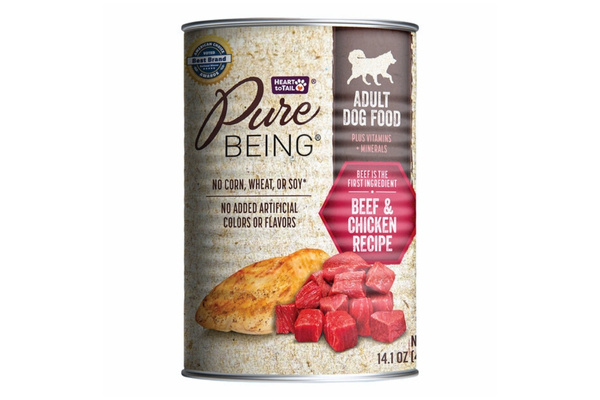
| Formula options | 3 product lines (Heart to Tail, Pure Being, Natural Elements) |
| Availability | Aldi stores only |
Take the free nutrition check and find out in under 1 minute which food is best tailored to your dog!
In just 60 seconds, find out which food fits your dog best — for free.
Aldi’s dog food formulas typically list deboned chicken, chicken meal, or salmon as the first ingredient, which is a good start. In the Pure Being Chicken & Brown Rice recipe, for example, deboned chicken comes first, followed by chicken meal—a concentrated protein source that’s higher in protein per pound than fresh meat. The Salmon & Potatoes grain-free formula leads with deboned salmon, though it also includes chicken meal further down the list, which is important to note if you’re dealing with a chicken allergy.
The use of named meat meals (chicken meal, salmon meal) is generally acceptable in budget dog food. Meal is simply meat that’s been rendered to remove moisture, leaving behind a protein-dense ingredient. What you won’t find here are vague terms like “poultry by-product meal” or “meat and bone meal,” which is a point in Aldi’s favor. However, there’s no information about where these proteins are sourced or what quality controls are in place, which limits your ability to assess the true quality of the meat.
Carbohydrates in Aldi dog food come primarily from brown rice, peas, barley, potatoes, and sweet potatoes, depending on the formula. The grain-inclusive recipes (like Chicken & Brown Rice) use whole grains, which are digestible for most dogs and provide steady energy. The grain-free formulas (like Salmon & Potatoes) swap grains for legumes and starchy vegetables, a common approach in grain-free dog food but one that’s been scrutinized for potential links to dilated cardiomyopathy (DCM) in some dogs.
While grains are often demonized in dog food marketing, the truth is that most dogs digest them just fine. Grain-free diets are only necessary for dogs with confirmed grain allergies, which are relatively rare. If you’re considering Aldi’s grain-free formula, it’s worth knowing that the peas and potatoes used as grain replacements can sometimes cause digestive upset, especially during the transition period.
Aldi dog food includes chicken fat, fish oil, and canola oil as fat sources. Chicken fat is a high-quality animal fat that’s rich in omega-6 fatty acids and highly palatable for dogs. Fish oil provides omega-3s, which support skin, coat, and joint health. Canola oil is a plant-based fat that’s often used to balance the fatty acid profile and keep costs down—it’s not harmful, but it’s not as nutrient-dense as animal fats.
One concern that’s come up in user reviews is the use of palm oil in some Aldi formulas, particularly in the Australian Natural Elements line. Palm oil is controversial both for its environmental impact and because some dogs don’t tolerate it well. If your dog has a sensitive stomach, this is something to watch for.
Aldi dog food includes a standard vitamin and mineral pack—vitamins A, D, E, B-complex, chelated minerals like zinc and copper, and amino acids like taurine. The Pure Being formulas also list probiotics (dried fermentation products), which can support digestive health, though the strains and colony-forming units (CFUs) aren’t specified.
The use of rosemary extract as a natural preservative is a positive; it replaces synthetic antioxidants like BHA or BHT, which some owners prefer to avoid. However, Aldi doesn’t disclose whether any synthetic preservatives are used alongside rosemary, which is a common practice in budget dog food to extend shelf life.
A few ingredients warrant a closer look. First, the chicken meal in the grain-free salmon formula means it’s not truly a single-protein food, which can be frustrating if you’re trying to eliminate chicken from your dog’s diet. Second, the presence of peas, lentils, and legumes in the grain-free recipes has been linked to potential DCM risk in some studies, though the FDA has not established a definitive causal link. Third, carrageenan appears in some of Aldi’s wet food formulas; it’s a thickening agent derived from seaweed that some owners avoid due to concerns about digestive irritation, though it’s considered safe in the amounts used in pet food.
Overall, Aldi’s ingredient lists are straightforward and free of the worst offenders (no corn gluten meal, no anonymous by-products), but they’re not exceptional. You’re getting functional, budget-conscious ingredients—not premium, traceable, or exotic proteins.
Aldi’s dry dog food formulas typically provide around 24% protein, 12% fat, and 4% fiber on an as-fed basis. When you convert to dry matter (removing moisture), these numbers rise slightly, putting the food in line with AAFCO’s minimum standards for adult maintenance. For comparison, premium brands often deliver 26–30% protein and 14–18% fat, so Aldi sits on the lower end of the spectrum—adequate, but not performance-level.
The carbohydrate content in Aldi dog food is estimated at 45–55% on a dry matter basis, which is typical for grain-inclusive kibble but higher than many grain-free or high-protein formulas. If your dog is active or needs to maintain lean muscle mass, you might find that Aldi’s formulas don’t provide quite enough energy density or protein to keep them in peak condition.
Most Aldi dry dog food formulas deliver around 350–360 kcal per cup, which is moderate. This means you’ll need to feed a bit more volume compared to a calorie-dense food, which can offset some of the cost savings. For a 60-pound active dog, you’re looking at roughly 2.5–3 cups per day, compared to 2–2.5 cups of a higher-calorie food.
Aldi dog food meets AAFCO standards for “all life stages” or “adult maintenance,” depending on the formula. This means the food provides complete and balanced nutrition as defined by industry standards. However, AAFCO compliance is a baseline—it doesn’t tell you anything about ingredient quality, digestibility, or long-term health outcomes. It simply means the food won’t cause obvious nutritional deficiencies if fed as directed.
Aldi includes glucosamine and chondroitin in some formulas, which are joint-supporting compounds often found in senior or active dog foods. The amounts aren’t disclosed, so it’s hard to say whether they’re present in therapeutic doses or just for marketing. Similarly, omega-3 and omega-6 fatty acids are listed, but specific ratios and concentrations aren’t provided.
The probiotic strains in Pure Being formulas are a nice touch, but again, without CFU counts or strain specifics, it’s impossible to assess their effectiveness. In short, Aldi’s nutritional profile is competent but not transparent—you’re getting the basics, but not the data you’d need to make a truly informed decision.
Aldi dog food works well for healthy adult dogs with no special dietary needs. If you have a medium-sized, moderately active dog who tolerates a variety of ingredients and doesn’t have allergies or sensitivities, Aldi’s formulas will likely keep them in good condition without breaking the bank. The grain-inclusive recipes (like Chicken & Brown Rice) are particularly suitable for dogs who do well on traditional kibble and don’t need grain-free options.
Aldi is also a solid choice for multi-dog households on a budget. When you’re feeding two or three dogs, the cost difference between Aldi and a premium brand can add up quickly. As long as your dogs are thriving on Aldi—steady energy, healthy coat, firm stools—there’s no reason to spend more.
Aldi dog food is not ideal for dogs with food allergies or sensitivities. The grain-free salmon formula still contains chicken meal, which rules it out for dogs allergic to poultry. There are no hydrolyzed protein or limited-ingredient formulas, and the lack of transparency around ingredient sourcing makes it hard to pinpoint potential triggers if your dog has a reaction.
Puppies and senior dogs can technically eat Aldi’s “all life stages” formulas, but they’re not optimized for those life stages. Puppies need higher protein and fat for growth, and seniors often benefit from joint support, lower calories, and easy-to-digest ingredients. Aldi’s formulas are generic adult maintenance—they’ll meet minimum requirements, but they won’t give you the targeted nutrition you’d find in a puppy- or senior-specific food.
If your dog has a chronic health condition—kidney disease, pancreatitis, diabetes, or digestive disorders—Aldi is not the right choice. You need a veterinary diet or a carefully formulated prescription food, neither of which Aldi offers.
Take the free nutrition check and find out in under 1 minute which food is best tailored to your dog!
In just 60 seconds, find out which food fits your dog best — for free.
Palatability is one area where Aldi generally scores well. Most user reviews report that dogs eat the food enthusiastically, with the salmon formulas earning particularly high marks for taste. The chicken recipes are more hit-or-miss—some dogs love them, others turn up their noses, which is typical of any chicken-based kibble.
One thing to keep in mind is that formula changes have caused some dogs to refuse the food after previously eating it happily. This is a recurring theme in reviews, particularly for the Australian Natural Elements line, where recipe tweaks led to sudden rejection by dogs who’d been eating the food for years. If you’re switching to Aldi, it’s smart to buy a small bag first and see how your dog responds before committing to a larger purchase.
The wet food formulas are generally well-received, though some owners note a strong smell that their dogs love but they find unpleasant. The texture is pâté-style, which works well as a topper or mixer with dry food. Aldi’s treats—especially the jerky varieties—are highly palatable and often used as training rewards.
If your dog is a picky eater, Aldi’s grain-free salmon formula is your best bet. The fish-based protein and higher fat content make it more enticing than the chicken recipes. That said, if your dog refuses it, you’re out of luck—Aldi doesn’t offer the flavor variety you’d find with a brand like Blue Buffalo or Purina Pro Plan.
Aldi dog food is significantly cheaper than most competitors. Pure Being Chicken & Brown Rice runs about $2.37 per pound, while the grain-free Salmon & Potatoes formula comes in at $1.69 per pound for a larger bag. Heart to Tail, Aldi’s budget line, can drop below $1.35 per pound. For comparison, Purina Pro Plan averages $2.50–$3.30 per pound, and premium brands like Blue Buffalo or Hill’s Science Diet can exceed $3.80 per pound.
When you calculate daily feeding costs, the savings are real. For a 60-pound dog, you’re looking at roughly $0.80–$1.00 per day on Aldi, compared to $1.50–$2.50 on a mid-range brand and $3.00+ on a premium food. Over a year, that’s a difference of several hundred dollars.
The question is whether you’re getting good value or just low cost. In Aldi’s case, I’d say you’re getting fair value. The food meets nutritional standards, uses named proteins, and avoids the worst filler ingredients. It’s not going to deliver the digestibility, bioavailability, or ingredient traceability of a premium brand, but it’s also not bottom-of-the-barrel junk. If your dog does well on it—healthy coat, good energy, firm stools—then the price-quality ratio is excellent.
However, if your dog needs more protein, better digestibility, or specialized nutrition, Aldi starts to look less like a bargain. You might end up feeding more volume to meet their energy needs, or supplementing with toppers and treats to improve palatability. At that point, the cost savings shrink, and you might be better off with a mid-range brand that’s formulated for performance.
Comparing Aldi to competitors in the same price range—like Kirkland (Costco’s brand) or Walmart’s Ol’ Roy—Aldi holds its own. The ingredient quality is comparable or slightly better, and the nutritional profile is solid. If you’re shopping on a tight budget, Aldi is one of the better options available in a grocery store setting.
If you’re curious how Aldi stacks up against other budget-friendly brands with a focus on natural ingredients, check out our Evanger’s review for a closer look at a brand that takes a more specialized, ingredient-forward approach at a higher price point.
Aldi doesn’t manufacture its own dog food—it contracts with private-label producers like Irish Dog Foods, which supplies some of Aldi’s UK, Irish, and US formulas from facilities in Ireland and the UK. This is standard practice for private-label brands, but it does mean that Aldi’s quality control is only as good as the manufacturers it partners with.
The good news is that Aldi’s dog food is made in the USA or EU, depending on the market, and is required to meet AAFCO standards. However, Aldi doesn’t publish detailed information about its production processes, quality testing protocols, or ingredient traceability. There are no third-party certifications (like ISO or HACCP) listed on the packaging, and no independent lab test results available to consumers.
Aldi’s recall history is clean—there have been no major food safety recalls for its dog food in recent years. The only recent recall was for a dog advent calendar due to a choking hazard, which was a packaging issue, not a food safety problem. This is a positive sign, but it’s also worth noting that the lack of transparency makes it harder to assess whether Aldi’s quality controls are truly robust or just adequate.
In short, Aldi’s production and quality control are functional but opaque. You’re trusting the brand’s reputation and the regulatory baseline, not detailed, verifiable data.
Aldi has made some commitments to sustainability and animal welfare, but specifics for its dog food line are hard to come by. The company’s corporate website references environmental goals and responsible sourcing, but there’s no detailed breakdown of how these principles apply to pet food ingredients or packaging.
One concern that’s surfaced in reviews is the use of palm oil in some formulas. Palm oil production is linked to deforestation and habitat destruction, and while Aldi has pledged to source sustainable palm oil for its human food products, it’s unclear whether the same standards apply to pet food.
On the packaging front, Aldi’s dog food comes in standard plastic bags with no clear recycling or sustainability initiatives. Some competitors are moving toward recyclable or compostable packaging, but Aldi hasn’t followed suit—at least not visibly.
Aldi’s supplier, Irish Dog Foods, has stated a commitment to animal well-being and customer satisfaction, but again, there’s no third-party certification or audit data to back this up. If ethical sourcing and sustainability are high on your priority list, Aldi isn’t going to give you the transparency or reassurance you’re looking for.
I work at a local dog shelter, and we recently tested Aldi’s Pure Being Chicken & Brown Rice formula with one of our residents—a three-year-old mixed-breed named Milo. Milo came to us as a stray, and while he’s friendly and energetic, he’s also been a bit of a picky eater since he arrived. He’d been doing okay on our standard shelter kibble, but we wanted to see if a change in food might help him put on a bit of weight and improve his coat, which was looking a little dull.
When we first introduced Aldi’s food, Milo was immediately interested. He sniffed the bowl, wagged his tail, and ate his entire portion without hesitation—something he didn’t always do with the previous food. We transitioned him gradually over about five days, mixing increasing amounts of the Aldi formula with his old kibble, and he had no digestive upset during the switch. His stools stayed firm and consistent, which was a good sign.
Over the next couple of weeks, we noticed a few small changes. Milo’s coat started to look shinier, and he seemed to have a bit more energy during playtime in the yard. He didn’t gain a dramatic amount of weight, but his body condition improved slightly—he filled out a little around the ribs, which was what we were hoping for. His appetite remained strong, and he never refused a meal, which was a relief after dealing with his earlier pickiness.
That said, the changes weren’t dramatic. Milo didn’t suddenly transform into a different dog—he was still the same goofy, affectionate guy, just with a slightly better coat and a bit more enthusiasm at mealtime. For a shelter environment where we’re feeding dogs on a tight budget, Aldi’s food did exactly what we needed it to do: it kept Milo healthy, satisfied, and looking good without costing us a fortune.
One thing I appreciated was how easy the food was to handle. The kibble size was manageable, it didn’t smell overly strong, and Milo’s stools were easy to clean up—smaller and firmer than they’d been on the previous food. For anyone managing multiple dogs or dealing with limited resources, those practical benefits matter.
Take the free nutrition check and find out in under 1 minute which food is best tailored to your dog!
In just 60 seconds, find out which food fits your dog best — for free.
User reviews for Aldi dog food are generally positive, with most owners praising the affordability and palatability of the food. On platforms like Aldi Reviewer and Amazon, the average rating hovers around 4 out of 5 stars, with the grain-free salmon formula earning slightly higher marks than the chicken recipes.
Positive feedback frequently mentions shiny coats, good energy levels, and healthy stools. Many owners report that their dogs transitioned smoothly to Aldi and have been eating it happily for months or even years. The value proposition is a recurring theme—owners appreciate being able to feed their dogs a decent-quality food without spending a fortune.
On the flip side, negative reviews tend to focus on formula changes and digestive issues. Some dogs who previously loved the food suddenly refused to eat it after Aldi tweaked the recipe, and a handful of owners reported diarrhea or vomiting during the transition. There are also scattered complaints about bags arriving with a rancid smell or inconsistent kibble size, which suggests potential quality control issues at the manufacturing level.
A few users have raised concerns about allergic reactions—itching, ear infections, or skin irritation—particularly with the grain-inclusive formulas. While these cases are relatively rare, they’re a reminder that no dog food works for every dog, and Aldi’s lack of specialized hypoallergenic options limits its usefulness for dogs with sensitivities.
Long-term users—those who’ve been feeding Aldi for three or more years—generally report consistent results. Their dogs remain healthy, maintain a good weight, and show no signs of nutritional deficiencies. However, some note that they supplement with fresh food or toppers to boost protein intake or improve palatability, which cuts into the cost savings.
When you stack Aldi up against other budget brands, it holds its own. Kirkland (Costco’s brand) offers similar pricing and nutritional profiles, with slightly higher protein content in some formulas. Walmart’s Ol’ Roy is cheaper but uses lower-quality ingredients, including more fillers and generic meat sources. Aldi sits comfortably in the middle—better than the bottom-tier brands, but not quite as good as mid-range options like Purina ONE or Iams.
Compared to premium brands like Blue Buffalo, Hill’s Science Diet, or Royal Canin, Aldi falls short in several areas. Premium brands typically offer higher protein and fat content, better digestibility, more transparent sourcing, and specialized formulas for different life stages, breeds, and health conditions. They’re also more expensive—often double or triple the cost per pound. If your dog is healthy and thriving on Aldi, there’s no compelling reason to switch to a premium brand. But if your dog needs targeted nutrition or has specific health concerns, Aldi won’t cut it.
For owners interested in fresh or human-grade dog food, brands like The Farmer’s Dog, Ollie, or Nom Nom offer a completely different experience—gently cooked, pre-portioned meals with visible, whole-food ingredients. These brands are significantly more expensive (often $5–$10+ per day for a medium dog), but they deliver noticeable benefits in digestibility, palatability, and overall health. If you’re curious whether fresh food might be a better fit for your dog, our Farmer’s Dog review breaks down what you can expect from that premium, personalized approach.
In the specialty/natural segment, brands like Evanger’s focus on limited-ingredient, exotic protein formulas at a higher price point. Evanger’s offers more variety and better ingredient transparency than Aldi, but it’s also harder to find and costs roughly double per pound. If your dog has allergies or sensitivities that Aldi can’t address, Evanger’s is worth exploring—but for everyday feeding of a healthy dog, Aldi is the more practical choice.
Aldi dog food is best suited for healthy adult dogs with no special dietary needs. If your dog is a medium-sized, moderately active breed—think a Labrador mix, a Beagle, or a Border Collie—and they don’t have allergies, sensitivities, or chronic health conditions, Aldi’s formulas will likely keep them in good condition. The grain-inclusive recipes work well for dogs who digest grains without issue, while the grain-free salmon formula is a decent option for dogs with mild wheat or corn sensitivities (though it’s not suitable for chicken allergies).
Aldi is also a practical choice for multi-dog households on a budget. When you’re feeding two or three dogs, the cost savings add up quickly, and if all your dogs are healthy and thriving on the food, there’s no reason to spend more. Just be sure to monitor their body condition, coat quality, and energy levels to make sure the food is meeting their needs.
For puppies, Aldi’s “all life stages” formulas are technically acceptable, but they’re not optimized for growth. Puppies need higher protein, fat, and specific nutrient ratios to support rapid development, and Aldi’s generic adult formulas don’t deliver the same level of targeted nutrition you’d get from a dedicated puppy food. If you’re raising a puppy, I’d recommend investing in a puppy-specific formula from a brand like Purina Pro Plan or Hill’s Science Diet for at least the first year.
Similarly, senior dogs can eat Aldi’s food, but they’d benefit more from a formula designed for their life stage—lower calories to prevent weight gain, higher fiber for digestive health, and added joint support. Aldi includes some glucosamine and chondroitin, but the amounts aren’t disclosed, so you can’t rely on it as a therapeutic joint supplement.
Aldi is not suitable for dogs with food allergies, sensitivities, or chronic health conditions. There are no hydrolyzed protein formulas, no true limited-ingredient options, and no veterinary diets. If your dog needs specialized nutrition, you’ll need to look elsewhere.
Take the free nutrition check and find out in under 1 minute which food is best tailored to your dog!
In just 60 seconds, find out which food fits your dog best — for free.
Aldi dog food is good for what it is—a budget-friendly, no-frills option that meets basic nutritional standards and keeps costs low. If you have a healthy adult dog with no special dietary needs, Aldi will likely do the job without causing problems. The food uses named proteins, avoids the worst filler ingredients, and has a clean recall history. For everyday feeding of a dog who tolerates a variety of ingredients and doesn’t need specialized nutrition, Aldi offers solid value.
That said, Aldi is not exceptional. The ingredient quality is functional but not premium, the nutritional profile is adequate but not optimized for performance or specific life stages, and the lack of transparency around sourcing and quality control is a limitation. You’re not getting the digestibility, bioavailability, or targeted nutrition you’d find in a mid-range or premium brand. If your dog has allergies, sensitivities, or health conditions that require careful ingredient selection, Aldi isn’t going to give you the options or the data you need.
Would I buy this for my dog? If I had a healthy, non-picky adult dog and I was on a tight budget, yes. Aldi is one of the better grocery-store dog foods available, and it’s a smarter choice than bottom-tier brands like Ol’ Roy or generic supermarket kibble. But if my dog had any health issues, or if I wanted to optimize their nutrition for performance, longevity, or specific needs, I’d invest in a better brand.
Would I recommend it to a friend? It depends. If they’re feeding a healthy dog and they’re price-conscious, Aldi is a practical, defensible choice. If they’re dealing with allergies, digestive issues, or a picky eater, I’d steer them toward a brand with more variety and better ingredient transparency—something like Purina Pro Plan, Iams, or even a fresh food service if they can afford it.
Honestly, Aldi dog food is a baseline option. It’s not going to impress anyone who’s deeply invested in canine nutrition, but it’s not going to harm a healthy dog either. It’s the kind of food you buy when you need to keep costs down and your dog is doing fine on it. If you’re looking for more than that—better digestibility, specialized formulas, or ingredient traceability—there are better options at this price point or slightly above it. But if your dog is thriving on Aldi and you’re happy with the cost savings, there’s no reason to fix what isn’t broken.
Take the free nutrition check and find out in under 1 minute which food is best tailored to your dog!
In just 60 seconds, find out which food fits your dog best — for free.
Yes, Aldi dog food sold in the US is manufactured domestically, often by contract manufacturers like Irish Dog Foods. However, Aldi also sources from EU facilities for some markets. The food meets AAFCO standards regardless of the specific manufacturing location, but Aldi doesn’t provide detailed transparency about which facilities produce which formulas.
Technically yes, but it’s not ideal. While Aldi’s “all life stages” formulas meet AAFCO requirements for puppies, they’re essentially adult maintenance formulas that hit the minimum standards for growth. Puppies need higher protein, fat, and specific nutrient ratios for optimal development. You’d be better off with a dedicated puppy food from brands like Purina Pro Plan or Hill’s for the first year, then switching to Aldi if budget is a concern.
No, unfortunately. Even Aldi’s grain-free salmon formula contains chicken meal further down the ingredient list, so it’s not suitable for dogs with chicken allergies. Aldi doesn’t offer any truly limited-ingredient or single-protein formulas that would work for dogs with poultry sensitivities. If your dog has confirmed food allergies, you’ll need to look at specialized brands or prescription diets.
They’re quite similar in terms of price and quality. Kirkland typically offers slightly higher protein content in some formulas and comes in larger bags, which can bring the per-pound cost down even further. Both are solid budget options that use named proteins and avoid the worst filler ingredients. Your choice might come down to which store is more convenient for you, though Costco requires a membership while Aldi doesn’t.
This is a common complaint in reviews and usually relates to formula changes. Aldi occasionally tweaks recipes—sometimes to reduce costs, sometimes to improve nutrition—and dogs can be sensitive to these changes in taste, texture, or smell. If your dog previously loved the food and suddenly refuses it, compare the ingredient list to an older bag if you have one. You might need to try a different formula or gradually transition to a new brand.
No major red flags, but there are a few things to watch for. Some formulas contain palm oil, which can cause digestive upset in sensitive dogs and has environmental concerns. The grain-free formulas include peas and legumes, which have been studied for potential links to heart issues (DCM) in some dogs. Aldi also uses carrageenan in wet food formulas, which some owners prefer to avoid. Overall, the ingredients are functional and safe, just not premium quality.
Follow the feeding guidelines on the bag as a starting point, but adjust based on your dog’s body condition and activity level. Aldi’s formulas are moderately calorie-dense (around 350-360 kcal per cup), so you might need to feed slightly more volume compared to higher-calorie premium foods. For a 60-pound active dog, expect to feed roughly 2.5-3 cups per day, divided into two meals.
Aldi’s dog food has a clean recall history with no major food safety issues in recent years. The only pet-related recall was for a dog advent calendar due to choking hazards, which was a packaging issue rather than a food safety problem. This is a positive sign, though the lack of detailed quality control transparency makes it harder to assess the robustness of their safety protocols.
Aldi’s online shopping availability varies by location, and pet food isn’t always included in their delivery options. Your best bet is to check your local Aldi store or call ahead to confirm they have the formula you want in stock. Unlike brands sold through major retailers like Amazon or Chewy, Aldi’s private-label products are typically only available through Aldi stores.
The FDA has investigated potential links between grain-free diets (particularly those high in peas, lentils, and potatoes) and dilated cardiomyopathy in dogs, but no definitive causal relationship has been established. Aldi’s grain-free formulas do contain these ingredients. If you’re concerned, the grain-inclusive recipes (like Chicken & Brown Rice) are a safer choice, as most dogs digest grains just fine and true grain allergies are relatively rare.
Heart to Tail is Aldi’s budget line with more basic formulations and lower prices (often under $1.35 per pound). Pure Being is positioned as a slightly more premium option with better ingredients, added probiotics, and natural preservatives like rosemary extract. Both lines meet AAFCO standards, but Pure Being offers marginally better nutrition for a modest price increase. If your budget allows, Pure Being is the better choice.
Take the free nutrition check and find out in under 1 minute which food is best tailored to your dog!
In just 60 seconds, find out which food fits your dog best — for free.
9 out of 10 dog owners are feeding their dog the wrong food.
Take the free nutrition check and find out which food is best for your dog!
2,847+ dog owners already did